Artwork
What is an American?
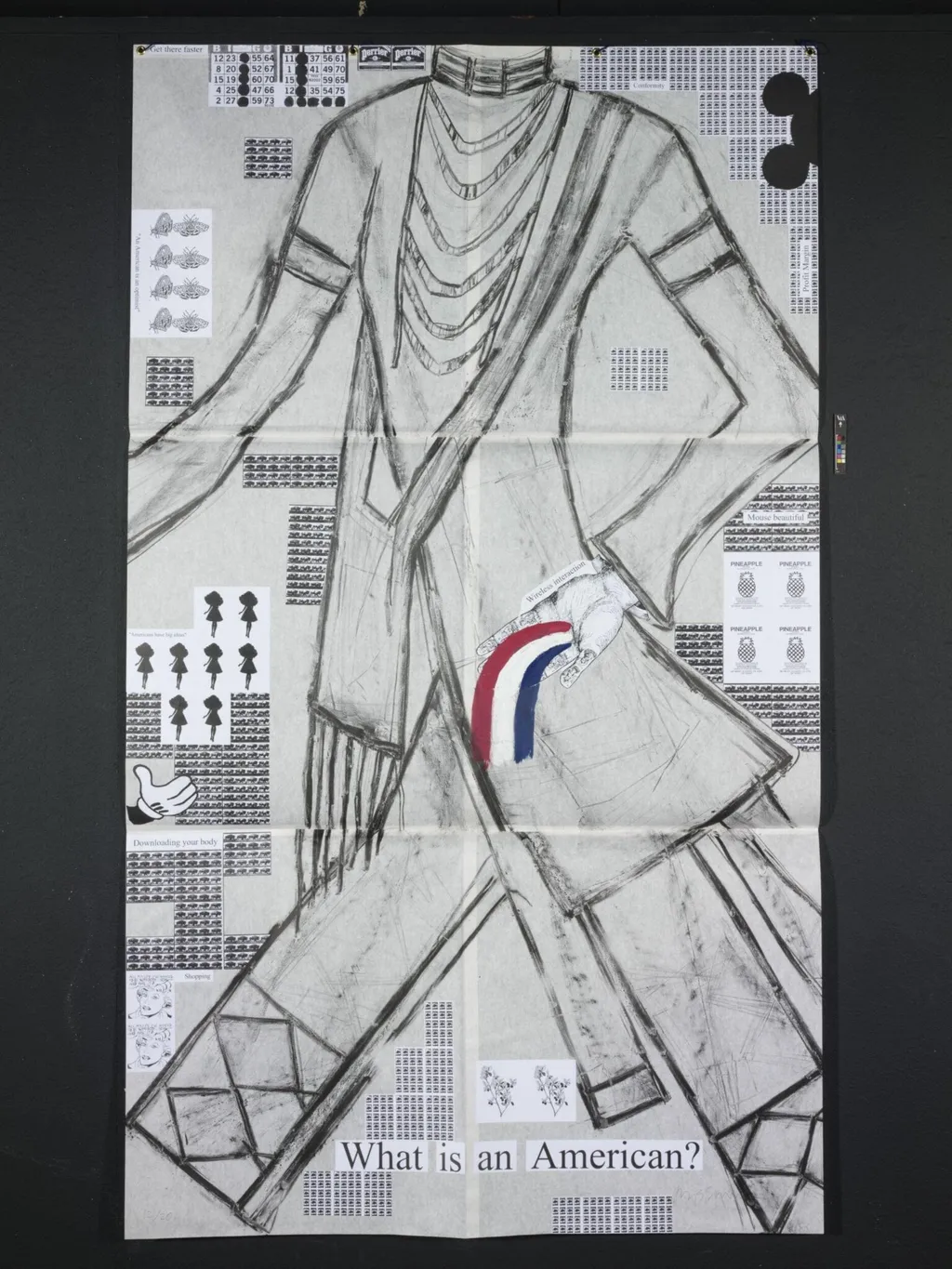
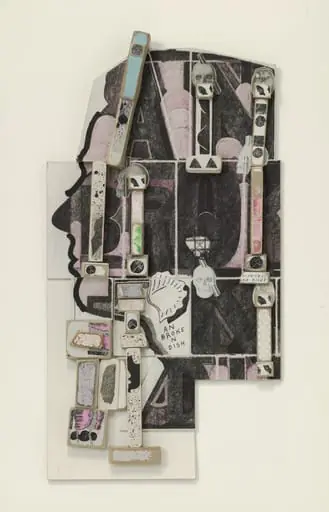
What is an American? is a print by Jaune Quick-to-See Smith. It dates from 2003 and is held in the collection of the Victoria and Albert Museum.
About this work
The work mixes symbols of white America with Native American marks, made right after 9/11.
This 2003 print asks, “What is an American?” It’s a modern take on a parfleche, a folded hide pouch used by Plains tribes.
Smith ties the piece with messages about origins, history and identity. The work mixes symbols of white America with Native American marks, made right after 9/11. It questions the patriotism shown then, asking who really belongs.
Check out another print by Smith at the Victoria and Albert Museum.
Overview
What is an American? is a 2003 print by Jaune Quick-to-see Smith, a Native American artist of Salish, French, Cree, and Shoshone heritage. The work reimagines the traditional Plains parfleche—a folded, painted buffalo hide container—as a printed surface. By adapting this Indigenous object form, Smith transforms it into a visual inquiry into national identity, memory, and belonging in post-9/11 America.
Subject & Meaning
The print juxtaposes symbols associated with mainstream American culture—such as maps, flags, and consumer logos—with Indigenous motifs and text. This collision invites reflection on whose histories are honored in national narratives. Smith challenges the surge of patriotic expression after September 11 by reminding viewers of the long-standing displacement and violence endured by Native peoples, questioning who is considered truly American.
Technique & Style
Smith employs a mixed-media print technique that mimics the layered, textured appearance of a traditional parfleche. She layers stenciled imagery, handwritten phrases, and abstract marks over a grid-like structure, evoking both archival documents and ceremonial surfaces. The composition is deliberately fragmented, resisting linear interpretation and mirroring the complexity of cultural hybridity and historical erasure.
History & Provenance
Created in 2003, the work emerged in direct response to the national climate following the September 11 attacks. Smith, drawing on her own mixed heritage and decades of artistic engagement with Indigenous sovereignty, used the parfleche form to critique selective patriotism. The piece has since been included in major institutional collections, including the Victoria and Albert Museum, as part of broader efforts to center Native voices in contemporary art.
Context
In the early 2000s, American patriotism often emphasized unity and defense of national borders, while overlooking historical injustices against Indigenous communities. Smith’s work intervenes in this discourse by presenting the parfleche—a vessel that once carried material and cultural knowledge—as a container of suppressed histories. The piece situates Native experience as central, not marginal, to the American story.
Legacy
What is an American? remains a pivotal work in contemporary Native art for its unflinching interrogation of national identity. It has influenced subsequent artists to use traditional forms as sites of political commentary. Smith’s integration of personal heritage with public history continues to shape dialogues around belonging, memory, and the responsibilities of citizenship in the United States.
Artist & collection
Artist
Jaune Quick-to-See Smith (January 15, 1940 – January 24, 2025) was a Native American visual artist and curator.