Artwork
Untitled
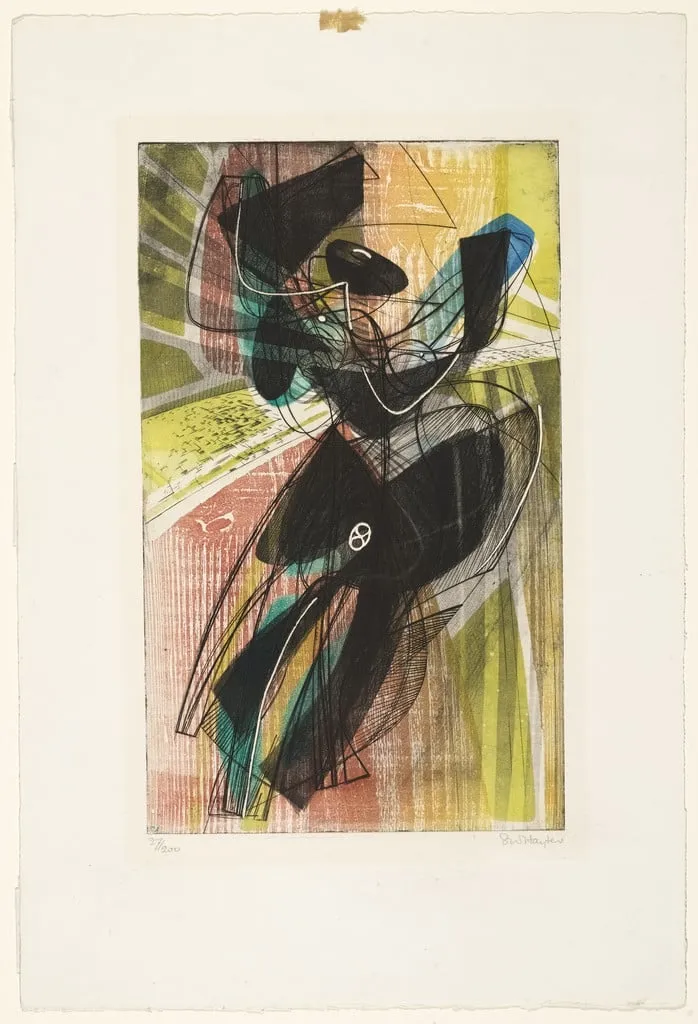
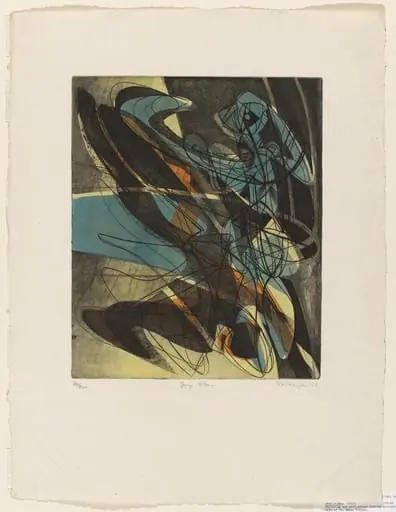
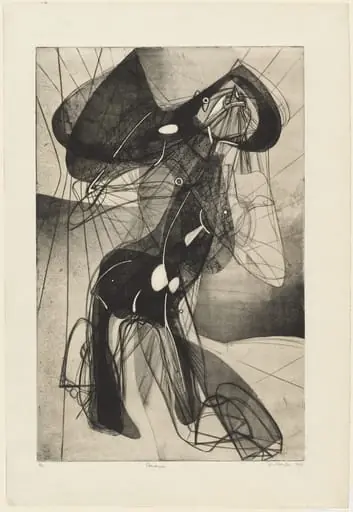
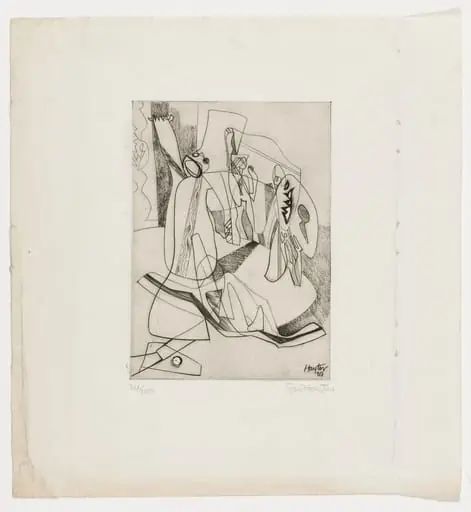
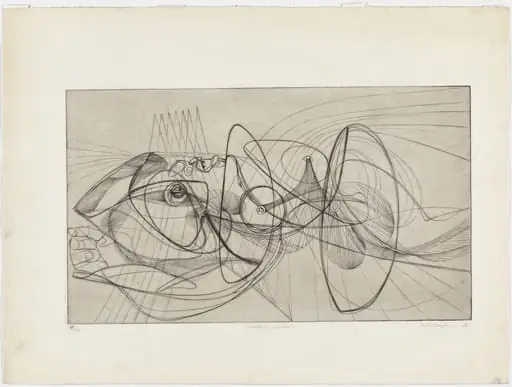
Untitled is an ink print by Stanley William Hayter. It dates from 1951 and is held in the collection of the Museum of Modern Art.
About this work
Overview
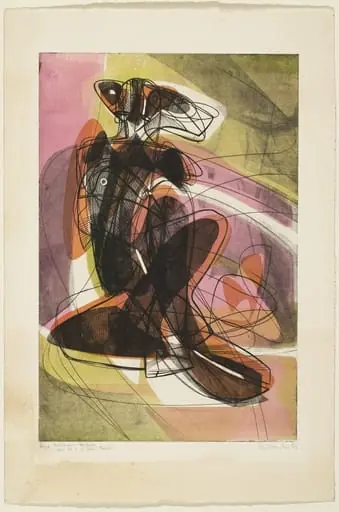
Created in 1951, this print by Stanley William Hayter combines engraving and soft ground etching to produce a dynamic composition. Hayter, a pivotal figure in modern printmaking, developed innovative techniques at his Paris studio, Atelier 17. The work exemplifies his exploration of texture and form through direct, hands-on methods that emphasized the materiality of the printing process.
Subject & Meaning
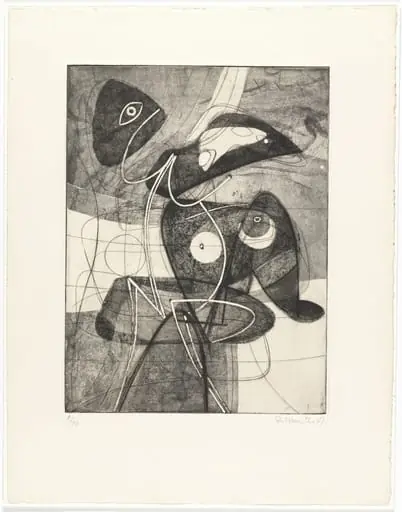
The central form is an abstract, angular silhouette that suggests movement rather than a defined figure. Its sharp contours contrast with the fluid, erratic lines surrounding it, evoking tension between structure and chaos. A small white circle with a curved mark on the chest introduces a focal point, possibly hinting at symbolic or psychological weight, though no explicit narrative is provided.
Technique & Style
Hayter employed soft ground etching to capture the texture of drawn lines and engraving for precise, incised details. The background layers of red, green, and yellow were built through multiple plate impressions, creating a sense of layered depth. Ink was pressed unevenly into the plate, producing a rough, tactile surface that enhances the work’s energetic, spontaneous quality.
History & Provenance
Made during Hayter’s time in New York, where he relocated Atelier 17 during World War II, the print reflects his continued experimentation beyond European surrealism. Though unsigned and untitled, it aligns with his broader output from the early 1950s, when he increasingly favored abstract compositions over figurative representation, influenced by emerging American avant-garde practices.
Context
This work emerged amid a period when printmaking was gaining recognition as a medium for abstraction, not just reproduction.
This work emerged amid a period when printmaking was gaining recognition as a medium for abstraction, not just reproduction. Hayter’s studio had become a hub for artists exploring new possibilities in intaglio, bridging European modernism and the developing American abstract expressionist movement. His methods encouraged direct, intuitive mark-making that resonated with contemporaries like Pollock and Motherwell.
Legacy
Hayter’s technical innovations and pedagogical approach reshaped printmaking’s role in modern art. This print, like others from the period, demonstrates how traditional techniques could be adapted to express abstraction and emotional intensity. His influence persists in contemporary print studios that prioritize process-driven experimentation and collaborative exploration.
Artist & collection
Artist
Stanley William Hayter (27 December 1901 – 4 May 1988) was an English painter and master printmaker associated in the 1930s with surrealism and from 1940 onward with abstract expressionism.