Artwork
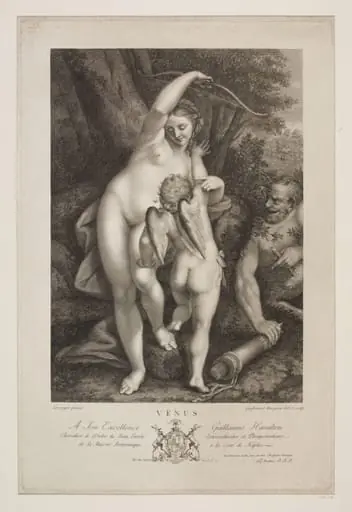
Cupid Cutting His Bow
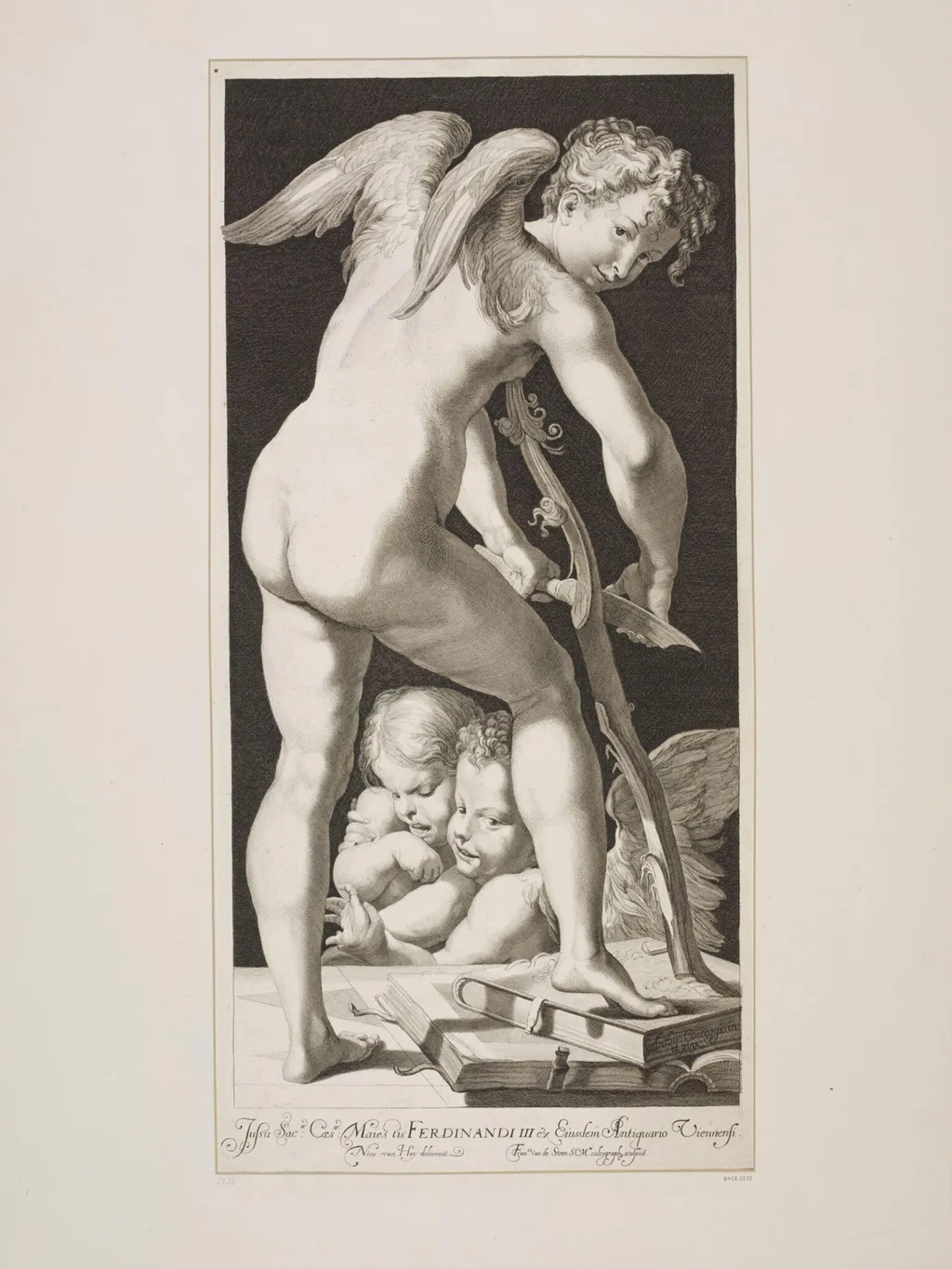
Cupid Cutting His Bow is a print by Franciscus van der Steen. It dates from 1650 and is held in the collection of the Victoria and Albert Museum.
About this work
Overview
The print circulated widely in the 16th century, particularly as a copy of the version held in the Belvedere Gallery in Vienna.
This print is a reproductive engraving of Parmigianino’s original drawing, *Cupid Cutting His Bow*. Long misattributed to Correggio, the work was later recognized as Parmigianino’s. The print circulated widely in the 16th century, particularly as a copy of the version held in the Belvedere Gallery in Vienna. It served as a vehicle for disseminating the artist’s composition beyond the original medium.
Subject & Meaning
The scene depicts Cupid, the god of desire, in the act of cutting his own bowstring—a symbolic gesture suggesting the suspension or end of love’s power. Two smaller putti observe from below, their stillness contrasting with the central figure’s focused motion. The scattered papers and open book imply intellectual or artistic interruption, deepening the allegory of love’s temporary surrender to reason or restraint.
Technique & Style
The engraving employs strong chiaroscuro to heighten dramatic tension, using deep shadows and sharp contrasts to model the figures against a dark ground. The delicate lines of the engraving capture the texture of skin, fabric, and parchment, while the composition’s diagonal energy draws the eye toward Cupid’s knife. These techniques reflect the printmaker’s adaptation of Parmigianino’s Mannerist sensibility to the demands of reproductive printmaking.
History & Provenance
The original drawing by Parmigianino was owned by the Habsburgs and entered the Belvedere collection in Vienna. The print was likely made shortly after, possibly by a skilled engraver working from a copy of the drawing. Its circulation helped cement Parmigianino’s reputation beyond Italy, even as it was initially mistaken for Correggio’s work—a misattribution corrected in later scholarship.
Context
In mid-16th-century Italy, drawings were increasingly valued as autonomous works, and their reproduction in print allowed broader access to elite artistic ideas. Parmigianino’s complex, elegant figures appealed to collectors and artists alike. This print reflects a trend where Mannerist compositions were translated into graphic form, bridging the gap between private studio practice and public visual culture.
Legacy
Though the original drawing remains in Vienna, the print ensured the image’s longevity and influence. Later artists studied its composition and lighting, and its misattribution highlights the shifting perceptions of authorship in Renaissance art. The print endures as a testament to how reproductive techniques shaped the reception and transmission of artistic innovation across Europe.
Artist & collection

Artist
Franciscus van der Steen was a Flemish painter and engraver who was active in Vienna.