Artwork
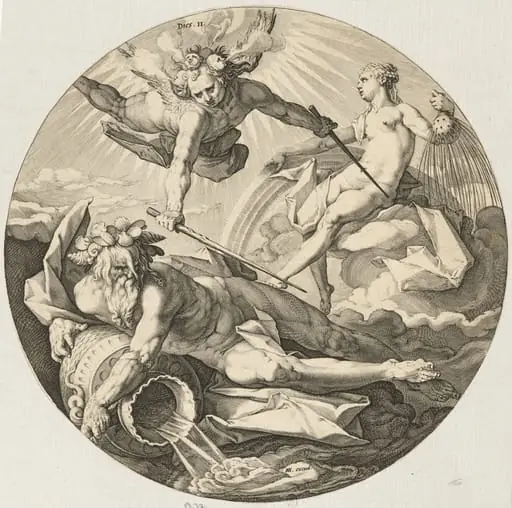
Ixion Deceived by Juno
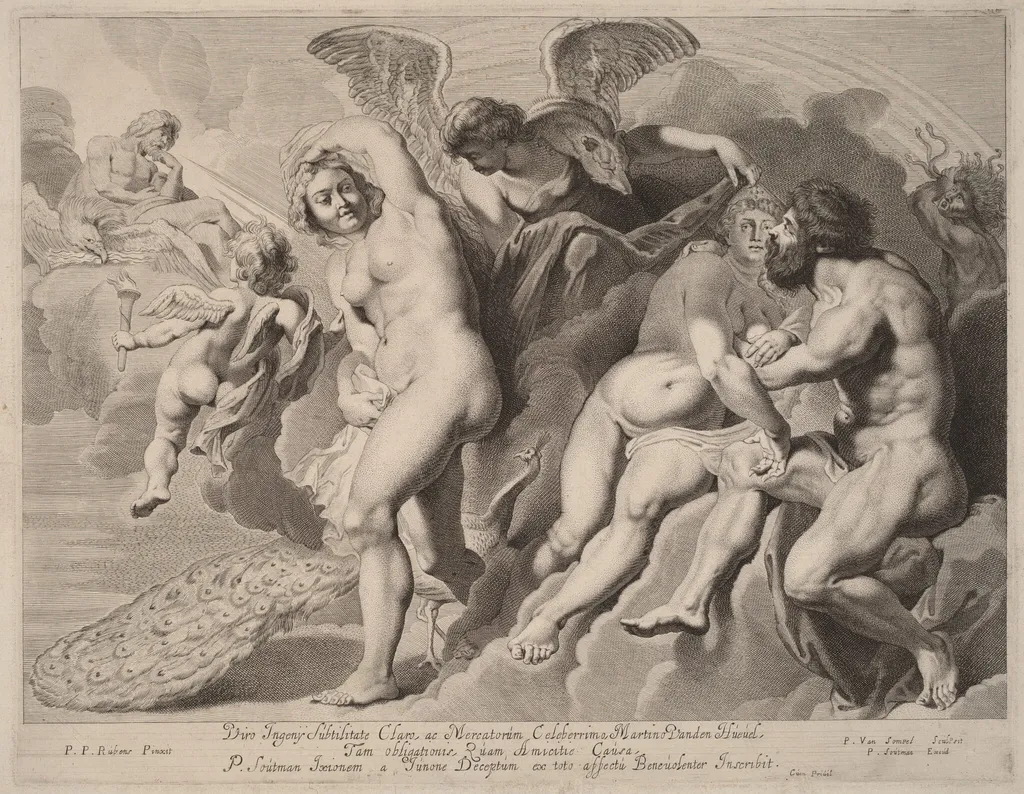
Ixion Deceived by Juno is an ink print by the Baroque artist Pieter van Sompel. It dates from 1601 and is held in the collection of the National Gallery of Art.
About this work
Overview
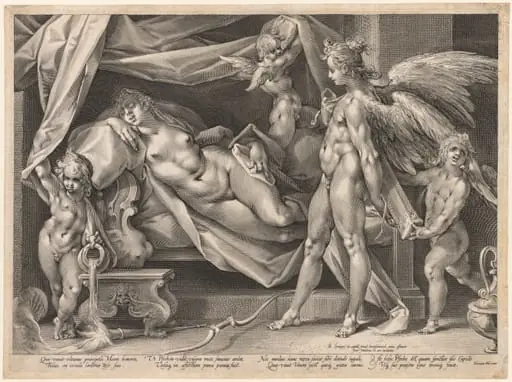
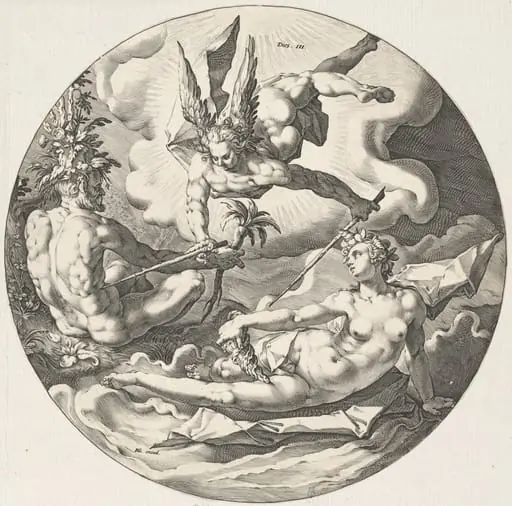
The composition captures a dramatic confrontation between mythological figures, rendered through precise linear technique.
Created in 1601 by Pieter van Sompel, this engraving depicts a moment from Greek myth in monochrome ink on laid paper. The composition captures a dramatic confrontation between mythological figures, rendered through precise linear technique. The print’s fine detail and dynamic composition reflect the Northern European tradition of narrative engraving, where storytelling is conveyed through intricate line work rather than color.
Subject & Meaning
The scene illustrates Ixion, a mortal king punished for his hubris, being deceived by Juno, who appears here as a cloud-born figure with wings and a torch. Juno, disguised as his desired bride Nephele, lures Ixion into a false union. The winged figures restraining him symbolize divine retribution. The imagery underscores themes of deception, divine justice, and the consequences of transgressing mortal boundaries.
Technique & Style
Van Sompel employed a burin to incise fine, controlled lines into a metal plate, creating tonal variation through cross-hatching and stippling. The swirling clouds and muscular forms are rendered with rhythmic, fluid strokes that suggest motion and tension. Despite the absence of color, the engraving achieves emotional depth and spatial complexity through gradations of ink density and line weight.
History & Provenance
The print was made in the early 17th century, likely in the Netherlands, where engraving flourished as a medium for mythological and allegorical subjects. Van Sompel, active in Amsterdam, was part of a network of printmakers who reproduced or reinterpreted classical themes for scholarly and elite audiences. Its survival in collections today reflects its status as a carefully produced, circulating image of moral narrative.
Context
This work emerged during a period when Northern European artists frequently drew from Ovid’s Metamorphoses and other classical texts to explore human folly and divine punishment. Engravings like this served as visual aids for educated viewers familiar with myth, functioning as both art and moral instruction. The emphasis on dramatic movement and psychological intensity aligns with Mannerist sensibilities prevalent in print culture at the time.
Legacy
Van Sompel’s engraving contributes to a broader tradition of mythological prints that influenced later illustrators and printmakers. While not widely known today, it exemplifies the technical precision and narrative clarity valued in early modern printmaking. Its preservation in institutional collections ensures its role as a historical record of how classical myths were visually interpreted in the age of humanist scholarship.
Artist & collection