Artwork
Rana Amar Singh II (reigned 1698–1710) smoking a hookah
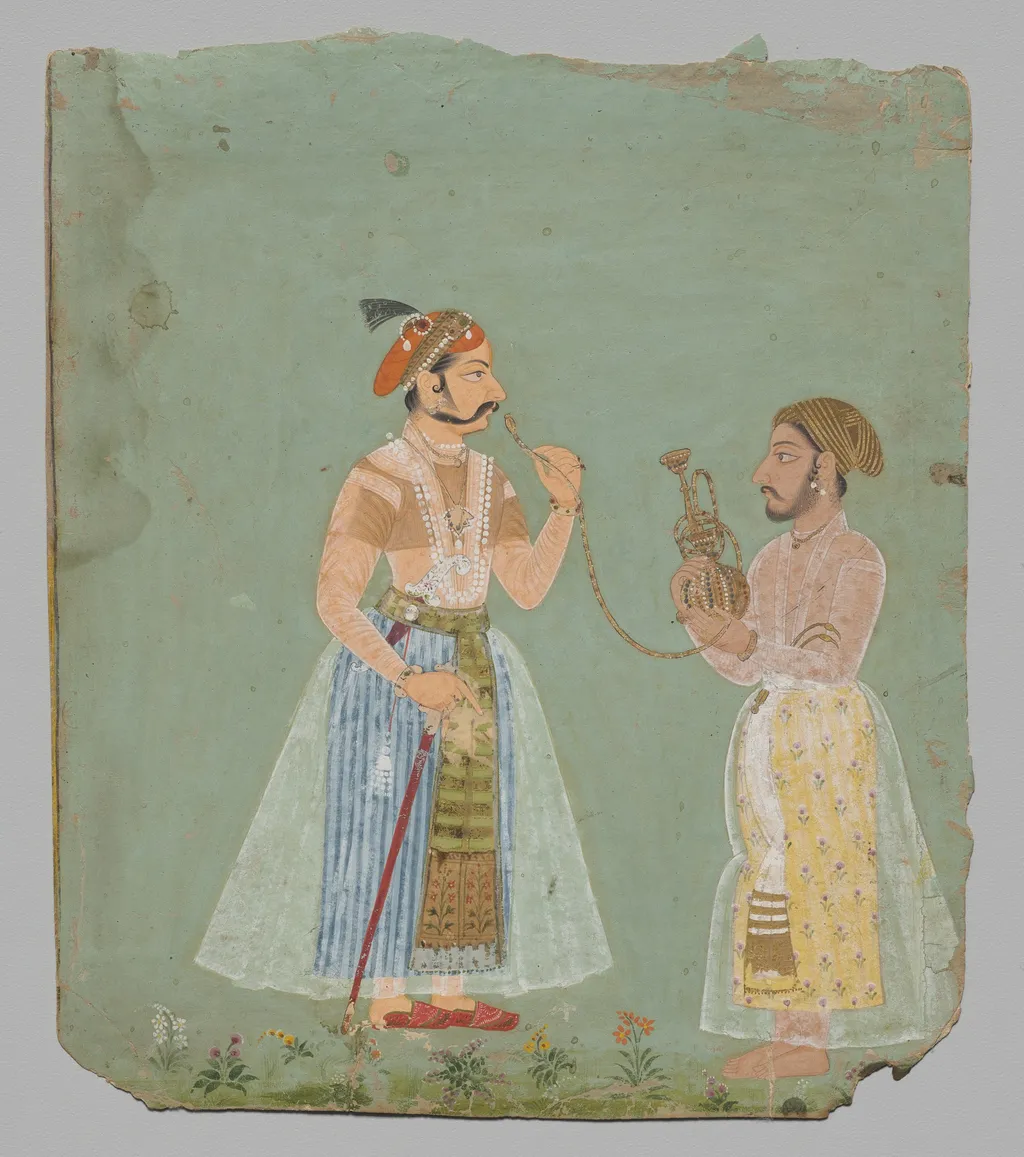
Rana Amar Singh II (reigned 1698–1710) smoking a hookah is an unspecified painting by Stipple Master. It dates from 1700 and is held in the collection of the Cleveland Museum of Art. Created in 1700, this portrait presents the Rajput ruler Rana Amar Singh II, who governed from 1698 to 1710, in a moment of leisure.
About this work
Overview
Created in 1700, this portrait presents the Rajput ruler Rana Amar Singh II, who governed from 1698 to 1710, in a moment of leisure. Executed by the anonymous artist known as the Stipple Master, the work now belongs to the collection of the Cleveland Museum of Art. The composition features two figures standing on a grassy, flower‑dotted ground, bathed in a soft, light‑green backdrop.
Subject & Meaning
A second, similarly attired gentleman shares the scene, suggesting companionship or a ceremonial gathering.
The central figure, identified as Rana Amar Singh II, holds a hookah in his right hand, a symbol of aristocratic relaxation and courtly refinement in early‑18th‑century India. A second, similarly attired gentleman shares the scene, suggesting companionship or a ceremonial gathering. Their relaxed posture and the presence of the hookah convey an atmosphere of cultivated ease, reflecting the ruler’s personal tastes and the cultural practices of his court.
Technique & Style
The painting is rendered in the stipple technique, a method characterized by fine dots that build tonal variation, a hallmark of the Stipple Master’s hand. Delicate brushwork defines the intricate patterns of the striped and floral skirts, while the feathered headband and sword are outlined with precise, yet subtle, detailing. The overall palette of muted greens and earth tones enhances the tranquil mood.
History & Provenance
Attributed to the Stipple Master, an artist active in the early 1700s, the work entered the Cleveland Museum of Art’s collection through acquisition in the mid‑20th century. Documentation links the portrait to the court of Mewar, where Rana Amar Singh II ruled, confirming its origin as a courtly commission intended to record the ruler’s likeness and leisurely pursuits.
Context
During Amar Singh II’s reign, the Mewar kingdom experienced a period of relative stability, allowing the patronage of fine arts. Hookah smoking, imported from the Middle East, had become a fashionable pastime among Indian nobility, symbolizing both wealth and cultural exchange. The portrait thus reflects broader patterns of Indo‑Persian artistic synthesis and the adoption of foreign customs within Rajput elite circles.
Artist & collection