Artwork
Lanul albastru
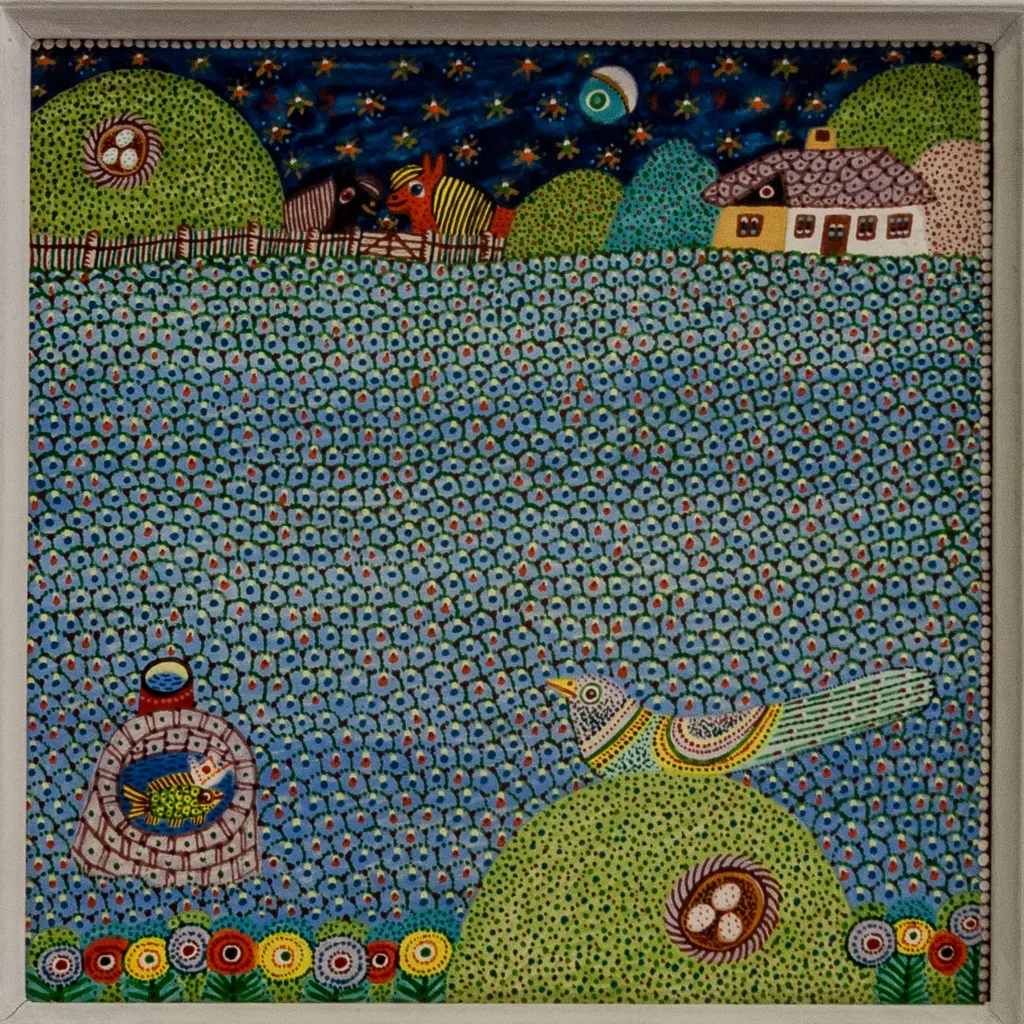
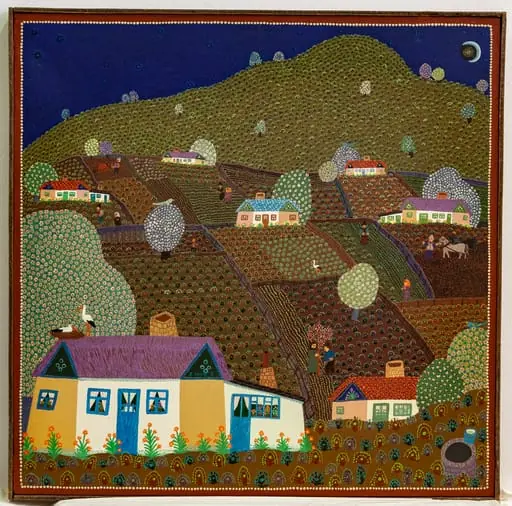
Lanul albastru is an unspecified painting by Stirbu Ștefan. It dates from 1994 and is held in the collection of the Gavrila Simion Eco-Museum Research Institute Tulcea.
About this work
Overview
Its technique and palette evoke folk traditions while resisting straightforward narrative, inviting contemplation rather than literal interpretation.
Lanul albastru, created in 1994 by Romanian artist Stirbu Ștefan, is a small-scale painting held in the collection of the Museum of Ethnography. Rendered entirely in dense, colored dots, the work presents a nocturnal rural scene charged with symbolic energy. Its technique and palette evoke folk traditions while resisting straightforward narrative, inviting contemplation rather than literal interpretation.
Subject & Meaning
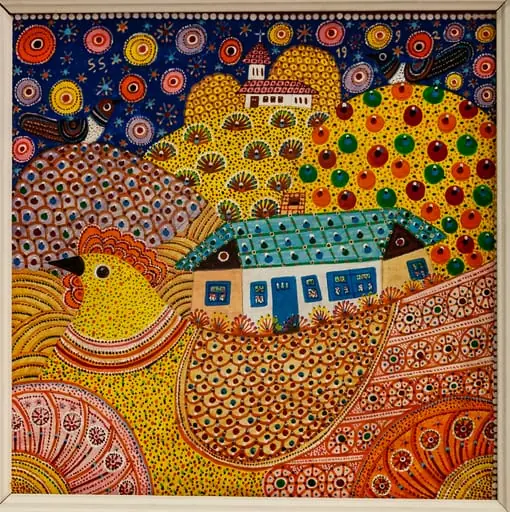
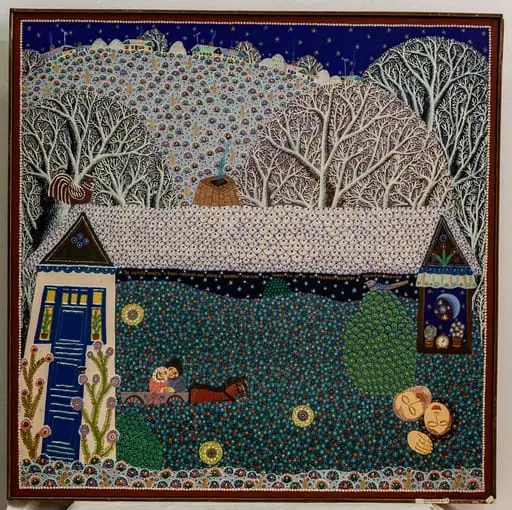
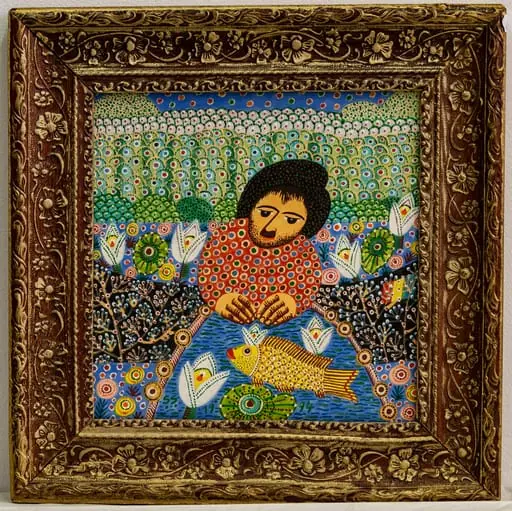
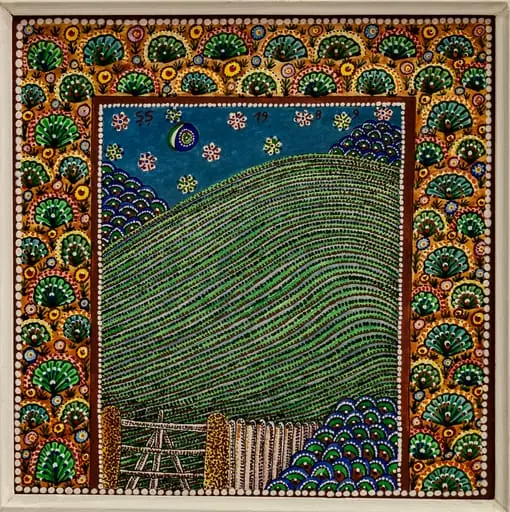
The painting centers on a long-tailed bird singing above a flowering meadow, flanked by a rabbit and a cat, both still and attentive. A thatched cottage perches on a distant hill, while a crescent moon and rising sun share the dark blue sky. These elements—animals, home, celestial bodies—suggest harmony between nature and domestic life, possibly reflecting rural Romanian cosmology or seasonal cycles, though no explicit allegory is stated.
Technique & Style
Stirbu Ștefan employs a pointillist method using tightly packed dots of red, blue, and green pigment to build form and light. The absence of outlines and the saturation of color create a luminous, vibrating surface. This technique, while reminiscent of European modernism, is adapted here with a folk sensibility—each dot functions as both brushstroke and symbolic unit, enhancing the scene’s rhythmic, almost musical quality.
History & Provenance
Lanul albastru entered the Museum of Ethnography’s collection shortly after its creation in 1994. It was acquired as part of a broader effort to document contemporary Romanian folk-inspired art. The artist, Stirbu Ștefan, was active in regional artistic circles but remained largely outside mainstream galleries. The work’s preservation in a museum context underscores its significance as a cultural artifact rather than a commercial product.
Context
Created in post-communist Romania, the painting emerges during a period of renewed interest in rural identity and traditional aesthetics. While not directly political, its emphasis on nature, domesticity, and celestial order resonates with a broader cultural reconnection to pre-industrial life. The work aligns with a generation of artists who sought meaning in indigenous visual languages, distancing themselves from both Soviet realism and Western modernist trends.
Legacy
Lanul albastru remains a quiet but distinctive example of late 20th-century Romanian folk-modernist painting. It has not been widely reproduced or exhibited beyond regional institutions, yet its meticulous dotwork and symbolic composition continue to influence local artists exploring texture and symbolism. Its endurance lies in its understated resonance with everyday rural experience, preserved without romanticization.
Artist & collection
Artist
Stirbu Ștefan liked to paint the same patch of wheat field near his village every summer, even when the sky stayed stubbornly gray.
Museum
Gavrila Simion Eco-Museum Research Institute Tulcea
Continue through works from the same source collection.