Artwork
Folded Hills
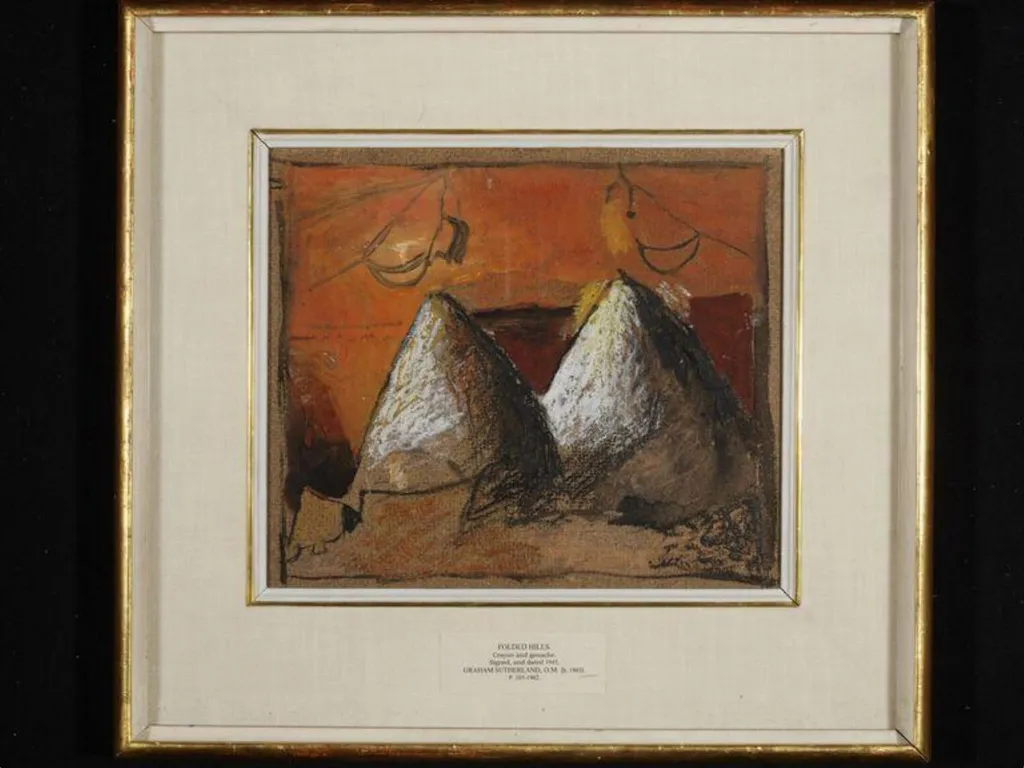
Folded Hills is a drawing by Graham Vivian Sutherland. It dates from 1945 and is held in the collection of the Victoria and Albert Museum.
About this work
Overview
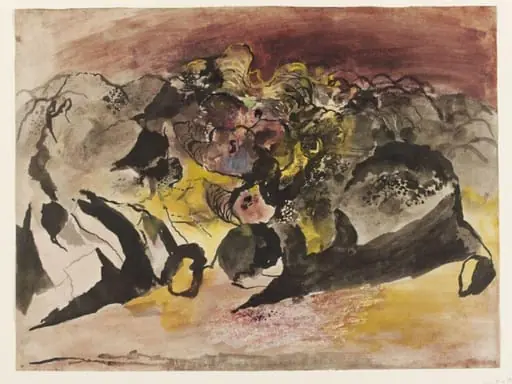
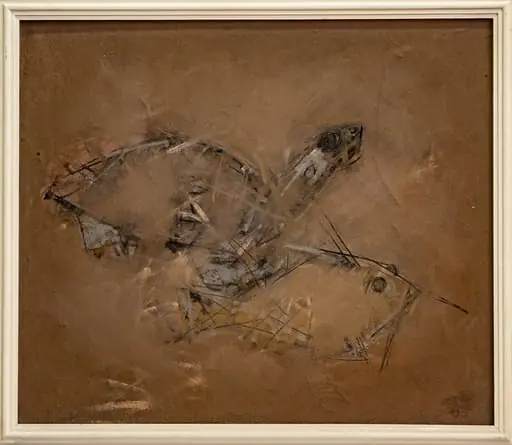
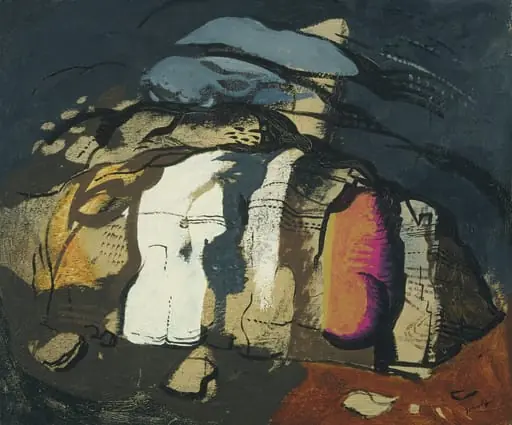
Graham Sutherland's 1945 drawing *Folded Hills* is a monochromatic work rendered in brown, orange, and white pigments on paper. It presents two abstracted, undulating forms that suggest geological ridges or eroded landforms. Executed with rapid, textured strokes, the piece conveys a sense of energetic immediacy, as if the landscape was observed and recorded in a single, urgent gesture.
Subject & Meaning
The two dominant forms in *Folded Hills* evoke natural topography without literal representation. Their sharp, angular folds imply tectonic force or weathering, evoking the rawness of the earth rather than idealized scenery. Sutherland avoids romanticism, instead focusing on the physicality and tension within the land, reflecting a postwar interest in elemental, almost primal landscapes.
Technique & Style
Sutherland employed a dry, scratchy technique, using pencil or charcoal to build texture through layered, uneven lines. The background is washed in warm reddish-brown, allowing the lighter forms to emerge as if carved from the surface. The roughness of the strokes and the absence of smooth contours give the drawing a tactile, almost sculptural quality, emphasizing process over polish.
History & Provenance
The drawing was included in the 1962 exhibition *Water-colours and Drawings by Kokoschka, Moore, Sutherland* at Marlborough Fine Art Ltd.
The drawing was included in the 1962 exhibition *Water-colours and Drawings by Kokoschka, Moore, Sutherland* at Marlborough Fine Art Ltd., listed as work number 88 in the accompanying catalogue. Its presence in this group show situates it within a broader context of mid-century British artists exploring expressive abstraction in drawing, though its specific provenance prior to 1962 remains undocumented.
Context
Created shortly after World War II, *Folded Hills* aligns with a period when British artists turned to landscape as a site of psychological and emotional resonance. Sutherland’s abstraction reflects influences from both modernist experimentation and the enduring tradition of British topographical drawing, filtered through a lens of existential unease and material honesty.
Legacy
The drawing contributes to Sutherland’s reputation for transforming natural forms into emotionally charged abstractions. While less known than his later religious or portrait works, *Folded Hills* exemplifies his early commitment to expressive line and texture, influencing subsequent generations of British artists who valued rawness and material presence over finished composition.
Artist & collection
Artist
Graham Vivian Sutherland was a prolific English artist. Notable for his paintings of abstract landscapes and for his portraits of public figures, Sutherland also worked in other media, including printmaking, tapestry and glass design.