Artwork
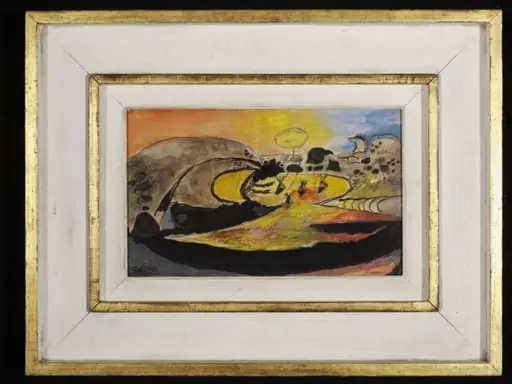
Low Cliff with Trees
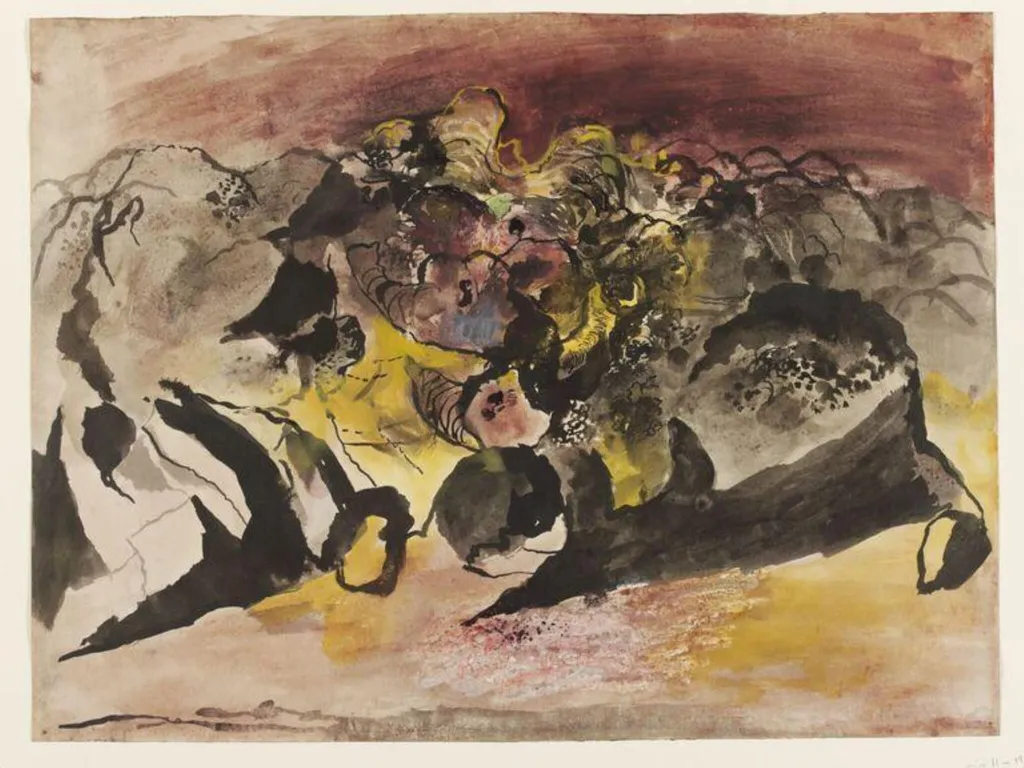
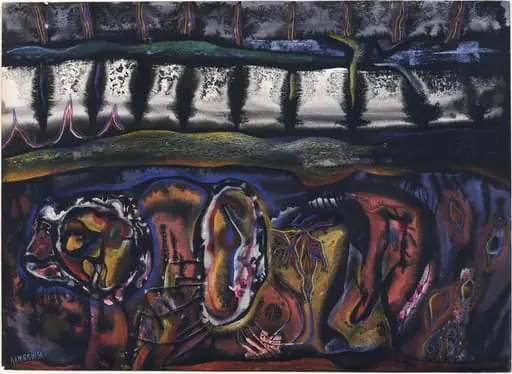
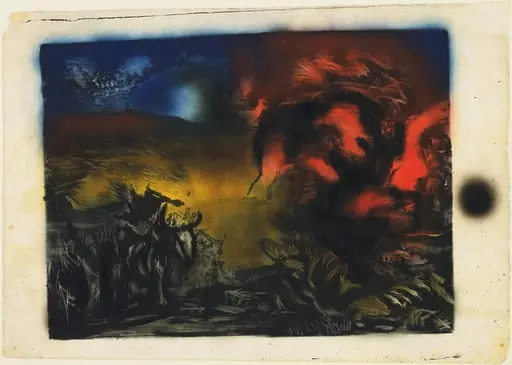
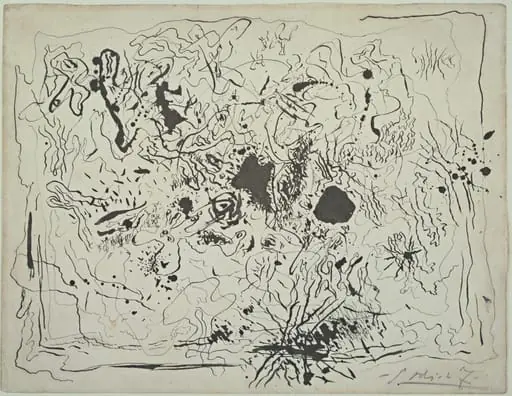
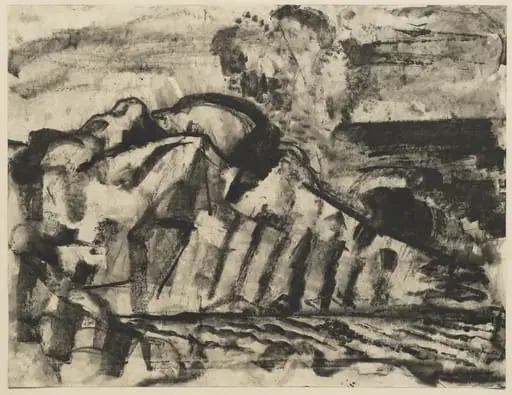
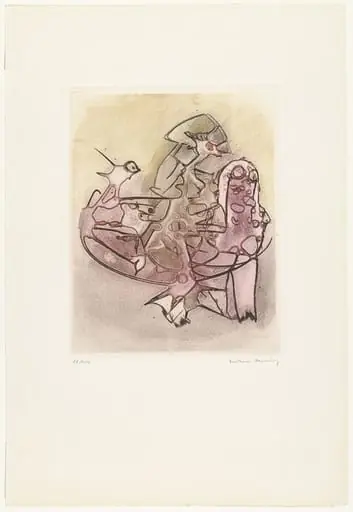
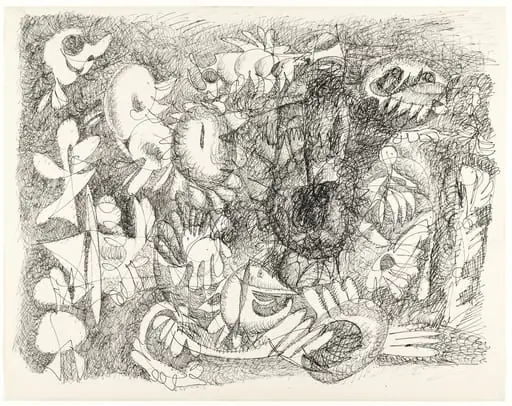
Low Cliff with Trees is a watercolor work on paper by Graham Vivian Sutherland. It dates from 1942 and is held in the collection of the Victoria and Albert Museum.
About this work
Overview
The medium’s fluidity allowed for spontaneous layering, resulting in a surface that feels both elemental and unstable.
Graham Vivian Sutherland created this 1942 watercolour as part of his wartime landscape studies. The work captures a rugged coastal cliff in loose, expressive brushwork, emphasizing texture over detail. The medium’s fluidity allowed for spontaneous layering, resulting in a surface that feels both elemental and unstable. No human presence or clear horizon anchors the scene, reinforcing its sense of isolation.
Subject & Meaning
The subject is a barren, wind-scarred cliffside where trees cling precariously to rocky ledges. The forms are simplified into dark, gnarled silhouettes and fragmented rock masses, suggesting endurance amid decay. Subtle hints of red and yellow in the foliage imply fleeting life against a somber, earth-toned sky. The composition evokes resilience in nature, shaped by forces beyond human control.
Technique & Style
Sutherland employed watercolour with minimal control, allowing pigments to bleed and pool unpredictably. He used coarse, rapid strokes to define jagged rock edges and twisted tree trunks, leaving paper exposed in places to suggest light and void. The palette is restrained—grays, browns, and muted reds—enhancing the raw, almost geological quality of the scene. The technique rejects polish in favor of emotional immediacy.
History & Provenance
Painted during Sutherland’s official commission for the War Artists’ Advisory Committee, this work reflects his focus on Britain’s rugged terrain during World War II. It was likely produced in the south coast regions, where he traveled to document landscapes under threat. The piece entered the Victoria and Albert Museum’s collection as part of the wartime art archive, preserving its historical context.
Context
Created amid the Blitz and national anxiety, Sutherland’s landscapes shifted from romanticized views to raw, introspective visions of nature. This watercolour aligns with contemporaneous works by British artists exploring psychological terrain through physical environment. The absence of human figures and structured composition mirrors a broader cultural mood of uncertainty and existential unease.
Legacy
This watercolour exemplifies Sutherland’s transition toward abstraction in his later career, influencing postwar British landscape art. Its emphasis on texture and emotional resonance over realism contributed to a redefinition of natural representation in modern British painting. Though not widely exhibited, it remains a key example of wartime art that prioritized inner experience over outward description.
Artist & collection
Artist
Graham Vivian Sutherland was a prolific English artist. Notable for his paintings of abstract landscapes and for his portraits of public figures, Sutherland also worked in other media, including printmaking, tapestry and glass design.