Artwork
Inn at the Prima Porta
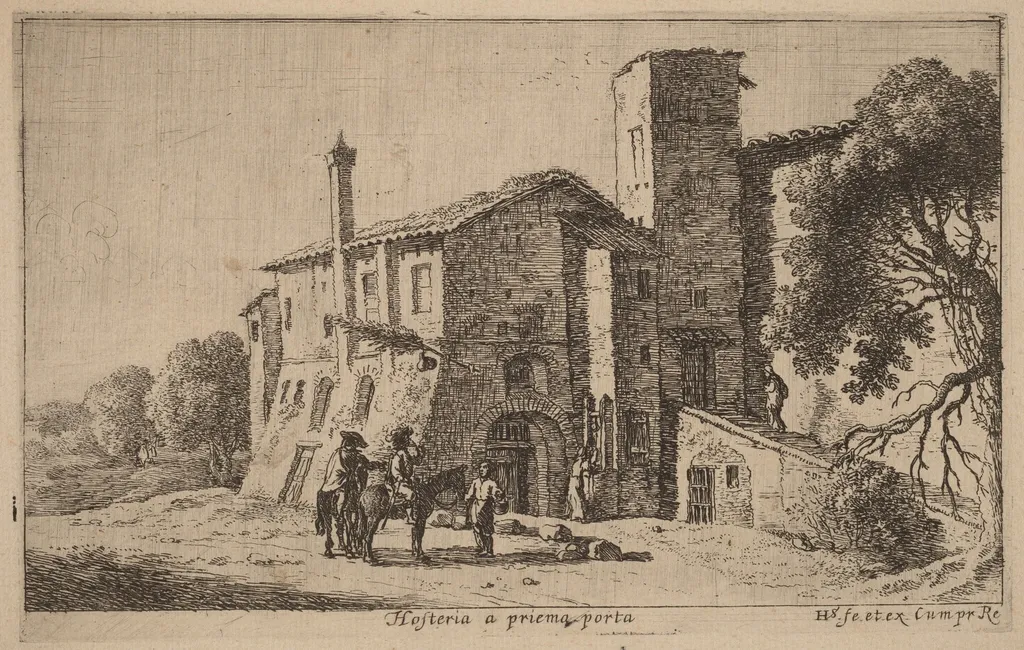
Inn at the Prima Porta is an ink print by the Baroque artist Herman van Swanevelt. It dates from 1628 and is held in the collection of the National Gallery of Art.
About this work
Overview
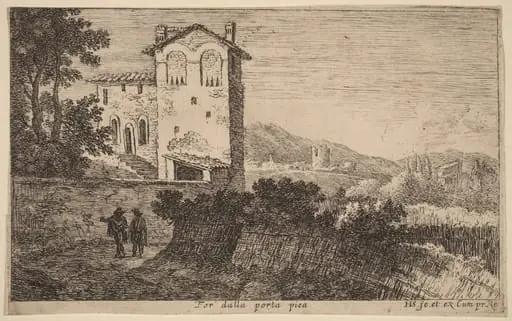
Rendered in monochrome, the scene captures travelers pausing at a substantial stone structure marked with the inscription 'Hosteria a prima porta.
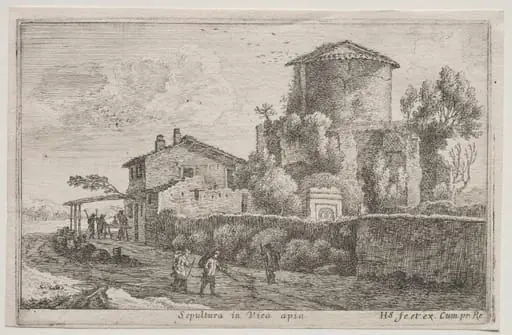
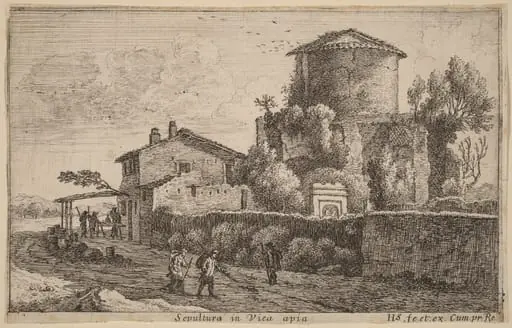
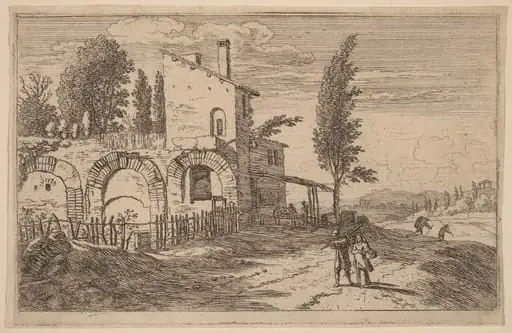
Created in 1628 by Herman van Swanevelt, this etching depicts a roadside inn near the ancient Via Flaminia, just outside Rome. Rendered in monochrome, the scene captures travelers pausing at a substantial stone structure marked with the inscription 'Hosteria a prima porta.' The composition balances architectural detail with natural elements, suggesting a moment of rest along a well-traveled route.
Subject & Meaning
The scene portrays a group of riders and their horses halting at a wayside inn, a common motif in 17th-century Northern European landscape prints. The presence of a tower and courtyard implies a functioning establishment for travelers, while the uneven ground and scattered rocks ground the image in realism. The inscription confirms its location, linking the image to the historical Prima Porta crossing, a known stop on the road to Rome.
Technique & Style
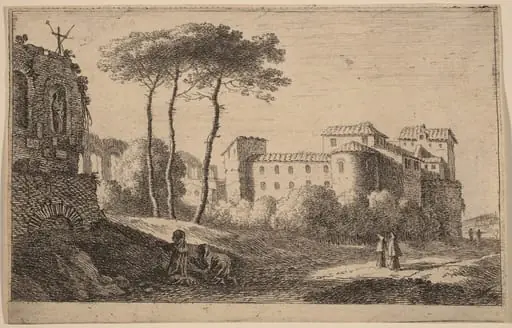
Van Swanevelt employed fine, controlled etching lines to render textures—rough stone walls, woven reins, leafy foliage, and rocky terrain. The precision of the lines creates depth without heavy shading, relying on density and direction to suggest form. The composition is tightly framed by trees and a low fence, directing focus to the central building while maintaining a sense of spatial depth and atmospheric quiet.
History & Provenance
The etching was produced during van Swanevelt’s time in Rome, where he absorbed Italian landscape traditions while retaining his Northern European sensibility. It was likely made for a private collector or print market interested in topographical views. No definitive early ownership records survive, but similar works by the artist circulated among connoisseurs of Italianate scenery in the 17th century.
Context
This print reflects the growing interest among Northern artists in Italian landscapes during the early 1600s. Van Swanevelt was part of a generation that traveled to Rome, sketching ruins and rural scenes to bring back as finished prints. The inn at Prima Porta, a real landmark, served as both a functional stop and a symbolic threshold between the city and the countryside.
Legacy
Van Swanevelt’s etchings contributed to the development of the Italianate landscape print in Northern Europe. His attention to architectural detail and naturalistic terrain influenced later artists working in the genre. While not widely known today, this work remains a representative example of how travel and observation shaped printmaking traditions across 17th-century Europe.
Artist & collection