Artwork
Inn in the Ruins of the Palace of the Emperors
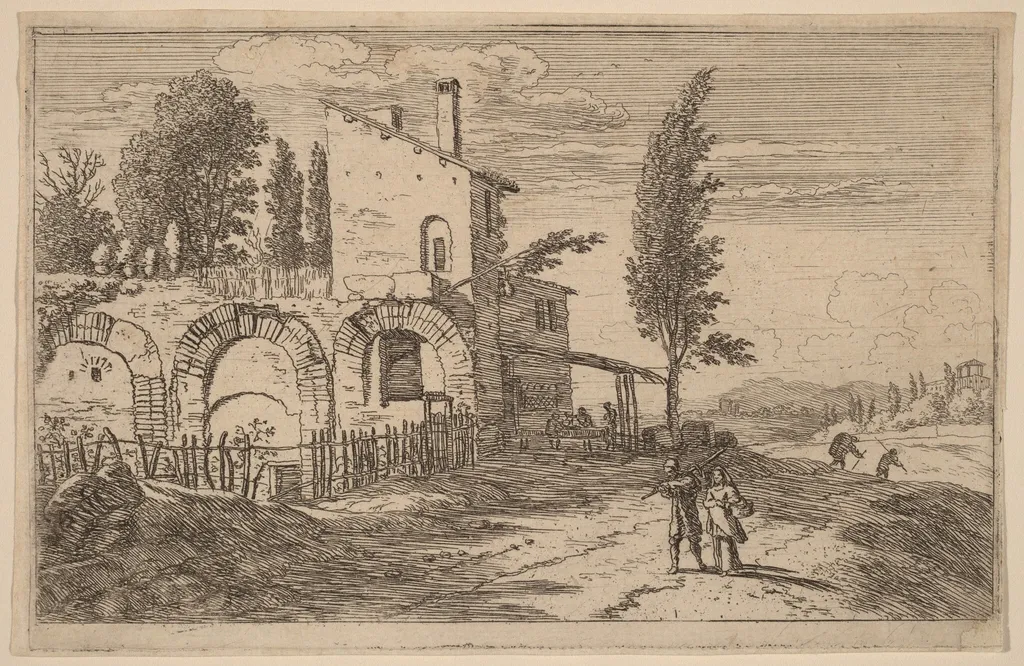
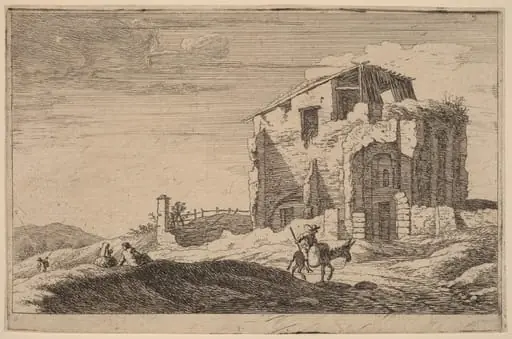
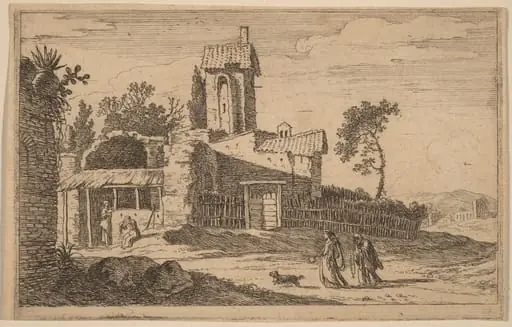
Inn in the Ruins of the Palace of the Emperors is an ink print by the Baroque artist Herman van Swanevelt. It dates from 1628 and is held in the collection of the National Gallery of Art.
About this work
Overview
The composition centers on a weathered stone structure with arched openings and a chimney, partially overgrown by trees and enclosed by a low fence.
Herman van Swanevelt created this etching in 1628, capturing a quiet rural scene amid the remnants of imperial architecture. The composition centers on a weathered stone structure with arched openings and a chimney, partially overgrown by trees and enclosed by a low fence. A dirt path leads through the foreground, where two figures walk, while a third tends to a horse near the horizon. The work balances architectural decay with natural renewal, evoking a contemplative stillness.
Subject & Meaning
The scene juxtaposes the remnants of imperial power with humble human activity. The ruined palace, once a symbol of authority, now serves as a shelter or inn, suggesting the passage of time and the repurposing of history. The quiet figures and domesticated animal imply continuity in everyday life, indifferent to the grandeur that once stood there. The image reflects a 17th-century fascination with ruins as sites of quiet reflection rather than lament.
Technique & Style
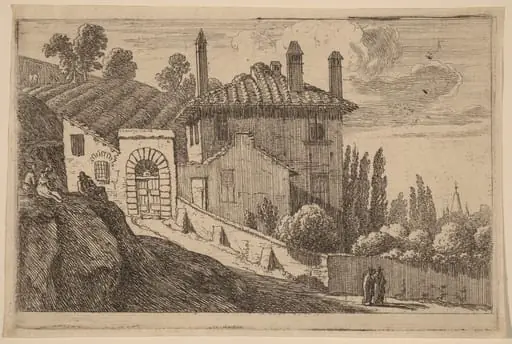
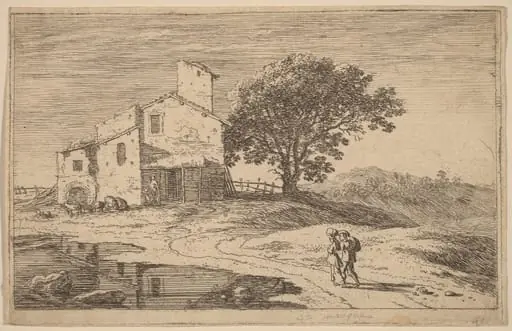
Van Swanevelt employed fine, controlled etching lines to render texture—rough stone, leafy foliage, and the grain of the path. Subtle tonal gradations, achieved through varied line density, suggest depth and atmospheric light without heavy shading. The composition is deliberately uncluttered, emphasizing spatial recession and the interplay between man-made structure and organic growth. The technique aligns with Northern European landscape traditions, prioritizing quiet observation over dramatic effect.
History & Provenance
Created during van Swanevelt’s early career, the print likely originated from his time in Rome, where he studied classical ruins and developed his landscape style. Though specific early ownership records are sparse, the work entered broader circulation through print collections in the Low Countries and France. Its survival in museum holdings today reflects its enduring appeal as an example of early Dutch-Italianate etching.
Context
In the 1620s, Northern artists increasingly turned to Italian landscapes as subjects, drawn by the romantic potential of ancient ruins. Van Swanevelt was part of a generation that blended Italian topography with Northern attention to detail and mood. This print reflects a broader cultural interest in ruins as poetic metaphors—not for decline, but for harmony between nature and the traces of human endeavor.
Legacy
The etching contributed to the development of the idealized landscape print in Northern Europe. Van Swanevelt’s restrained composition and sensitivity to atmosphere influenced later artists who sought to evoke tranquility through architectural decay. While not widely reproduced in his lifetime, the work remains a quiet benchmark in the evolution of etched landscape as a genre of contemplative observation.
Artist & collection