Artwork
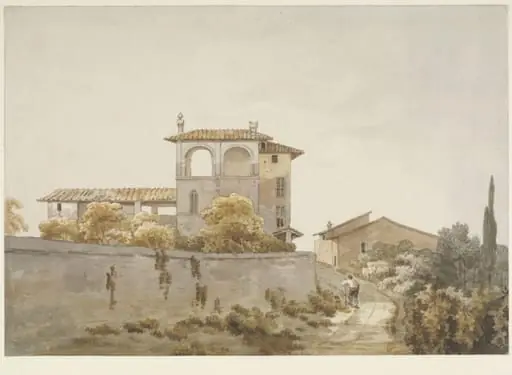
Buildings near Rome
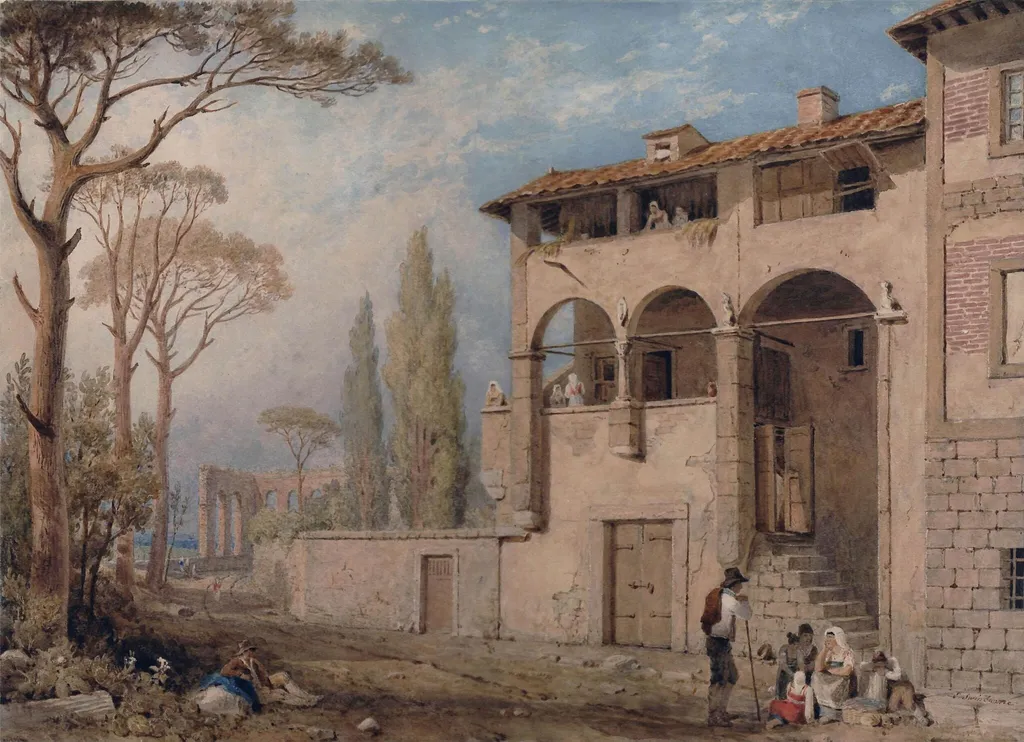
Buildings near Rome is a watercolor work on paper by the British Romanticist artist Edward Swinburne. It dates from 1850 and is held in the collection of the Victoria and Albert Museum.
About this work
Overview
Created around 1850, this watercolour by Edward Swinburne captures a quiet rural scene near Rome. Executed in delicate washes, the work is signed by the artist and labeled on the reverse of its mount. The composition emphasizes stillness and decay, with muted tones and soft lighting conveying the passage of time without dramatic emphasis.
Subject & Meaning
The presence of a tall cypress and distant ruins reinforces themes of endurance and quiet decay, evoking a sense of temporal layering rather than narrative.
The scene centers on an ancient structure with arched windows, broken shutters, and cracked masonry, suggesting long-term neglect. Figures beneath its shadow—a seated group and a lone man leaning on a cane—hint at daily life persisting amid ruin. The presence of a tall cypress and distant ruins reinforces themes of endurance and quiet decay, evoking a sense of temporal layering rather than narrative.
Technique & Style
Swinburne employed transparent watercolour washes to build subtle gradations of light and texture. The palette is restrained, favoring earth tones and pale sky hues, with minimal detail to suggest weathering. Brushwork is loose yet deliberate, allowing the paper’s whiteness to imply highlights and the fragility of the architecture. No sharp outlines define forms, enhancing the atmospheric mood.
History & Provenance
The work is attributed to Edward Swinburne, an artist active in the mid-19th century known for topographical watercolours of Italy. Its survival with original mounting and inscription suggests it was likely kept as a personal record or study. The piece entered the Victoria and Albert Museum’s collection, where it is held alongside other British watercolours of Italian landscapes from the period.
Context
During the 1840s–1860s, British artists frequently traveled to Italy to sketch ruins and rural scenes, often for private collections or as preparatory studies. Swinburne’s work aligns with this tradition, reflecting a fascination with antiquity’s quiet remnants rather than grand historical narratives. The emphasis on everyday life amid decay mirrors broader Romantic-era interests in transience and the sublime in ordinary settings.
Legacy
Though not widely exhibited, Swinburne’s watercolours contribute to a body of 19th-century British topographical art that documented Italy’s evolving landscapes. His focus on understated, unidealized ruins offers a counterpoint to more theatrical depictions of antiquity. The work remains a quiet example of how travel and observation shaped artistic responses to historical space in the Victorian era.
Artist & collection
Artist
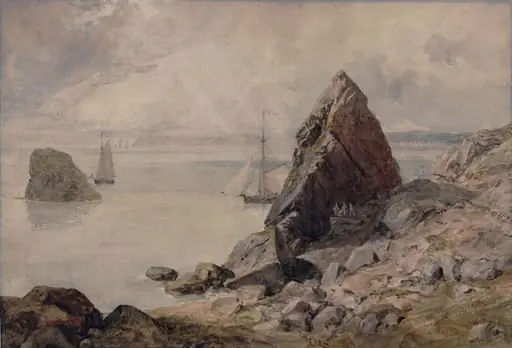
Edward Swinburne painted soft watercolours of real places. In *Buildings near Rome* you can spot sunlit arches and distant domes. His *The Shag Rock, Tor Bay* shows jagged cliffs dropping into green water. Another…

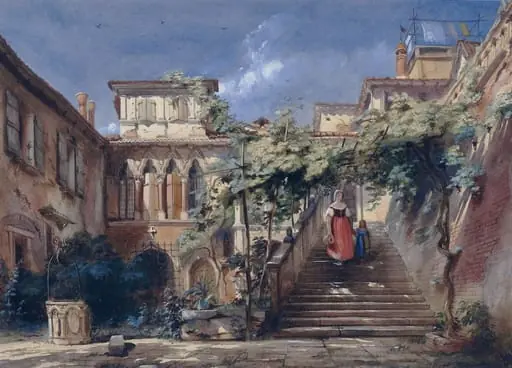 Cortile della Casa Salviati, Venice
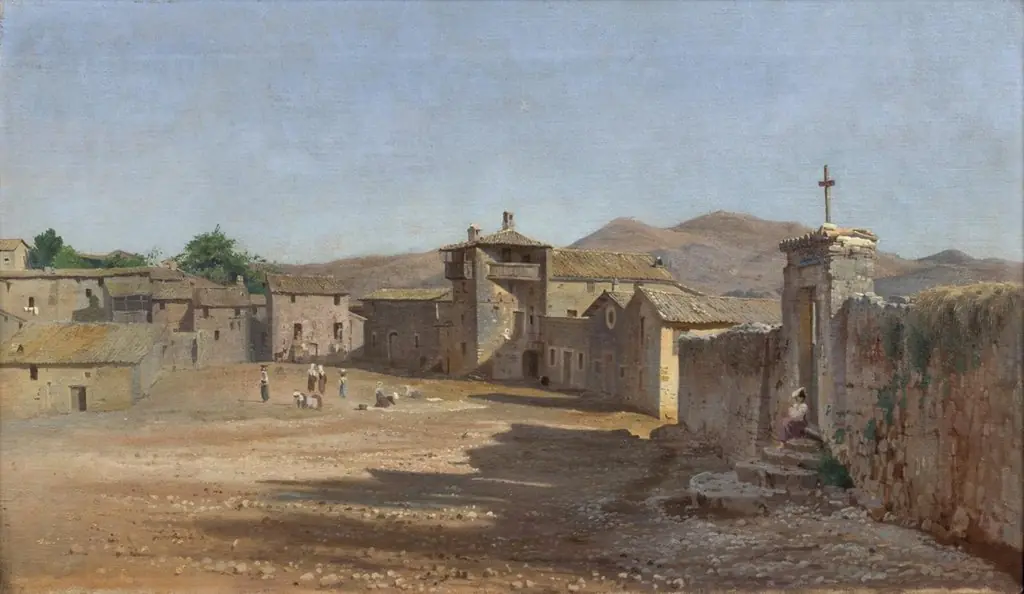 Torvet i Anticoli Corrado, Italien
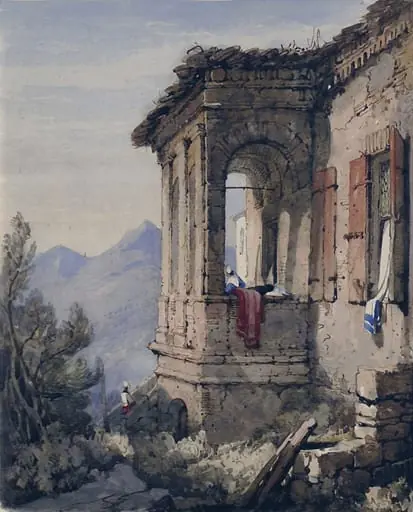 House of Petrarch at Arqua
 Torvet i Anticoli Corrado, Italien
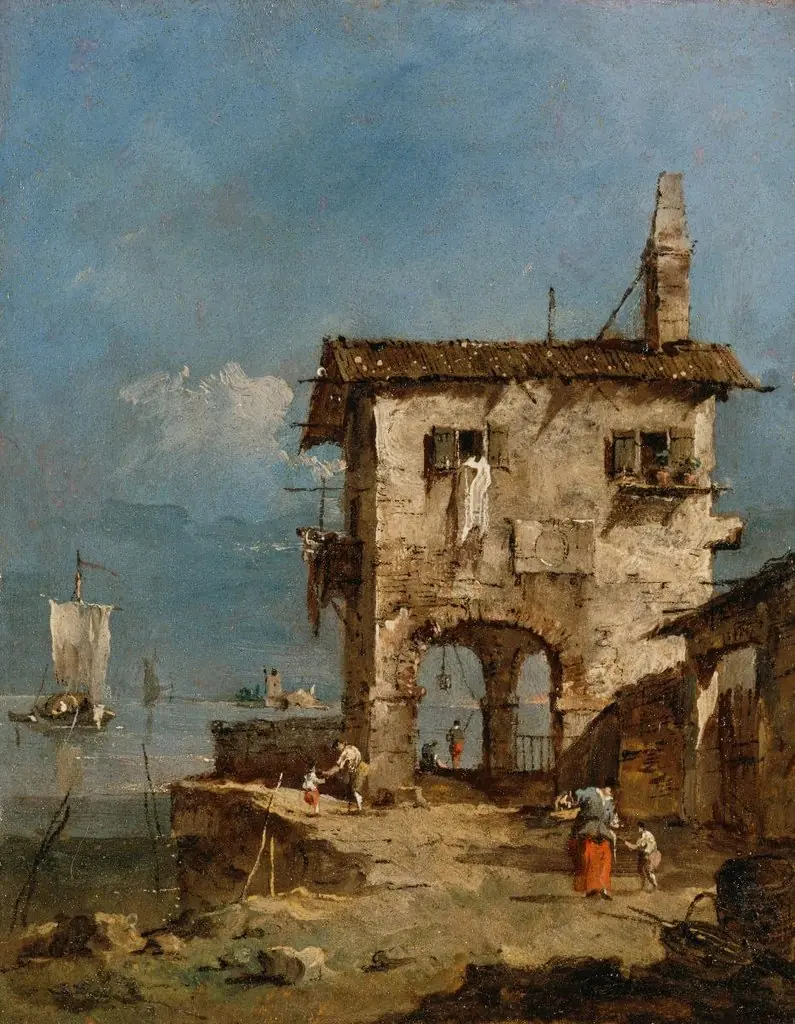 Capriccio con chiesa diroccata, casa rustica e figurine varie in riva alla laguna
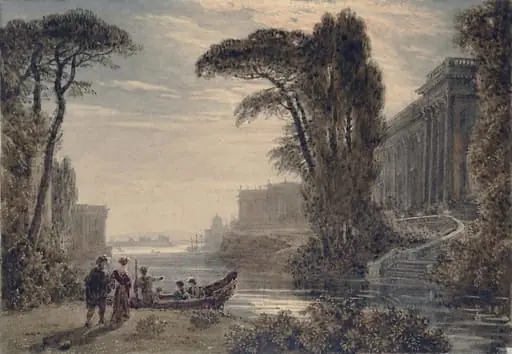 A Classical Composition
 Italian villa
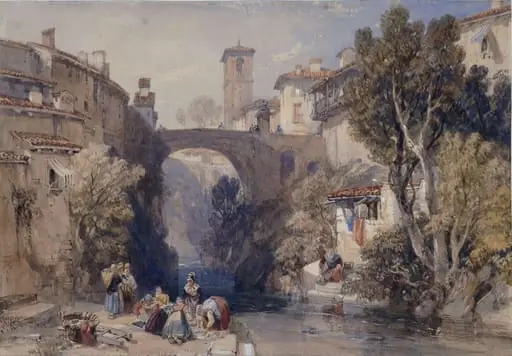 Ivrea, Val d'Aosta
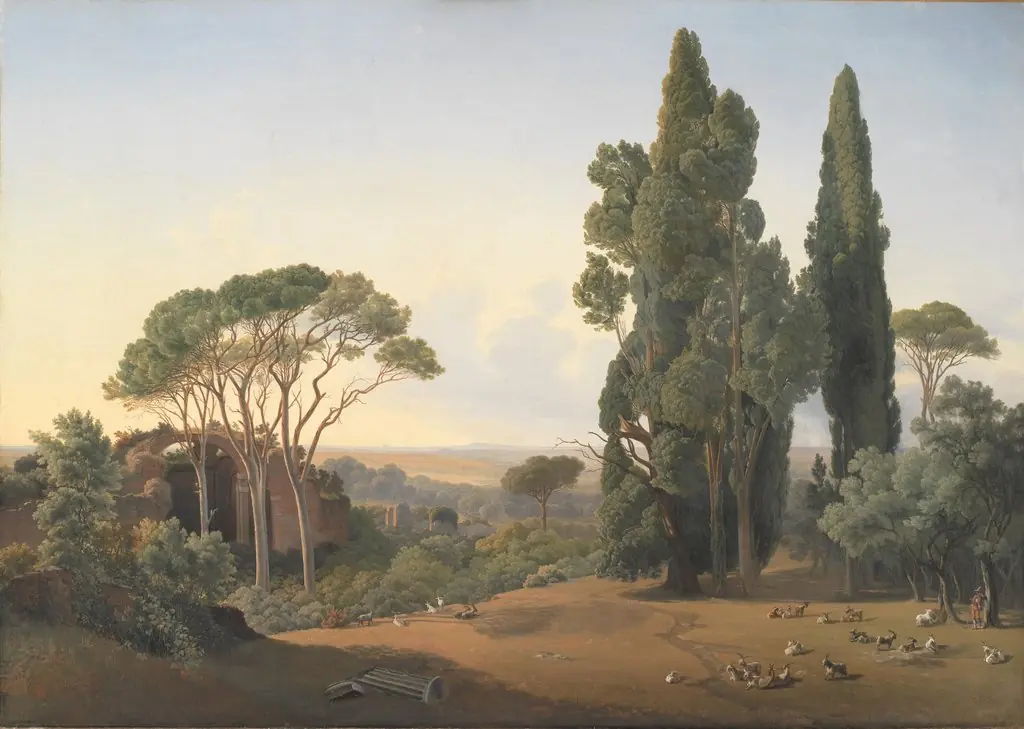 A View from Hadrian's Villa, Tivoli
 The Terrace
 Bay of Naples
 View of Rome