Artwork
Quimperlé, Brittany
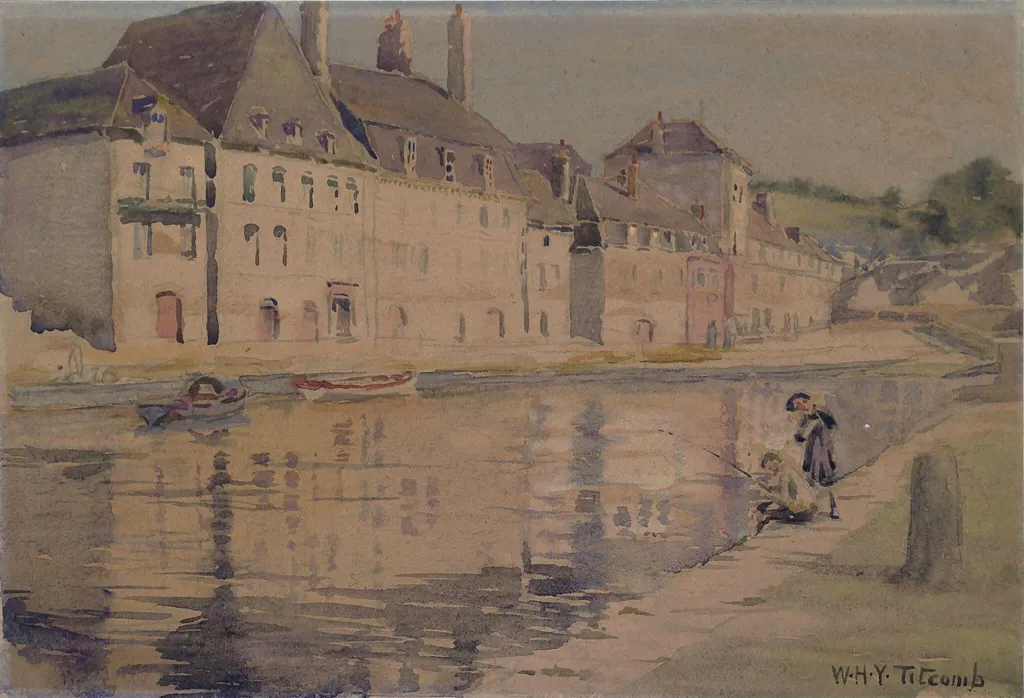
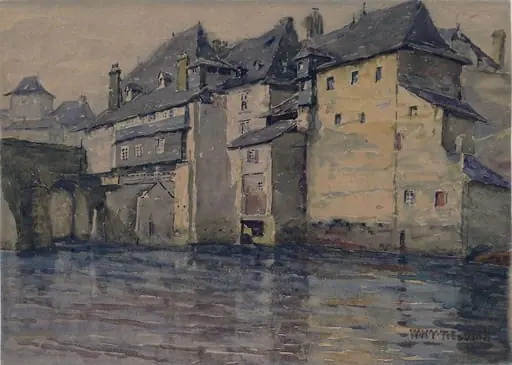
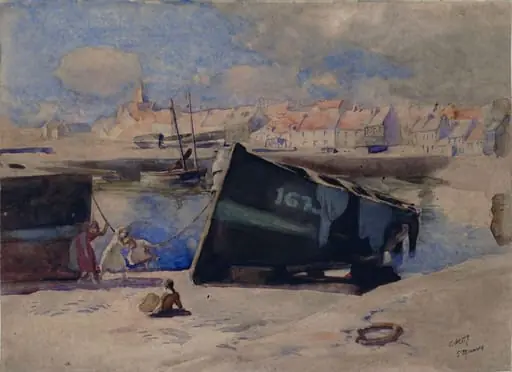
Quimperlé, Brittany is a watercolor work on paper by the Impressionist artist William Holt Yates Titcomb. It dates from 1885 and is held in the collection of the Victoria and Albert Museum.
About this work
Overview
William Holt Yates Titcomb created this watercolour in 1885, depicting a quiet stretch of the river in Quimperlé, Brittany.
William Holt Yates Titcomb created this watercolour in 1885, depicting a quiet stretch of the river in Quimperlé, Brittany. The work is signed and inscribed with its title, confirming its origin and subject. Executed in a loose, observational manner, it captures a moment of daily life rather than a grand landscape. The medium’s transparency allows subtle shifts in tone, reinforcing the scene’s calm atmosphere.
Subject & Meaning
The scene centers on two figures near a still riverbank: one stooping as if gathering something, the other holding a long pole, possibly a fishing rod or boat hook. Behind them, weathered stone buildings line the shore, their simple forms suggesting long-standing use. The absence of dramatic action or idealized beauty points to an interest in ordinary, unremarkable moments, reflecting a quiet reverence for everyday rural life.
Technique & Style
Titcomb employed loose, fluid brushwork, allowing pigments to bleed slightly at the edges and soften contours. The watercolour’s transparency captures ambient light rather than sharp detail, with muted tones dominating the sky and stone surfaces. There is no attempt at photographic precision; instead, the focus is on the interplay of light, texture, and atmosphere, aligning with broader trends in late 19th-century observational painting.
History & Provenance
Created during Titcomb’s travels in Brittany, the work is one of many watercolours he produced during this period. It was signed and titled by the artist, indicating it was intended as a finished piece rather than a sketch. While its early ownership is undocumented, its survival in collections suggests it was valued for its quiet sincerity and technical restraint.
Context
In the 1880s, many British artists traveled to rural France seeking subjects removed from industrial urban life. Titcomb’s focus on modest architecture and unposed figures reflects this trend. Though not formally part of the Impressionist movement, his approach shares affinities with their interest in light, transient moments, and everyday subjects, placing him within a wider European shift toward observational realism.
Legacy
Titcomb’s watercolours, including this one, remain modest but enduring records of late 19th-century rural France. They offer no grand narrative, but their quiet attention to place and light provides insight into how artists of the time engaged with the ordinary. His work is not widely known, but among collectors of British watercolour, it is appreciated for its restraint and sincerity.
Own this work as a print
Artist & collection
Artist
A British watercolorist active in late 1800s France, Titcomb painted quiet towns and old buildings in Brittany and on the island of Oléron.