Artwork
Dover Balcony
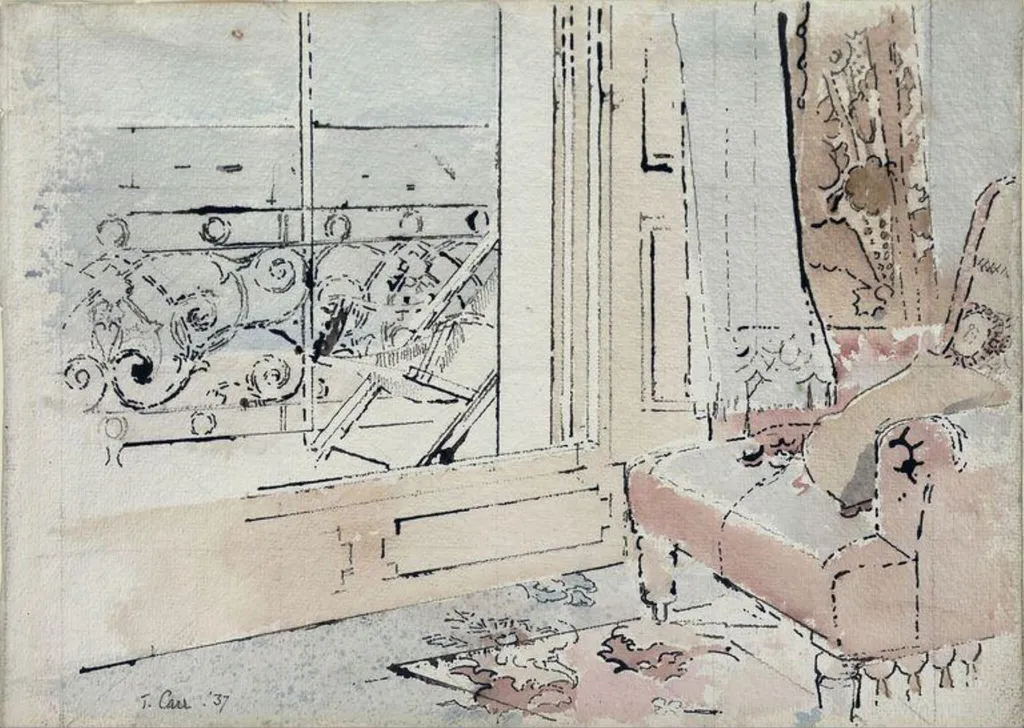
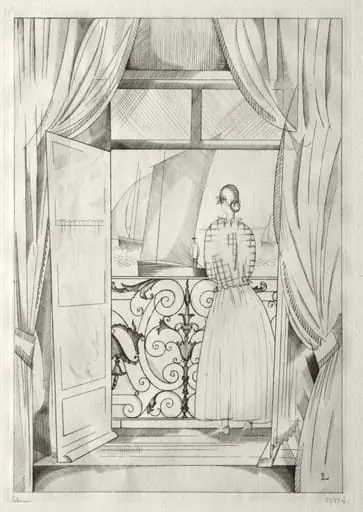
Dover Balcony is a watercolor work on paper by the Spanish Baroque Tenebrist artist Tom Carr. It dates from 1937 and is held in the collection of the Victoria and Albert Museum.
About this work
Overview
Painted in 1937, this watercolour by Tom Carr captures a modest interior space in Dover, rendered with minimal detail and deliberate incompleteness.
Painted in 1937, this watercolour by Tom Carr captures a modest interior space in Dover, rendered with minimal detail and deliberate incompleteness. The work lacks the polish of a finished composition, instead presenting a spontaneous, almost casual observation of a domestic balcony area. Its fragile lines and sparse washes suggest immediacy, as if recorded in passing rather than planned for display.
Subject & Meaning
The scene depicts a simple interior with a balcony opening to the outside, populated by indistinct human figures. These figures are reduced to basic outlines, functioning more as markers of presence than individual portraits. The focus lies not in narrative but in the quiet, unremarkable moment of a room caught mid-day, suggesting an interest in ordinary spaces rather than dramatic events.
Technique & Style
Carr employs loose, uneven brushwork and thin washes that leave large areas of paper exposed. Lines are hesitant and angular, with walls and floors rendered as flat, tilted planes rather than perspectivally accurate forms. The balcony railing is barely suggested, and the figures resemble quick notations. The technique prioritizes gesture over finish, embracing the transparency and fragility of watercolour as a medium for fleeting impressions.
History & Provenance
Created in 1937, the work belongs to a period when Carr was producing numerous small-scale watercolours, often of domestic and coastal scenes. It likely originated from his personal sketchbook or studio practice rather than a commissioned project. No public record of early ownership exists, and it remains within private or institutional collections as an example of his observational work.
Context
In the late 1930s, British artists increasingly turned to intimate, unidealized subjects as a counter to grand historical or romantic themes. Carr’s approach aligns with this trend, reflecting a broader interest in everyday environments and the quiet rhythms of domestic life. His style echoes contemporaries who valued spontaneity and material honesty over technical refinement.
Legacy
This watercolour contributes to an understated body of work that redefined British watercolour as a vehicle for personal observation rather than polished display. Though not widely exhibited, such pieces influenced later generations of artists who embraced sketch-like immediacy and the expressive potential of unfinished forms in water-based media.
Artist & collection

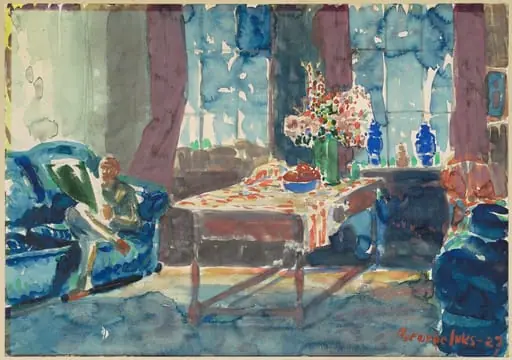 Self-Portrait: Interior of My New York Apartment
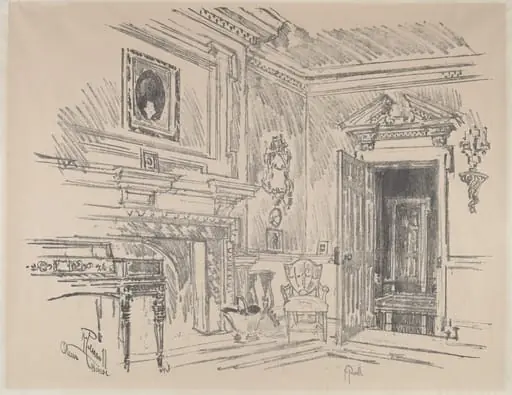 Drawing Room at Cliveden
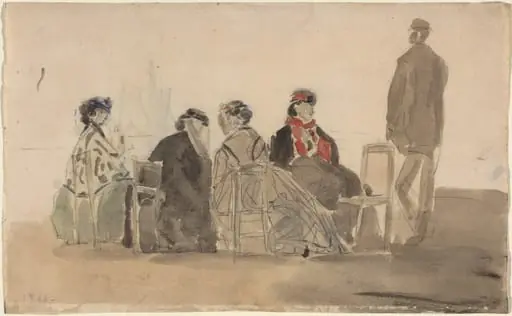 Four Ladies Seated at Trouville
 The Garden, York House, Twickenham
 The Studio, New House, Rye
 Carlton Terrace
 'Woman on Sofa'
 Hallway at Dr. Wister's
 Cannons Park, Edgware; from the Tennis Courts
 O femeie citind pe terasă
 Hallway to Bed Room, Stenton
 The Balcony over the Sea