Artwork
James IV, King of Scotland
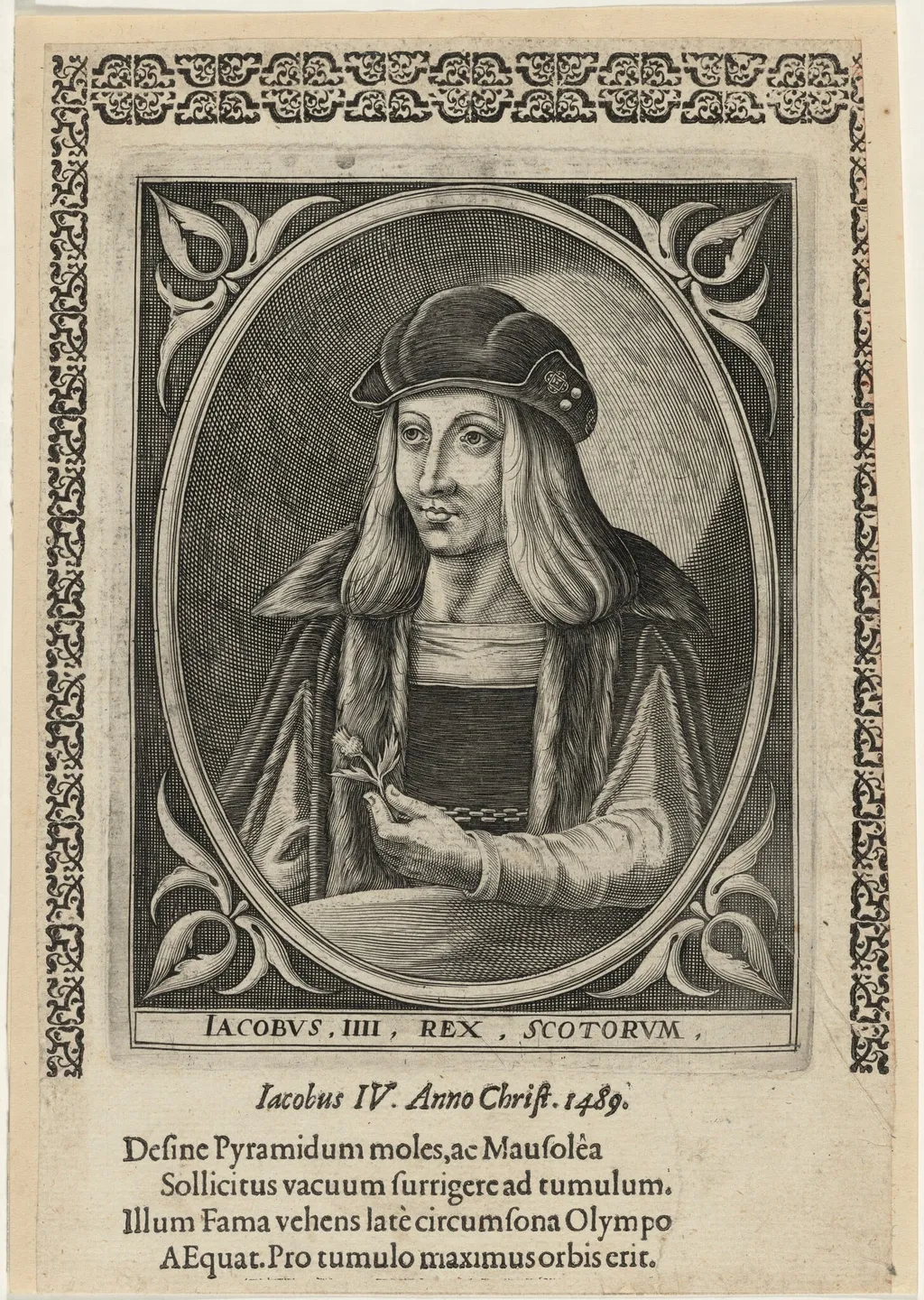
James IV, King of Scotland is an ink print by the Baroque artist Unknown 19th Century. It dates from 1603 and is held in the collection of the National Gallery of Art.
About this work
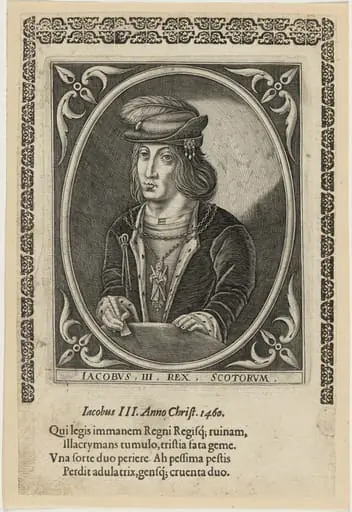
The text below says "Iacobus IIII, Rex, Scotorum" and the year 1489, but this engraving was actually printed in 1603.
This is a black-and-white portrait of a man in a dark hat and fur-lined robe. He holds a small object in his right hand, maybe a flower or a piece of paper. The background is a simple oval frame with swirling patterns on the sides.
The text below says "Iacobus IIII, Rex, Scotorum" and the year 1489, but this engraving was actually printed in 1603. The detailed lines show the artist used careful shading to make the face and clothes look three-dimensional.
Look up engraving to see how artists like this carved fine lines into metal to create prints.
Overview
This early‑17th‑century engraving presents a portrait of James IV, King of Scotland. Rendered in black and white, the figure wears a dark hat and a fur‑trimmed robe, holding a small object—perhaps a flower or a slip of paper—in his right hand. The composition is framed by an oval border adorned with modest swirling motifs, emphasizing the sitter’s status.
Subject & Meaning
The image identifies the monarch by the Latin inscription “Iacobus IIII, Rex, Scotorum” and the date 1489, referencing James IV’s birth year. The dignified pose, luxurious attire, and the held object convey royal authority and personal refinement, typical of portraiture intended to affirm the king’s legitimacy and lineage.
Technique & Style
Executed through intaglio engraving, the artist incised fine lines into a metal plate, achieving delicate gradations of tone that model the face and garments in three dimensions. Careful cross‑hatching creates depth, while the crisp linear borders contrast with the softer shading, illustrating the high level of craftsmanship characteristic of early modern printmaking.
History & Provenance
Although the portrait bears the year 1489, the print itself was first issued in 1603, shortly after James IV’s accession to the Scottish throne. The work circulated as a printed likeness, likely serving both as a political emblem and as a collectible image for admirers of the new monarch.
Artist & collection

Artist