Artwork
A Mughal courtier
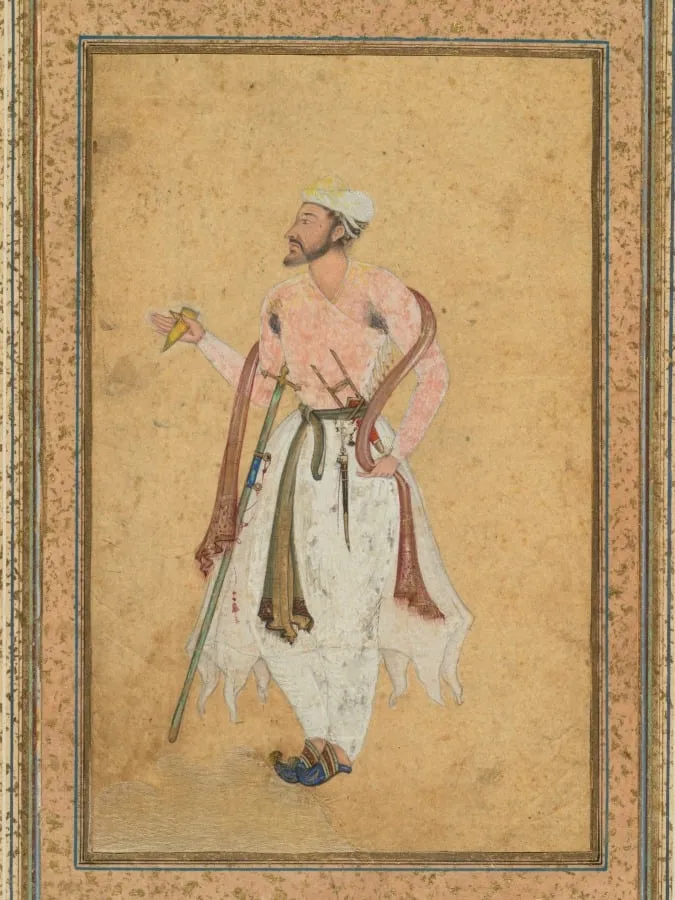
A Mughal courtier is an unspecified painting by the Mughal Painting artist Unknown. It dates from 1704 and is held in the collection of the Cleveland Museum of Art.
About this work
The emperor Akbar wanted to remember people without writing their names—so artists had to make faces you’d recognize.
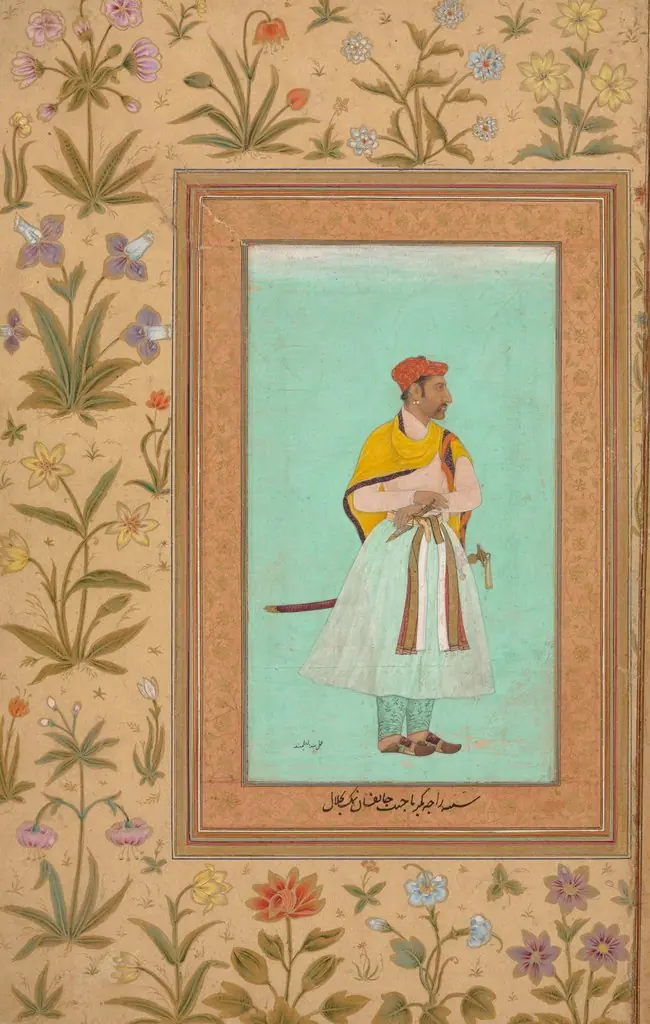
You see a man in a white robe and turban, standing against a plain green background. His hands are folded, one clutching a maroon and gold scarf.
This is one of the first realistic portraits from Mughal India. The emperor Akbar wanted to remember people without writing their names—so artists had to make faces you’d recognize. The scarf was probably a gift from the emperor, a sign of favor.
If you like this, look up more from the court of Akbar (reigned 1556–1605).
Overview
A Mughal courtier is depicted in this painting, one of the earliest surviving individual portraits from the Mughal atelier.
Subject & Meaning
The subject, likely a military officer due to the array of blades he carries, is shown grasping a maroon and gold scarf, possibly a gift from Emperor Akbar, signifying favor or promotion.
Technique & Style
The portrait exemplifies the realism that developed under Akbar's patronage, characterized by a focus on recognizable likenesses, as seen in the detailed rendering of the courtier's attire and accessories against a plain green background.
History & Provenance
Created during Akbar's reign (1556–1605), this painting was likely made for the emperor's personal records, as written notations were not used to identify recipients of gifts or promotions.
Context
The portrait is a product of the Mughal court's need for visual documentation, driven by Akbar's inability to read, and reflects the administrative and cultural practices of the time.
Artist & collection

 Domestic Scene
 Giacomo and Cardinal Marco, investing Andrea, Abbot of San Zeno, with his Benefice
 The Nymph of Fontainebleau
 Portrait of a Woman
 Madonna and Child with Saints in the Enclosed Garden
 Venus and Minerva
 Family Group of Four on Sofa
 Wall painting from Room H of the Villa of P. Fannius Synistor at Boscoreale