Artwork
A Muharram scene
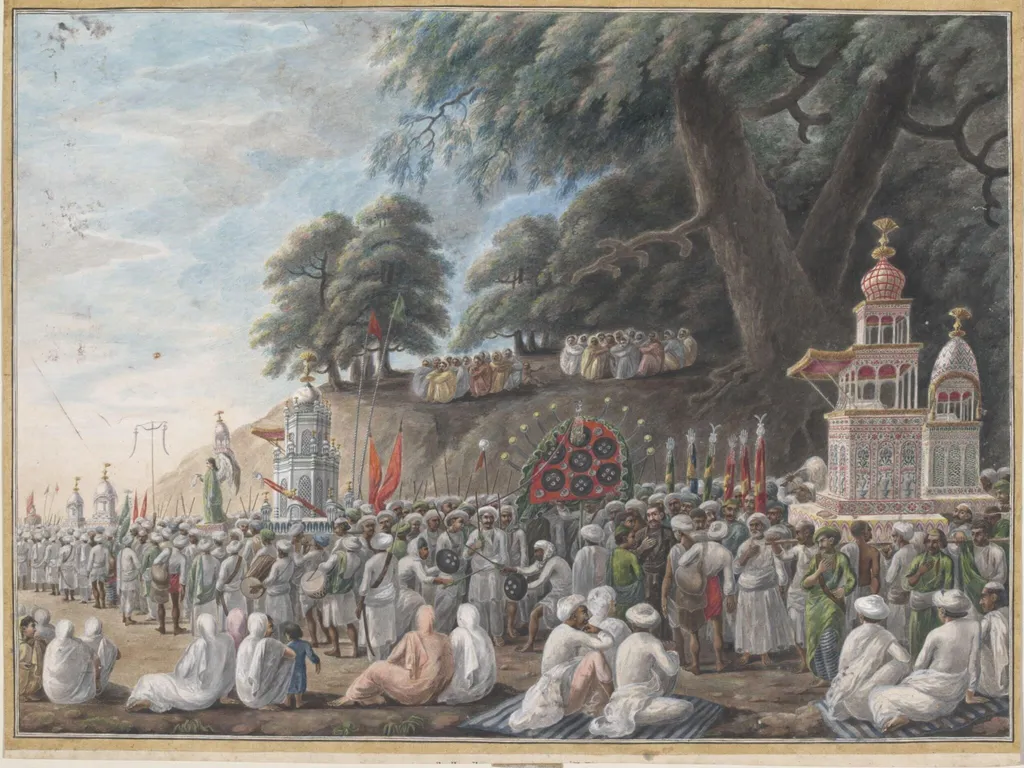
A Muharram scene is a paint painting by the Romanticist artist Unknown. It dates from 1807 and is held in the collection of the Victoria and Albert Museum.
About this work
Overview
Indian artists adapted local traditions to meet the tastes of British patrons, producing detailed works that documented cultural and religious practices.
This painting belongs to the Company style, a genre developed in India during the late 18th and early 19th centuries under British colonial influence. Indian artists adapted local traditions to meet the tastes of British patrons, producing detailed works that documented cultural and religious practices. The scene captures a Muharram procession, rendered with precision and a restrained palette typical of the style.
Subject & Meaning
The painting illustrates a Muharram observance, a solemn Shia Muslim commemoration of the martyrdom of Hasan and Husayn, grandsons of the Prophet Muhammad. Participants carry elaborate bamboo and paper structures symbolizing their tombs, known as taziya. These processions express grief and devotion, reinforcing communal identity and religious memory. The depiction reflects both spiritual significance and the visual culture of Shia observance in colonial India.
Technique & Style
Executed in watercolor on paper, the work employs fine brushwork and muted tones to render figures and architecture with clarity. While influenced by European naturalism, it retains indigenous conventions in composition and detail. Light is used to define form without dramatic chiaroscuro; instead, even illumination emphasizes the textures of textiles, bamboo frames, and crowd dynamics, aligning with Company painting’s documentary aims.
History & Provenance
The painting was once in the collection of Gilbert Elliot-Murray-Kynynmound, 1st Earl of Minto, who served as Governor-General of India from 1807 to 1813. His patronage reflects the British interest in documenting Indian customs during administrative rule. The work likely entered his collection through direct commission or acquisition from local artists, preserving a visual record of religious life under colonial oversight.
Context
Muharram processions were widely observed across northern Indian cities, particularly in Lucknow and Calcutta, where Shia communities were prominent. British officials often commissioned such scenes to understand local customs, sometimes viewing them as exotic spectacles. This painting captures a moment of public ritual that was both deeply religious and socially significant, offering insight into intercultural encounters during the colonial period.
Legacy
As a Company painting, this work contributes to a broader archive of Indian visual culture recorded for European audiences. It preserves details of Muharram rituals that continue today, serving as a historical reference for religious practice and artistic adaptation. While not widely exhibited, it remains a valuable artifact of cross-cultural observation and the complex dynamics of colonial patronage.
Artist & collection

 Domestic Scene
 Giacomo and Cardinal Marco, investing Andrea, Abbot of San Zeno, with his Benefice
 The Nymph of Fontainebleau
 Portrait of a Woman
 Madonna and Child with Saints in the Enclosed Garden
 Venus and Minerva
 Family Group of Four on Sofa
 Wall painting from Room H of the Villa of P. Fannius Synistor at Boscoreale
 Mailah-Jahn
 Mubarak ud-Daula, Nawab of Murshidabad, in durbar with the British Resident, Sir John Hadley D'Oyly
 Vishnu on Garuda
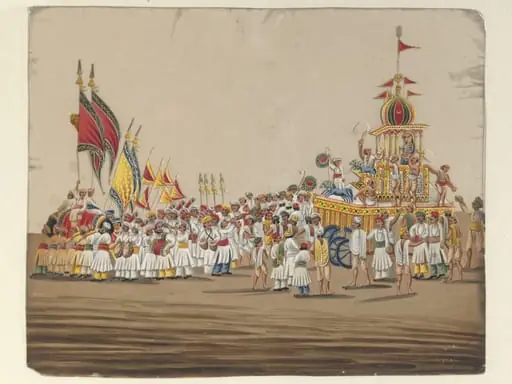 One of two drawings depicting procession scenes in Patna.
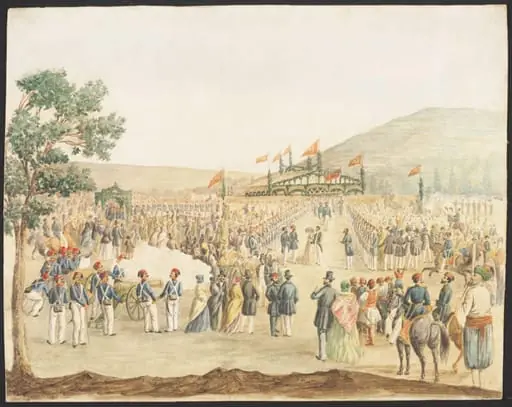 A Reception, probably for Naval Dignitaries, in Turkey
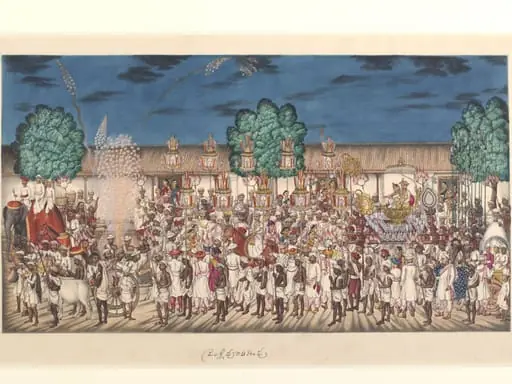 Marriage procession
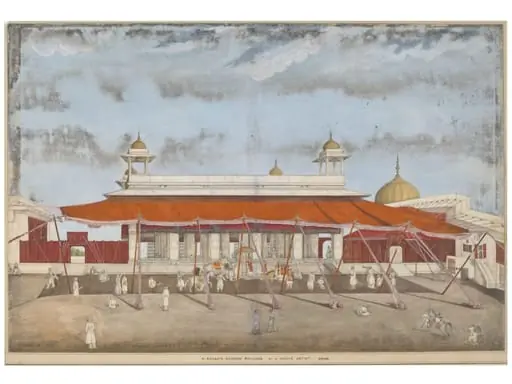 The Diwan-i Khas or Private Hall of Audience, Delhi.