Artwork
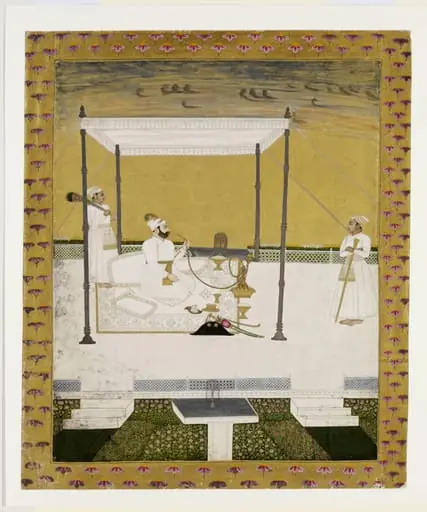
Mubarak ud-Daula, Nawab of Murshidabad, in durbar with the British Resident, Sir John Hadley D'Oyly
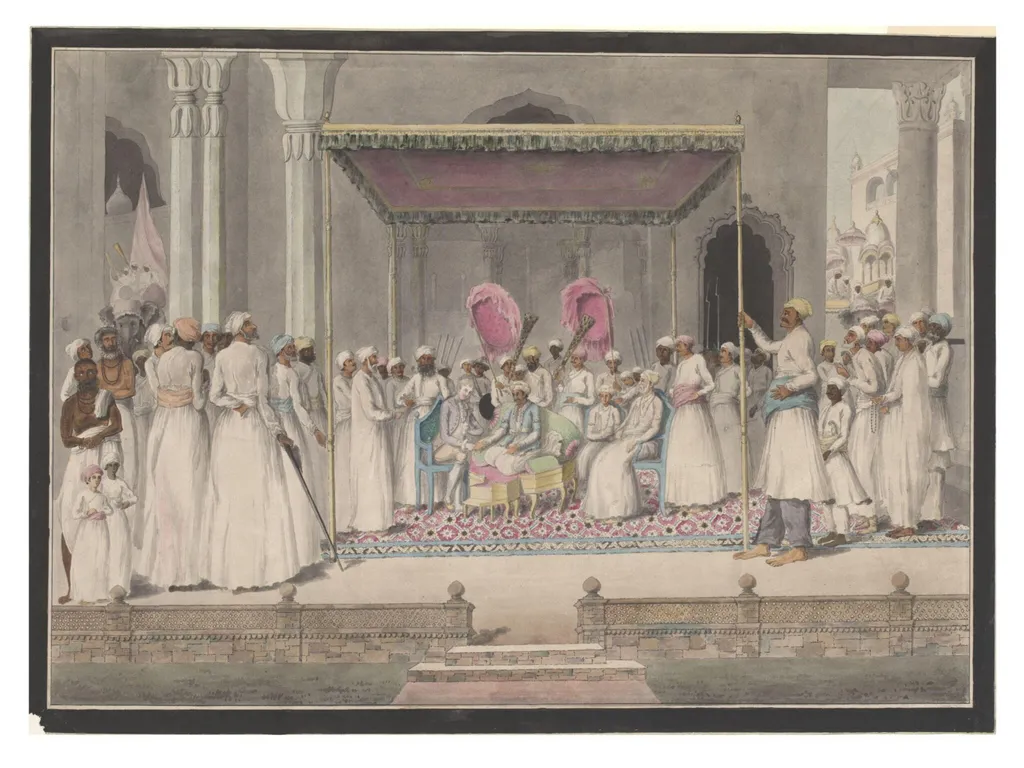
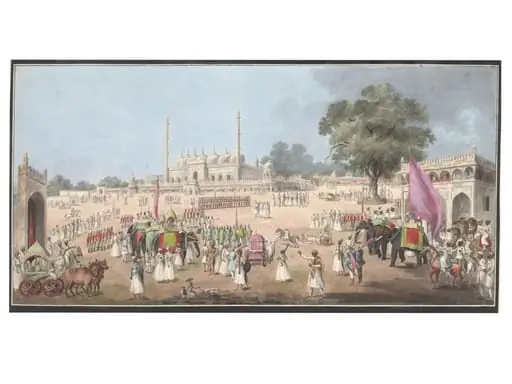
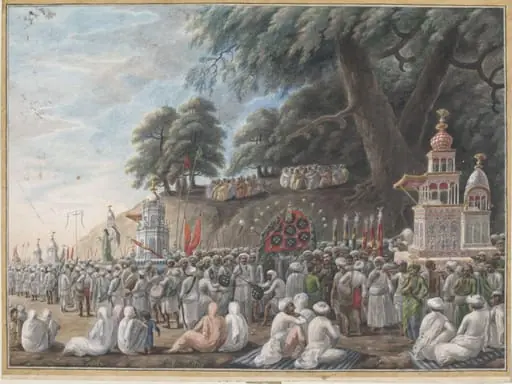
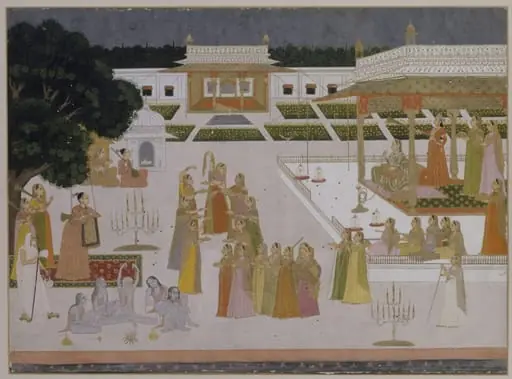
Mubarak ud-Daula, Nawab of Murshidabad, in durbar with the British Resident, Sir John Hadley D'Oyly is a paint painting by the Patna School of Painting artist Unknown. It dates from 1795 and is held in the collection of the Victoria and Albert Museum. This painting is one of nine works produced at the Murshidabad court, documenting ceremonial events and religious observances.
About this work
Overview
This painting is one of nine works produced at the Murshidabad court, documenting ceremonial events and religious observances.
This painting is one of nine works produced at the Murshidabad court, documenting ceremonial events and religious observances. It reproduces a lost oil painting by British artist George Farington, who worked in the region between 1785 and 1788. The copyist, likely a local artist, adapted Farington’s composition into a watercolor or gouache format, preserving key figures and spatial arrangement while adjusting materials to regional practices.
Subject & Meaning
The scene captures a durbar, a formal court audience, between Mubarak ud-Daula, the Nawab of Murshidabad, and Sir John Hadley D'Oyly, the British Resident. Their seated positions signify diplomatic interaction under the symbolic arch of authority. The presence of a guard with a tall spear underscores the ceremonial gravity of the moment, reflecting the complex political relationship between local rulers and colonial representatives during the late 18th century.
Technique & Style
The work employs transparent pigments typical of Indian miniature traditions, contrasting with Farington’s original oil medium. Figures are rendered with fine linework and flat, decorative backgrounds, characteristic of Murshidabad’s hybrid style. The exaggerated height of the sepoys, noted by contemporaries, suggests either stylistic preference or an attempt to emphasize military presence, revealing how local artists interpreted foreign visual models through their own aesthetic conventions.
History & Provenance
The original oil painting by George Farington, created during his brief tenure in Murshidabad, has not survived. This copy, likely made shortly after his death in 1788, preserves its composition. The painting entered the Victoria and Albert Museum’s collection as part of a group documenting court life under British influence, serving as both historical record and cultural artifact of colonial-era artistic exchange.
Context
In the late 1780s, Murshidabad’s court was navigating shifting power dynamics under East India Company influence. The production of such paintings reflected a desire to document authority and ritual amid political uncertainty. Farington’s presence introduced European techniques, yet local artists retained control over execution, resulting in hybrid works that balanced imperial representation with indigenous visual language.
Legacy
This painting stands as evidence of cross-cultural artistic transmission in colonial India. Though the original is lost, the copy preserves not only the scene but also the interpretive choices of its maker—highlighting how local artists engaged with, and subtly reshaped, foreign imagery. It remains a key example of how visual culture adapted to the realities of political transition in 18th-century Bengal.
Artist & collection

 Domestic Scene
 Giacomo and Cardinal Marco, investing Andrea, Abbot of San Zeno, with his Benefice
 The Nymph of Fontainebleau
 Portrait of a Woman
 Madonna and Child with Saints in the Enclosed Garden
 Venus and Minerva
 Family Group of Four on Sofa
 Wall painting from Room H of the Villa of P. Fannius Synistor at Boscoreale