Artwork
A Sinhalese Gentleman
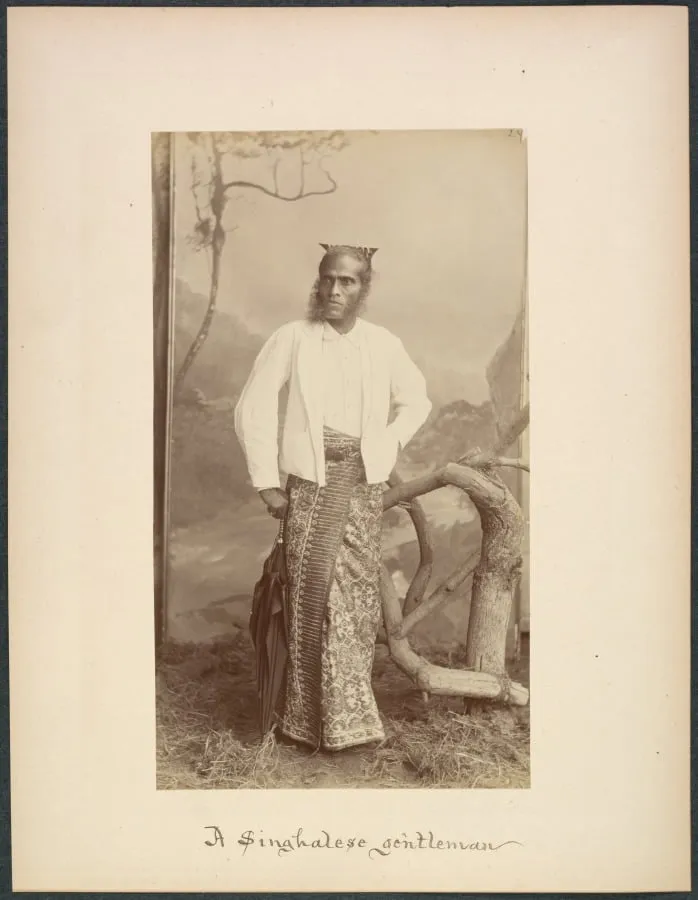
A Sinhalese Gentleman is a photography by the Impressionist artist Unknown. It dates from 1884 and is held in the collection of the Cleveland Museum of Art. This 19th-century photograph captures a Sinhalese man posed formally in a studio setting.
About this work
Overview
He stands before a painted backdrop depicting a scenic landscape of mountains, trees, and water, a common studio convention of the era.
This 19th-century photograph captures a Sinhalese man posed formally in a studio setting. He stands before a painted backdrop depicting a scenic landscape of mountains, trees, and water, a common studio convention of the era. His attire—a white long-sleeved shirt and patterned sarong—reflects local dress, while the composition aligns with Western photographic traditions of the time, blending cultural identity with colonial-era studio practices.
Subject & Meaning
The subject is presented with dignity and stillness, typical of formal portraiture in the 1800s. His clothing signals regional identity, while the artificial backdrop suggests an attempt to project an idealized or exoticized environment. The image may have served as a personal keepsake or a representation of cultural identity within a colonial framework, where studio photography became a tool for both self-presentation and external categorization.
Technique & Style
The photograph employs the technical conventions of 19th-century studio portraiture: even lighting, a static pose, and a sharply focused subject against a painted backdrop. The use of a hand-painted landscape as a setting was standard in commercial studios, allowing photographers to simulate grandeur or exoticism without location travel. The image’s clarity and composition reflect the precision expected in portrait photography of the period.
History & Provenance
The photograph resides in the collection of The Cleveland Museum of Art, indicating its acquisition as part of a broader effort to document global photographic practices. Its origin likely lies in Sri Lanka during British colonial rule, when studio photography became accessible to local elites. The specific photographer or date remains undocumented, but its style places it within the mid-to-late 1800s.
Context
During the 19th century, photographic studios emerged across colonial territories, offering locals a new medium to assert status and identity. In Sri Lanka, Sinhalese subjects often posed in traditional dress against staged backdrops, navigating between cultural authenticity and colonial expectations. This image reflects a moment when photography intersected with local customs and imperial visual norms.
Legacy
The photograph contributes to the historical record of how non-Western subjects engaged with emerging photographic technologies. It preserves a visual dialogue between personal identity and colonial aesthetics, offering insight into how individuals negotiated representation in a globalizing visual culture. Today, it serves as a quiet testament to the agency of subjects within constrained systems.
Artist & collection

 Domestic Scene
 Giacomo and Cardinal Marco, investing Andrea, Abbot of San Zeno, with his Benefice
 The Nymph of Fontainebleau
 Portrait of a Woman
 Madonna and Child with Saints in the Enclosed Garden
 Venus and Minerva
 Family Group of Four on Sofa
 Wall painting from Room H of the Villa of P. Fannius Synistor at Boscoreale
 Untitled (white woman in Japanese kimono with fan)
 Young Soldier
 A Tatar, or Government Courier
 An Indian Man
 Untitled
 Portfolio XII, Plate 430: Snake Dancer in Costume
 A portrait of Chang Woo Gow and Kin Foo
 Georgien (Kakhétie.)
 An Albanian
 7 seated men making bidis (cigarettes)
 Untitled
 Kalyoncu, or Sea Captain