Artwork
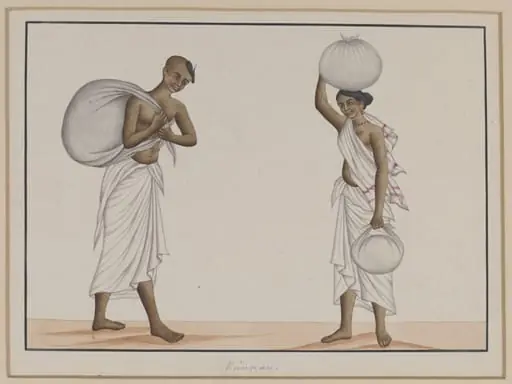
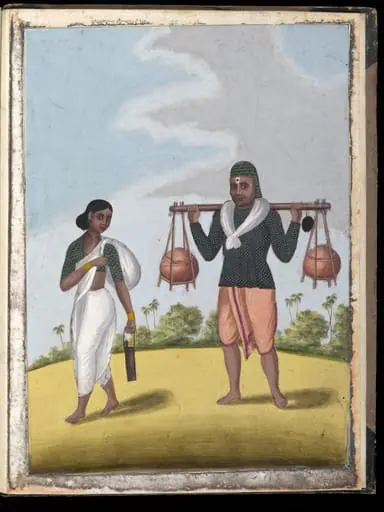
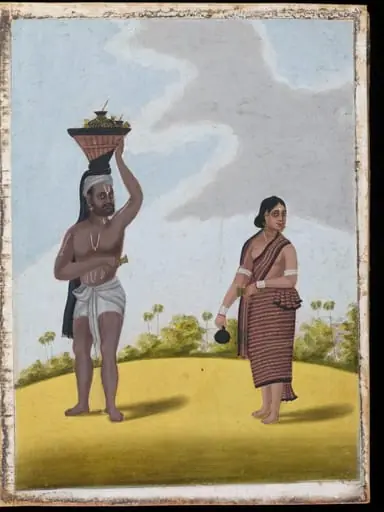
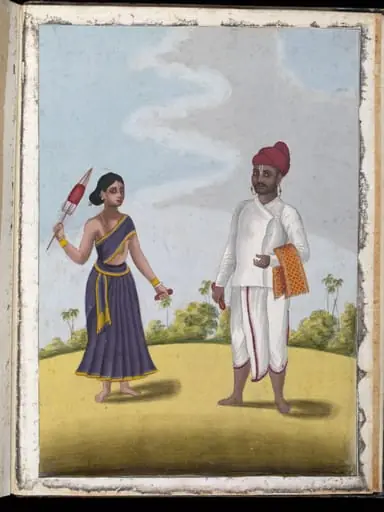
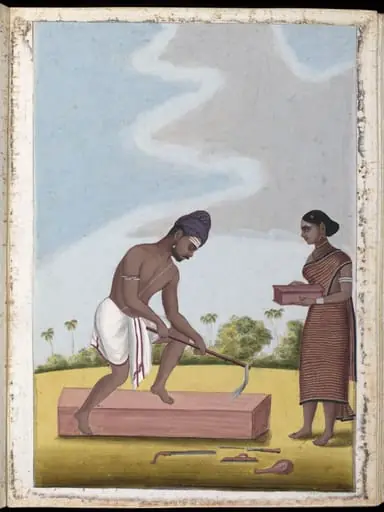
A washerman and his wife
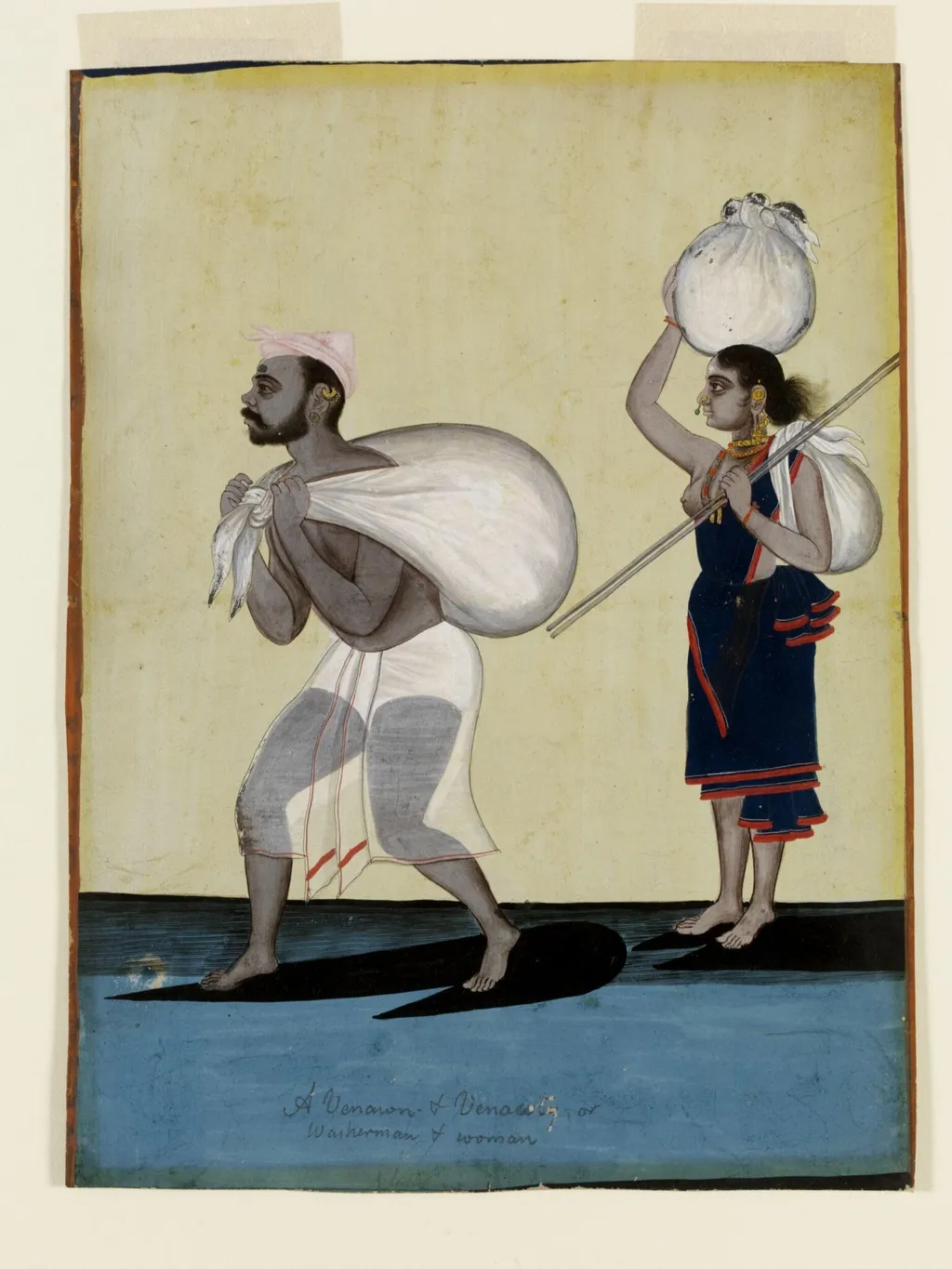
A washerman and his wife is a paint painting by the Romanticist artist Unknown. It dates from 1790 and is held in the collection of the Victoria and Albert Museum.
About this work
Overview
It portrays a washerman and his wife, engaged in the physical demands of their trade.
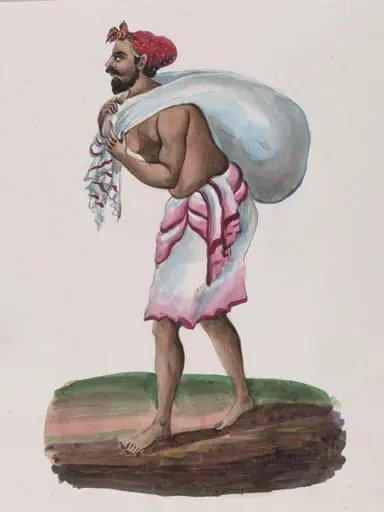
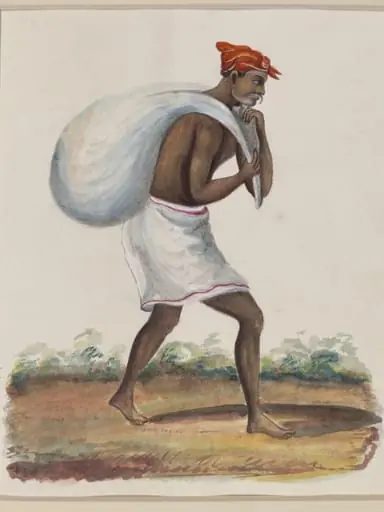
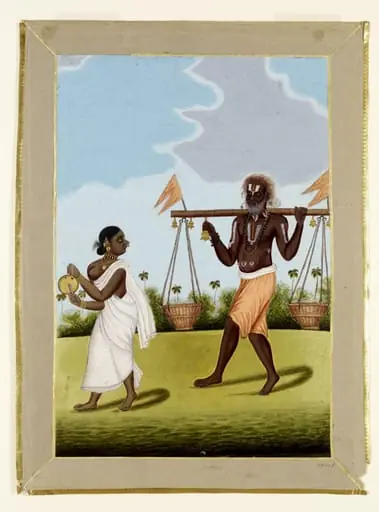
This painting is one of sixteen in a series documenting occupational roles in colonial India, each depicting a figure or pair against a flat, unadorned background. It portrays a washerman and his wife, engaged in the physical demands of their trade. The work was transferred to the Victoria and Albert Museum in 1879 from the India Museum and was cataloged in 1880 as part of a set of four framed illustrated groups donated by P. F. Campbell-Johnston.
Subject & Meaning
The figures represent laborers in the laundry trade, a common yet essential occupation in 19th-century India. The man carries a heavy bundle of soiled cloth, while the woman balances two bundles on her head and grips a long stick, likely used for support or as a tool. Their attire and posture emphasize endurance and routine, reflecting the dignity of manual work without romanticization or embellishment.
Technique & Style
Rendered in opaque watercolor on paper, the painting uses minimal background detail—a pale yellow field with a dark blue base—to isolate the figures and direct focus to their forms and garments. Lines are clear and economical; color is flat and localized, with no shading or perspective. The style prioritizes clarity and typological accuracy over atmospheric depth, aligning with documentary conventions of the period.
History & Provenance
The painting originated as part of a commissioned series illustrating Indian castes and trades, likely produced in the early 19th century. It was collected and preserved by British officials, later transferred to the India Museum in London. In 1879, it entered the Victoria and Albert Museum’s collection, cataloged under the donor name P. F. Campbell-Johnston, whose collection formed a significant part of the museum’s early South Asian holdings.
Context
This work belongs to a broader project of ethnographic documentation undertaken during British colonial rule, aiming to classify and record Indian society through visual means. Similar series were produced by local artists under European patronage, often for administrative or academic use. The plain backgrounds and standardized poses reflect a systematic approach, treating individuals as representatives of social roles rather than unique subjects.
Legacy
The painting survives as a quiet record of everyday labor in colonial India, offering insight into material culture and gendered division of work. Though not widely exhibited, it contributes to scholarly understanding of 19th-century Indian visual documentation. Its preservation in a major museum ensures continued access for researchers studying the intersection of art, anthropology, and colonial administration.
Artist & collection

 Domestic Scene
 Giacomo and Cardinal Marco, investing Andrea, Abbot of San Zeno, with his Benefice
 The Nymph of Fontainebleau
 Portrait of a Woman
 Madonna and Child with Saints in the Enclosed Garden
 Venus and Minerva
 Family Group of Four on Sofa
 Wall painting from Room H of the Villa of P. Fannius Synistor at Boscoreale