Artwork
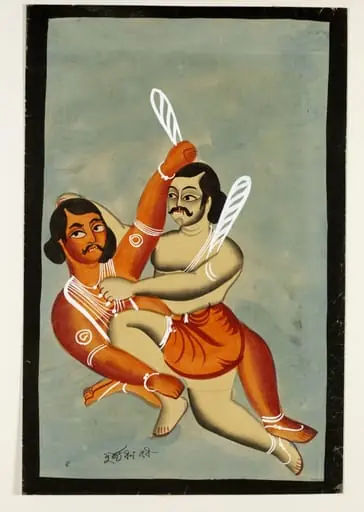
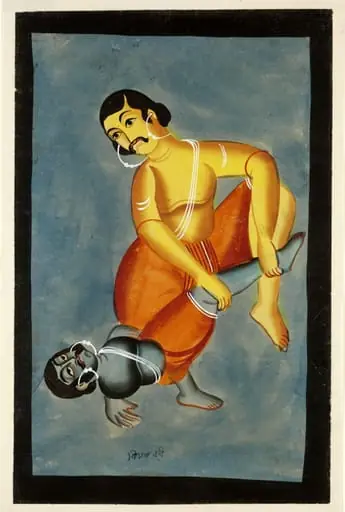
Bhima and Jarasandha
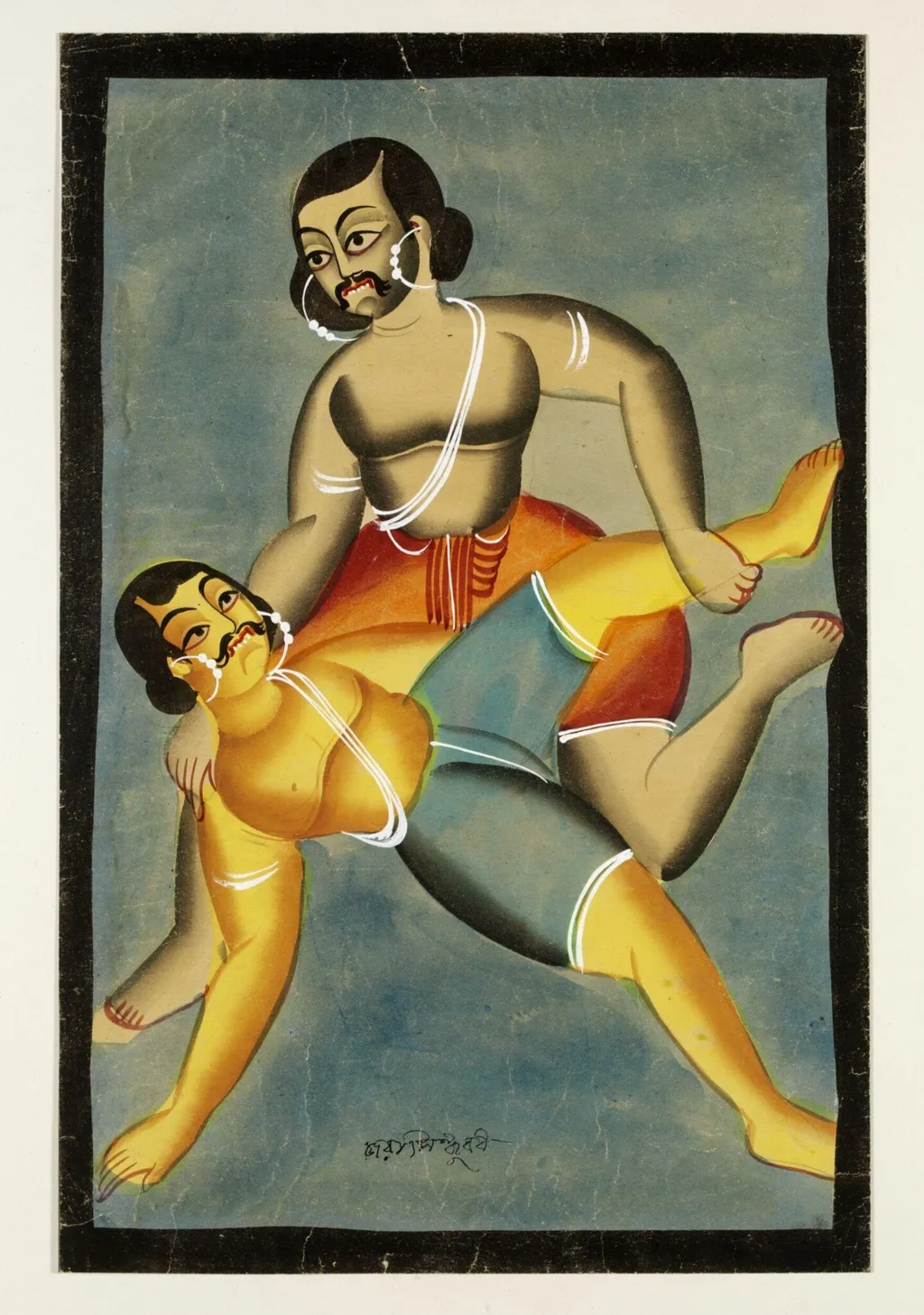
Bhima and Jarasandha is a paint painting by the Impressionist artist Unknown. It dates from 1885 and is held in the collection of the Victoria and Albert Museum.
About this work
The background is a flat blue-green color, and the figures have bold outlines with bright, flat colors—no shadows to soften their edges.
This painting shows two men in a wrestling pose. The larger man, with a mustache and curly hair, wears a red cloth around his waist and holds the smaller man’s arm. The smaller man, with a round face and bare chest, reaches up as if struggling. The background is a flat blue-green color, and the figures have bold outlines with bright, flat colors—no shadows to soften their edges.
The painting looks like it’s part of the *kalighat* style, a type of Indian folk art from the 19th century. The figures are strong and simple, with a focus on action over detail.
If you like this style, check out more works labeled *kalighat*.
Overview
This 1885 watercolor on paper portrays a dramatic encounter between two mythic warriors, Bhima and Jarasandha, captured in a moment of combat. Executed in an opaque technique, the composition relies on bold outlines and flat, vivid hues, set against an unmodulated blue‑green backdrop that emphasizes the figures' movement rather than atmospheric depth.
Subject & Meaning
The scene illustrates the legendary episode in which Bhima, one of the Pandava brothers, defeats the Magadhan king Jarasandha. The larger, mustachioed figure in a red waistcloth grips the smaller opponent, whose exposed chest and reaching arm convey struggle and resistance, highlighting the triumph of strength and heroic resolve.
Technique & Style
Rendered in the 19th‑century Kalighat tradition, the work employs opaque watercolour with crisp, black contours and saturated, flat colors. The lack of shading and the simplified anatomy reflect the folk‑art aesthetic of the period, where narrative clarity and dynamic pose take precedence over realistic detail.
History & Provenance
The artist remains unidentified, but the painting entered the museum’s holdings after being purchased from Miss M. Steele, who had inherited it from her mother’s collection. Its documented acquisition provides a traceable line of ownership from a private family collection to a public institution.
Context
Kalighat paintings emerged from the bustling Kolkata suburb of the same name, serving as popular visual storytelling media for a growing urban audience. This work exemplifies the genre’s focus on mythological and heroic subjects, rendered in a style accessible to a broad public.
Legacy
As an example of Kalighat’s narrative vigor, the piece contributes to the broader appreciation of Indian folk visual culture in the late 19th century, illustrating how traditional stories were adapted for contemporary artistic expression.
Artist & collection

 Domestic Scene
 Giacomo and Cardinal Marco, investing Andrea, Abbot of San Zeno, with his Benefice
 The Nymph of Fontainebleau
 Portrait of a Woman
 Madonna and Child with Saints in the Enclosed Garden
 Venus and Minerva
 Family Group of Four on Sofa
 Wall painting from Room H of the Villa of P. Fannius Synistor at Boscoreale