Artwork
Bhairavi Ragini
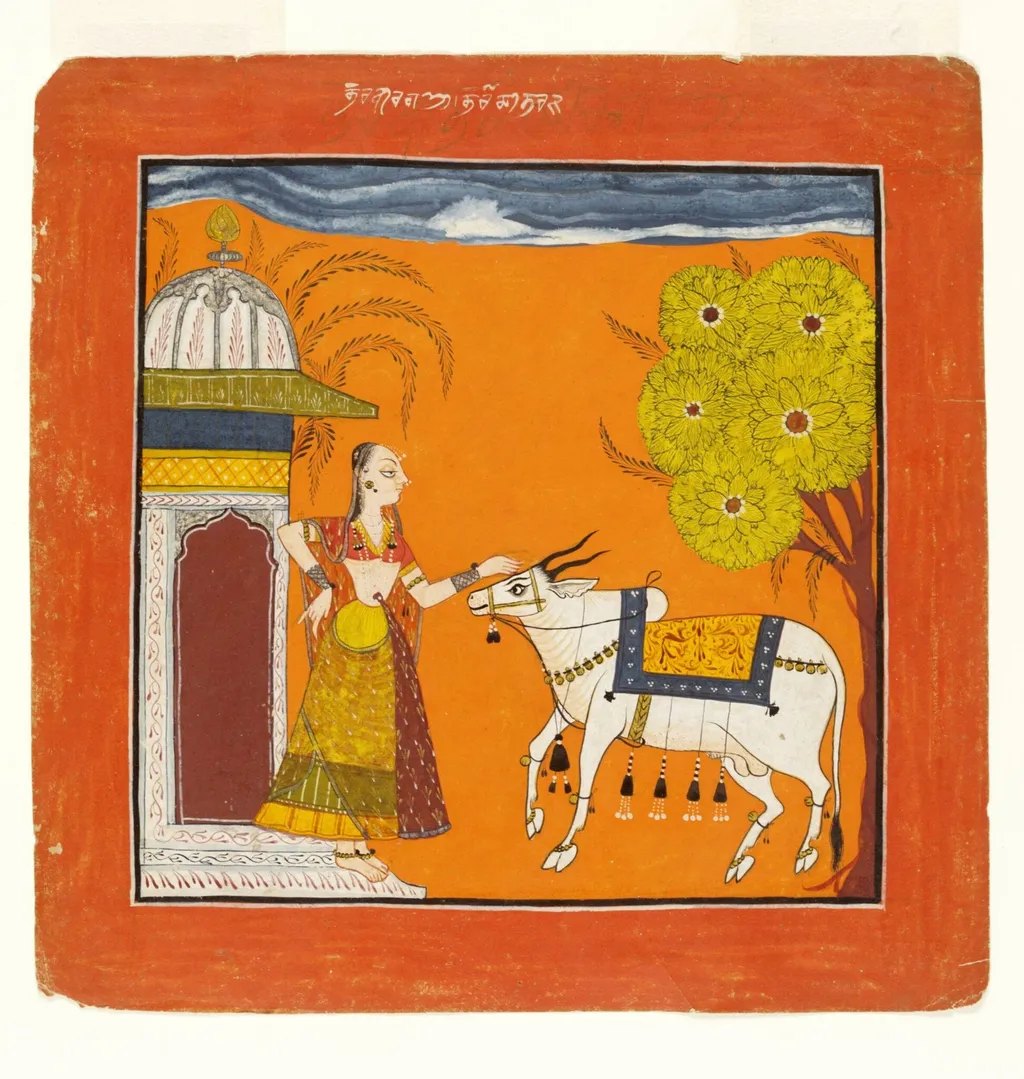
Bhairavi Ragini is a paint painting by the Baroque artist Unknown. It dates from 1700 and is held in the collection of the Victoria and Albert Museum.
About this work
Overview
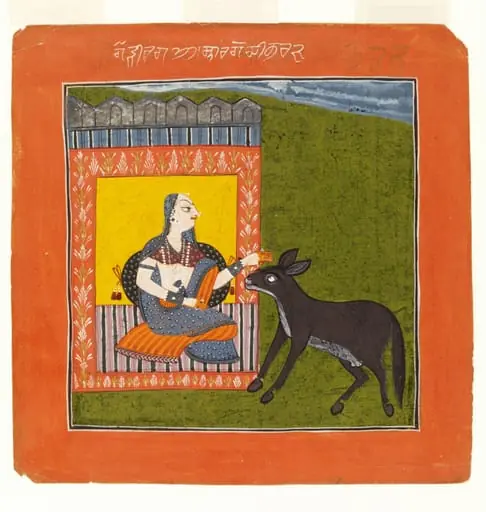
Executed in opaque watercolor on paper, it presents a solitary female figure at the threshold of a sacred space, accompanied by a bull.
This painting is one of a series illustrating the Bhairavi ragini, a melodic mode from the Indian ragamala tradition. Executed in opaque watercolor on paper, it presents a solitary female figure at the threshold of a sacred space, accompanied by a bull. The composition is restrained, with soft contours and a limited palette dominated by red, light blue, and earth tones, reflecting the aesthetic conventions of late Mughal or Rajput miniature painting.
Subject & Meaning
The woman, dressed in red, holds a vina, symbolizing her connection to music and devotion. Her presence at a shrine entrance, alongside a bull—often associated with Shiva—suggests a fusion of spiritual and artistic realms. Bhairavi ragini is traditionally linked to dawn and introspection; the figure’s quiet posture and the serene setting evoke a meditative mood, aligning visual form with the emotional character of the musical mode.
Technique & Style
The artist employed fine brushwork and layered opaque watercolor to achieve subtle gradations of color without harsh outlines. The flat, pale blue sky and stylized tree with dark green leaves reflect a decorative approach common in regional Indian miniatures. Details are rendered with precision yet softened by delicate lines, avoiding dramatic contrast in favor of harmonious, intimate scale and tonal balance.
History & Provenance
The painting entered the Victoria and Albert Museum’s collection in 1953 as part of a group acquired from the estate of Michael Rothenstein for £300. It was likely produced in a North Indian atelier during the 17th or 18th century, possibly in Rajasthan or the Punjab Hills. Its inclusion in a documented collection underscores its role in early Western efforts to preserve and classify Indian visual music traditions.
Context
This work belongs to the ragamala genre, a visual system mapping musical modes to poetic and emotional states. Such paintings were commissioned by royal patrons for private contemplation, often paired with devotional poetry. The integration of music, iconography, and landscape reflects a broader Indian aesthetic where sound, image, and spirituality were understood as interconnected expressions of cosmic order.
Legacy
As part of a larger corpus of ragamala paintings, this piece contributes to the historical record of how Indian musical theory was translated into visual form. Though not widely exhibited, it remains a reference in scholarly studies of South Asian miniature painting and the cultural interplay between sound and image. Its preservation supports ongoing research into pre-colonial artistic systems beyond Western frameworks.
Artist & collection

 Domestic Scene
 Giacomo and Cardinal Marco, investing Andrea, Abbot of San Zeno, with his Benefice
 The Nymph of Fontainebleau
 Portrait of a Woman
 Madonna and Child with Saints in the Enclosed Garden
 Venus and Minerva
 Family Group of Four on Sofa
 Wall painting from Room H of the Villa of P. Fannius Synistor at Boscoreale