Artwork
Bildnis der Barbara Schedel
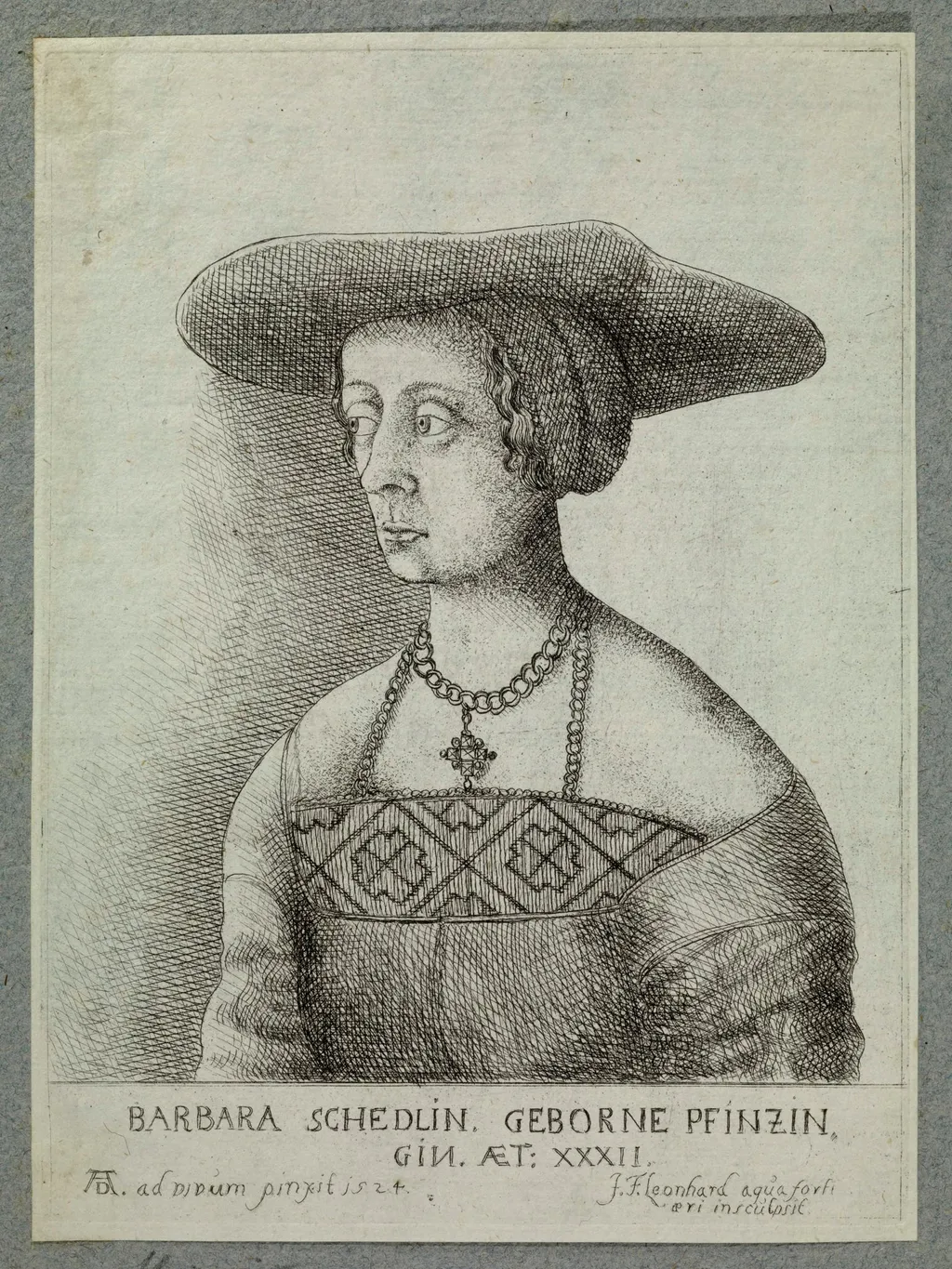
Bildnis der Barbara Schedel is a drawing by Unknown. It dates from 1656 and is held in the collection of the Bamberg State Library.
About this work
To learn more about this style of drawing, look at the technique of cross-hatching.
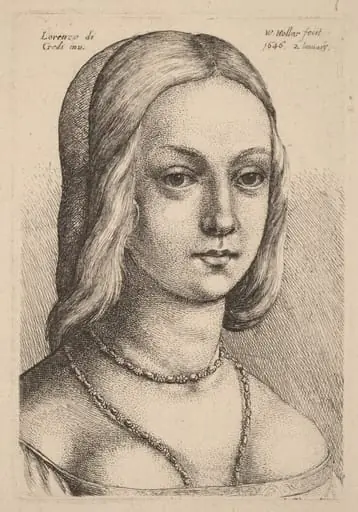
You see a drawing of a young woman with a hat, looking away into the distance.
She's in a three-quarter profile, with an inscription below her.
The artist erased a portrait of Barbara Schedel, which is interesting because it was based on a 1524 painting with the Dürer monogram, and this detail still puzzles researchers today.
To learn more about this style of drawing, look at the technique of cross-hatching.
Overview
Bildnis der Barbara Schedel is an etching based on a 1524 painting attributed to Albrecht Dürer, featuring a young woman in a three-quarter profile, identified by an inscription as Barbara Schedel (1492-1528). The work's authorship is complex due to the erasure of the original portrait and the incorporation of references to both the template and the actual artist.
Subject & Meaning
The subject, Barbara Schedel, is depicted in contemplative solitude, her gaze distant, suggesting a state of introspection or nostalgia. The inclusion of her name in the inscription emphasizes the portrait's identity and purpose.
Technique & Style
The etching employs techniques such as cross-hatching to achieve depth and texture, characteristic of the period's printmaking. The work's style reflects a blend of fidelity to the original Dürer-esque template and the interpreting artist's hand.
History & Provenance
Originally based on a 1524 Dürer-monogrammed painting, the etching's creation involved erasing the original portrait. Documented in historical publications, notably by Heller in 1827 (Dürer, II.914,2515) and earlier by Panzer (1790, p. 211), its provenance highlights scholarly interest in its Dürer connection.
Context
Created within a tradition of reproducing and interpreting famous artworks, Bildnis der Barbara Schedel reflects 19th-century scholarly and artistic practices of engaging with Renaissance masters like Dürer.
Legacy
The etching contributes to the broader legacy of Dürer's influence on subsequent artistic generations, while its peculiar history makes it a subject of ongoing research into attribution and the evolution of artistic techniques.
Artist & collection

 Domestic Scene
 Giacomo and Cardinal Marco, investing Andrea, Abbot of San Zeno, with his Benefice
 The Nymph of Fontainebleau
 Portrait of a Woman
 Madonna and Child with Saints in the Enclosed Garden
 Venus and Minerva
 Family Group of Four on Sofa
 Wall painting from Room H of the Villa of P. Fannius Synistor at Boscoreale