Artwork
Cairo: Palace of the Cadi
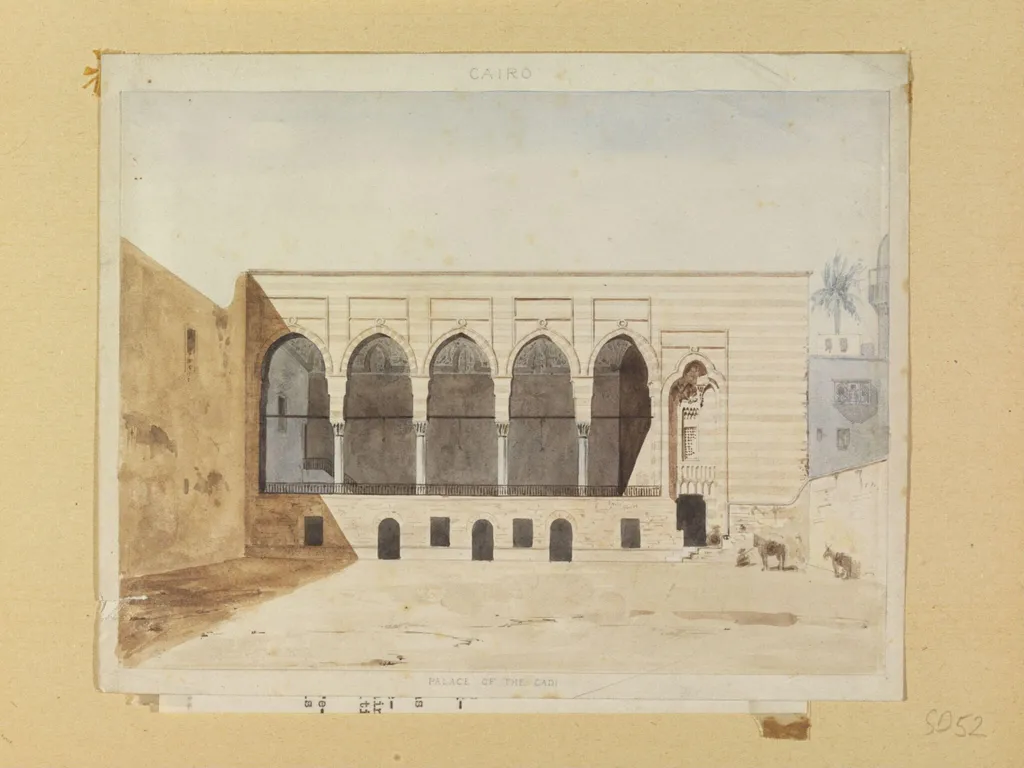
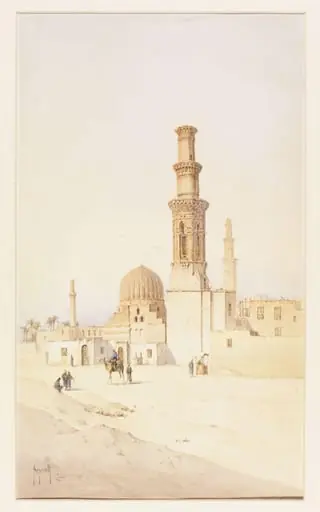
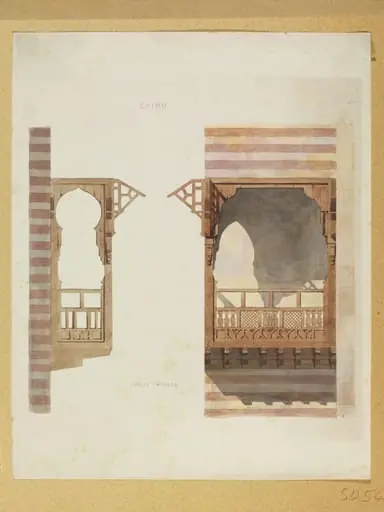
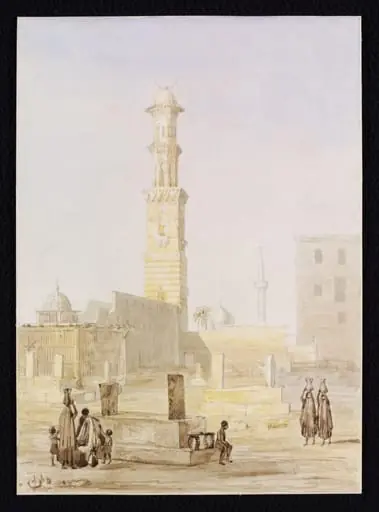
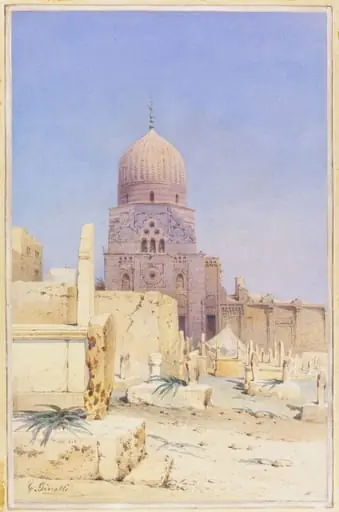
Cairo: Palace of the Cadi is a watercolor work on paper by the Orientalist artist Unknown. It dates from 1840 and is held in the collection of the Victoria and Albert Museum. Created in 1840, this watercolour depicts a courtyard structure in Cairo, attributed to an unidentified artist.
About this work
Overview
Its medium and composition reflect a period of European artistic engagement with Egyptian urban forms during the early 19th century.
Created in 1840, this watercolour depicts a courtyard structure in Cairo, attributed to an unidentified artist. It belongs to a series of architectural studies distinct in style from those by Arundale. The work was acquired by the collection between 1961 and 1966 from W. Spencer, as documented by Rodney Searight. Its medium and composition reflect a period of European artistic engagement with Egyptian urban forms during the early 19th century.
Subject & Meaning
The scene centers on a domestic Islamic building with arched colonnades and an elevated balcony, framed by palm trees and small animals in the courtyard. The composition emphasizes spatial depth and quiet domesticity, suggesting an interest in everyday architectural life rather than monumental grandeur. The inclusion of natural elements and subtle movement implies a contemplative observation of Cairo’s residential spaces during the 1830s.
Technique & Style
Executed in watercolour, the piece employs soft washes and layered tones to suggest light, shadow, and atmospheric depth. The brushwork is delicate, avoiding sharp definition in favor of a muted, lyrical quality. This approach aligns with Romantic-era tendencies to evoke mood over precision, though it lacks overt dramatization, favoring instead a restrained, observational realism.
History & Provenance
The drawing entered the collection between 1961 and 1966 through acquisition from W. Spencer, according to Rodney Searight’s records. Its origins prior to this are undocumented, though stylistic analysis places it within a group of 1830s–1840s watercolours of Cairo. No record of the artist’s identity survives, and the work was likely produced for private or scholarly circulation rather than public exhibition.
Context
During the 1830s, European travelers and artists increasingly documented Egyptian architecture following Napoleon’s campaign and the rise of Orientalist interest. This work contributes to a quieter, less exoticized strand of that trend—focusing on domestic structures rather than mosques or ruins. Its emphasis on courtyards and daily life reflects a growing curiosity in vernacular forms beyond official monuments.
Legacy
Though not widely exhibited, the drawing remains a valuable record of Cairo’s architectural character in the early 19th century. Its stylistic distinction from contemporaneous works by Arundale highlights the diversity of approaches among artists documenting the region. As part of a modest but coherent group, it offers insight into how non-professional observers interpreted Islamic domestic spaces during a period of heightened cross-cultural exchange.
Artist & collection

 Domestic Scene
 Giacomo and Cardinal Marco, investing Andrea, Abbot of San Zeno, with his Benefice
 The Nymph of Fontainebleau
 Portrait of a Woman
 Madonna and Child with Saints in the Enclosed Garden
 Venus and Minerva
 Family Group of Four on Sofa
 Wall painting from Room H of the Villa of P. Fannius Synistor at Boscoreale