Artwork
Christus und die Jünger im Seesturm
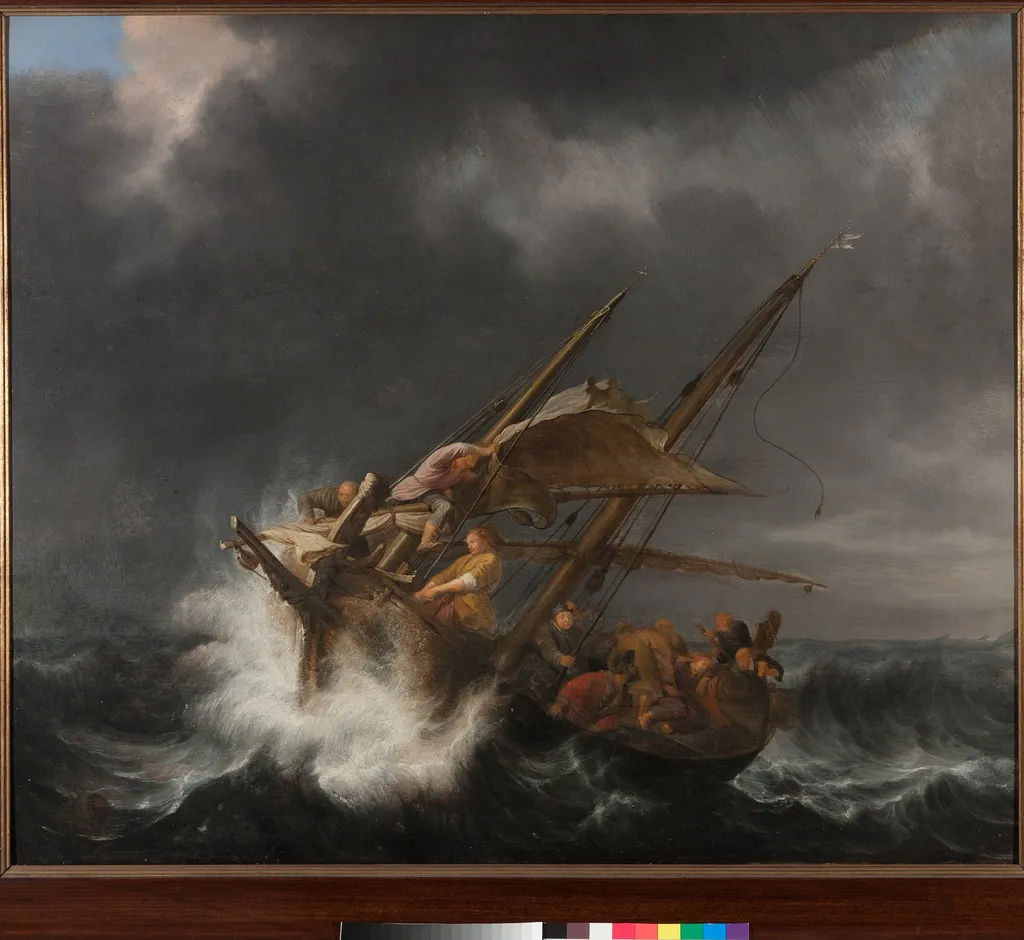
Christus und die Jünger im Seesturm is a drawing by Unknown. It dates from 1650 and is held in the collection of the Art Collection of the University Göttingen. This ink drawing depicts a moment from the New Testament when Jesus and his disciples are caught in a violent storm on the Sea of Galilee.
About this work
Overview
The boat is nearly overwhelmed by towering waves, while figures inside react with varied intensity, their postures suggesting fear, prayer, or determination.
This ink drawing depicts a moment from the New Testament when Jesus and his disciples are caught in a violent storm on the Sea of Galilee. Rendered with energetic, unrefined strokes, the composition conveys the turbulence of nature and the urgency of the scene. The boat is nearly overwhelmed by towering waves, while figures inside react with varied intensity, their postures suggesting fear, prayer, or determination.
Subject & Meaning
The scene illustrates the biblical episode in which Jesus calms the storm, though he is not visibly performing the miracle here. Instead, the focus is on human vulnerability amid chaos. One figure, possibly Christ, points toward the horizon—an indication of impending calm or divine presence. The disciples’ gestures reflect human responses to crisis: some pray, others brace against the elements, emphasizing faith under duress.
Technique & Style
The artist employs rapid, angular lines and dense cross-hatching to simulate the motion of wind and water. Texture is built through layered strokes rather than smooth shading, giving the sea and sky a raw, agitated quality. The figures are simplified but expressive, their forms defined by minimal contours that prioritize emotional tension over anatomical precision.
History & Provenance
The drawing’s origin is undocumented, but its style aligns with early modern European devotional sketches, likely made as a study or preparatory work. No known collector or institution is recorded as its early owner. Its survival suggests it was valued for its emotional immediacy rather than its finish, possibly used in private meditation or teaching.
Context
Created during a period when religious narratives were frequently rendered in intimate formats, this work reflects a trend toward personal, emotionally charged depictions of scripture. Unlike grand altarpieces, such drawings were meant for quiet contemplation, allowing viewers to project themselves into the disciples’ plight. The emphasis on human reaction over divine spectacle marks a shift in devotional practice.
Legacy
Though unsigned and unattributed, the drawing exemplifies how artists used minimal means to evoke profound spiritual tension. Its raw technique influenced later generations who favored expressive line over polished finish in religious imagery. It remains a quiet testament to the power of understated draftsmanship in conveying human vulnerability before the sublime.
Artist & collection
Museum
Art Collection of the University Göttingen
Continue through works from the same source collection.
 Domestic Scene
 Giacomo and Cardinal Marco, investing Andrea, Abbot of San Zeno, with his Benefice
 The Nymph of Fontainebleau
 Portrait of a Woman
 Madonna and Child with Saints in the Enclosed Garden
 Venus and Minerva
 Family Group of Four on Sofa
 Wall painting from Room H of the Villa of P. Fannius Synistor at Boscoreale