Artwork
Constantinople
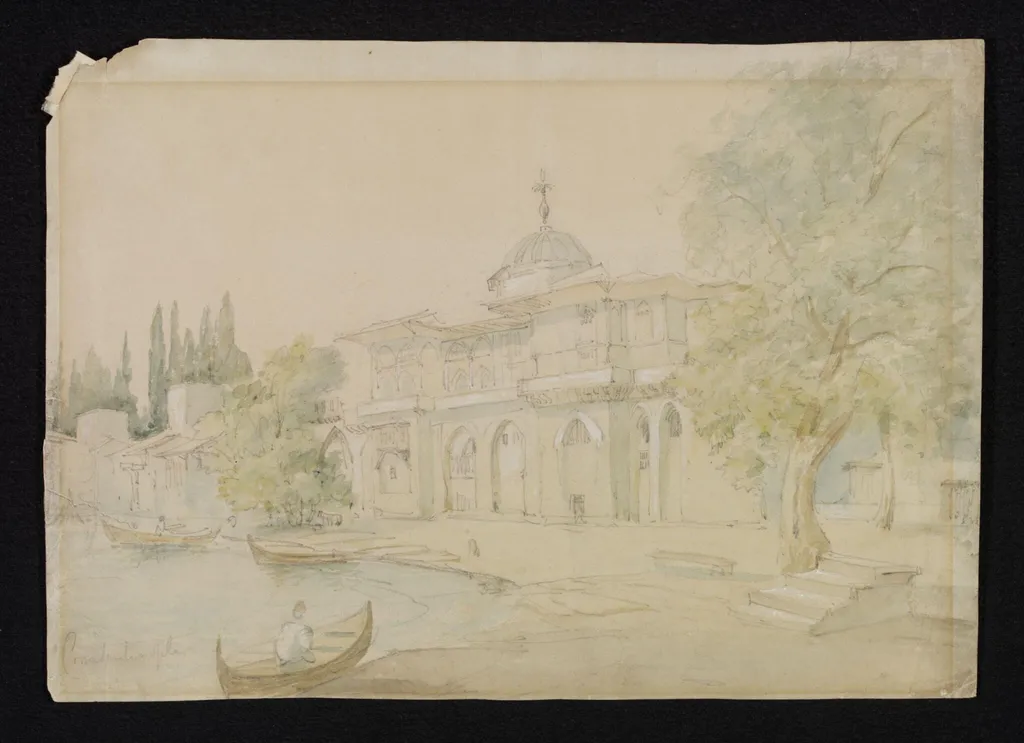
Constantinople is a watercolor work on paper by the Romanticist artist Unknown. It dates from 1840 and is held in the collection of the Victoria and Albert Museum.
About this work
Overview
Executed in delicate washes, the work captures a moment of quiet urban life rather than a grand architectural statement.
Created in 1840, this watercolour depicts a tranquil waterfront view of Constantinople. Executed in delicate washes, the work captures a moment of quiet urban life rather than a grand architectural statement. Its unpolished, observational quality suggests it was made as a field study, likely during a journey. The piece entered a public collection in 1971 after being acquired from a private dealer for £15.
Subject & Meaning
The scene centers on a monumental structure with arches and a dome, possibly a mosque or imperial building, flanked by modest boats and a solitary figure. Figures are sparse, their presence emphasizing stillness over activity. The composition avoids narrative drama, instead inviting contemplation of the city’s layered architecture and daily rhythms. The lone rower and distant trees reinforce a sense of solitude within an ancient urban landscape.
Technique & Style
The artist employed loose, transparent watercolour washes to suggest form and atmosphere. Light areas remain unpainted, allowing the paper to define highlights, while subtle tonal shifts indicate shadow and depth. Brushwork is restrained, with no sharp outlines or detailed rendering. The effect is atmospheric and immediate, characteristic of on-site sketching rather than studio refinement, prioritizing light over precision.
History & Provenance
The work was long attributed to Sir George Scharf, though this is now uncertain. It was acquired in May 1971 from James Mackinnon for £15, as recorded by Rodney Searight. Its prior ownership and exact origin remain undocumented. The piece entered institutional care shortly after purchase, where it has been preserved as an example of 19th-century topographical watercolour, regardless of authorship.
Context
In the 1840s, European artists and travelers frequently visited Constantinople, documenting its architecture amid political change. Watercolour was a preferred medium for quick, portable studies, often used for personal records or later reference. This work reflects a broader trend of visual documentation by amateurs and professionals alike, capturing the city’s blend of Byzantine and Ottoman forms before modernization intensified.
Legacy
Though unsigned and unattributed with certainty, the watercolour endures as a quiet testament to 19th-century visual travel. Its modest scale and unassuming technique contrast with grander imperial representations of the era. It contributes to a quieter archive of responses to Constantinople — not as spectacle, but as lived space — preserved in institutions like the Victoria and Albert Museum among similar studies.
Artist & collection

 Domestic Scene
 Giacomo and Cardinal Marco, investing Andrea, Abbot of San Zeno, with his Benefice
 The Nymph of Fontainebleau
 Portrait of a Woman
 Madonna and Child with Saints in the Enclosed Garden
 Venus and Minerva
 Family Group of Four on Sofa
 Wall painting from Room H of the Villa of P. Fannius Synistor at Boscoreale
 Pera
Pera Macau with the church of S. Lourenço
 Türbes in the Royal Cemetery of the Muradiye (Murad II), Bursa
 The Jesuits' Church, or Santa Maria del Rosario, Venice
 Spalato
 Smyrne
 The 'Dutch folly fort', Canton (Guangzhou)
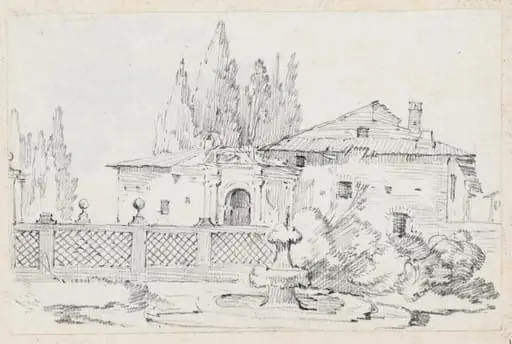 House and Trees across a Garden Wall
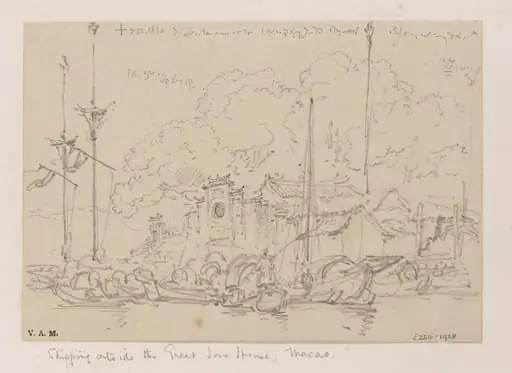 The A-Ma Temple, Macau
![Looking towards Leanders Tower and the Sultans New Palace [Dolmabahçe] From Scutari, by Michael Anthony Shrapnel Biddulph](https://artifactworldgallery.com/img/michael-anthony-shrapnel-biddulph--looking-towards-leanders-tower-and-the-sultans-new-palace-do--77513ba4e146ed32-w320.webp) Looking towards Leanders Tower and the Sultans New Palace [Dolmabahçe] From Scutari
Looking towards Leanders Tower and the Sultans New Palace [Dolmabahçe] From Scutari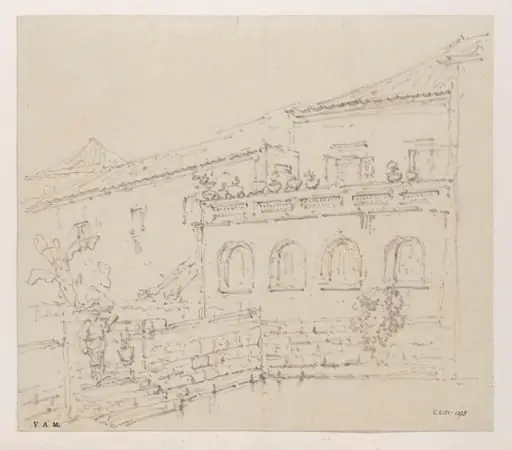 Adjacent houses, Macau
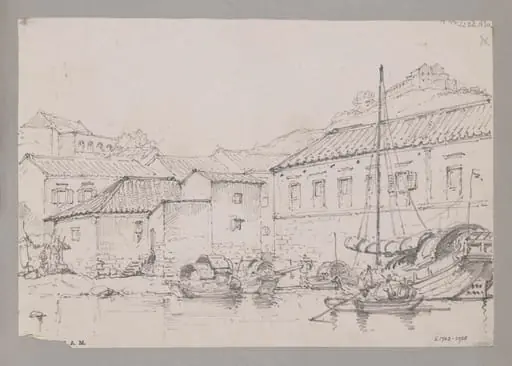 Waterside houses below Penha Hill, Macau