Artwork
Departure from Kashima
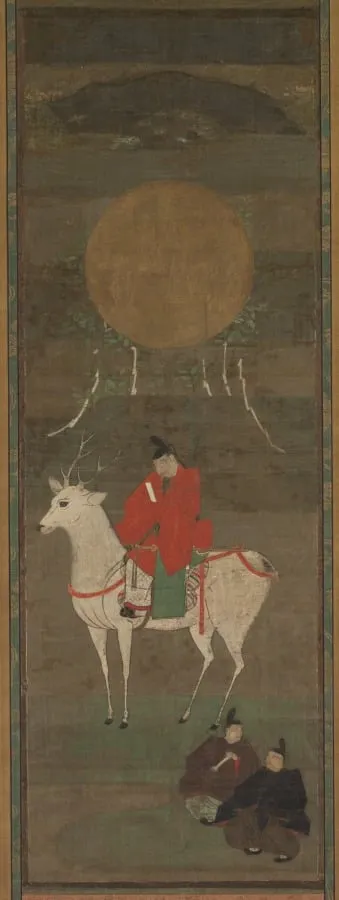
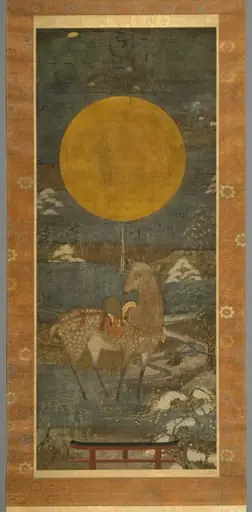
Departure from Kashima is an unspecified painting by Unknown. It dates from 1364 and is held in the collection of the Cleveland Museum of Art.
About this work
The wisteria hints at the powerful Fujiwara family who ruled Japan at the time.
You see a god riding a white deer through a dark forest. Five other gods float inside a golden circle held by tree branches. White paper strips and purple wisteria flowers trail behind them.
This painting shows a real moment from a 700-year-old story. The god Takemikazuchi leaves his shrine in Kashima to move to Nara. The golden circle and paper strips are signs of purity used in Shinto rituals. The wisteria hints at the powerful Fujiwara family who ruled Japan at the time.
Look up more art from the subject: japan, nanbokuchō period (1336–92).
Overview
Departure from Kashima is a painting depicting a pivotal moment in a 700-year-old narrative: the relocation of the kami Takemikazuchi from Kashima to Mount Mikasa in Nara. The scene unfolds with Takemikazuchi riding a white deer through a dark forest, accompanied by symbolic elements and figures.
Subject & Meaning
The painting illustrates Takemikazuchi's departure, marking his transition to residency at Mount Mikasa. The golden circle, suspended from a sakaki tree's branches, contains the five Kasuga kami. This arrangement, along with white paper streamers (indicating purity and the sacredness of the five shrine halls) and blossoming wisteria vines (symbolizing the Fujiwara family), conveys themes of sacred transition and patronage.
Technique & Style
Executed during the Nanbokuchō period (1336–92), the painting reflects the artistic sensibilities of its time. The contrast between the dark forest and the luminous golden circle, combined with the meticulous depiction of natural elements (such as wisteria vines and paper streamers), suggests a blend of traditional Japanese motifs with the period's characteristic attention to detail and composition.
History & Provenance
While specific details on the painting's history and provenance are not provided, its depiction of a well-documented mythological event and its creation during the Nanbokuchō period situate it within a broader cultural and artistic movement in 14th-century Japan. The inclusion of Nakatomi no Tokifū and his brother Hidetsura, who follow Takemikazuchi to become priests of Kasuga Taisha, highlights the painting's narrative depth and its connection to the religious practices of the time.
Context
Created during the Nanbokuchō period, a time of political division and religious flourishing, the painting may reflect the era's emphasis on Shinto traditions and the influence of powerful families like the Fujiwara. The wisteria, a symbol of this family, underscores their patronage and significance in religious and artistic endeavors.
Legacy
As a visual representation of a revered mythological event, 'Departure from Kashima' contributes to the enduring narrative of Takemikazuchi's relocation. Its style and themes place it within the broader canon of Nanbokuchō period art, offering insights into the intersection of religious, familial, and artistic practices in 14th-century Japan.
Artist & collection

 Domestic Scene
 Giacomo and Cardinal Marco, investing Andrea, Abbot of San Zeno, with his Benefice
 The Nymph of Fontainebleau
 Portrait of a Woman
 Madonna and Child with Saints in the Enclosed Garden
 Venus and Minerva
 Family Group of Four on Sofa
 Wall painting from Room H of the Villa of P. Fannius Synistor at Boscoreale