Artwork
Der Maler im Dachstübchen
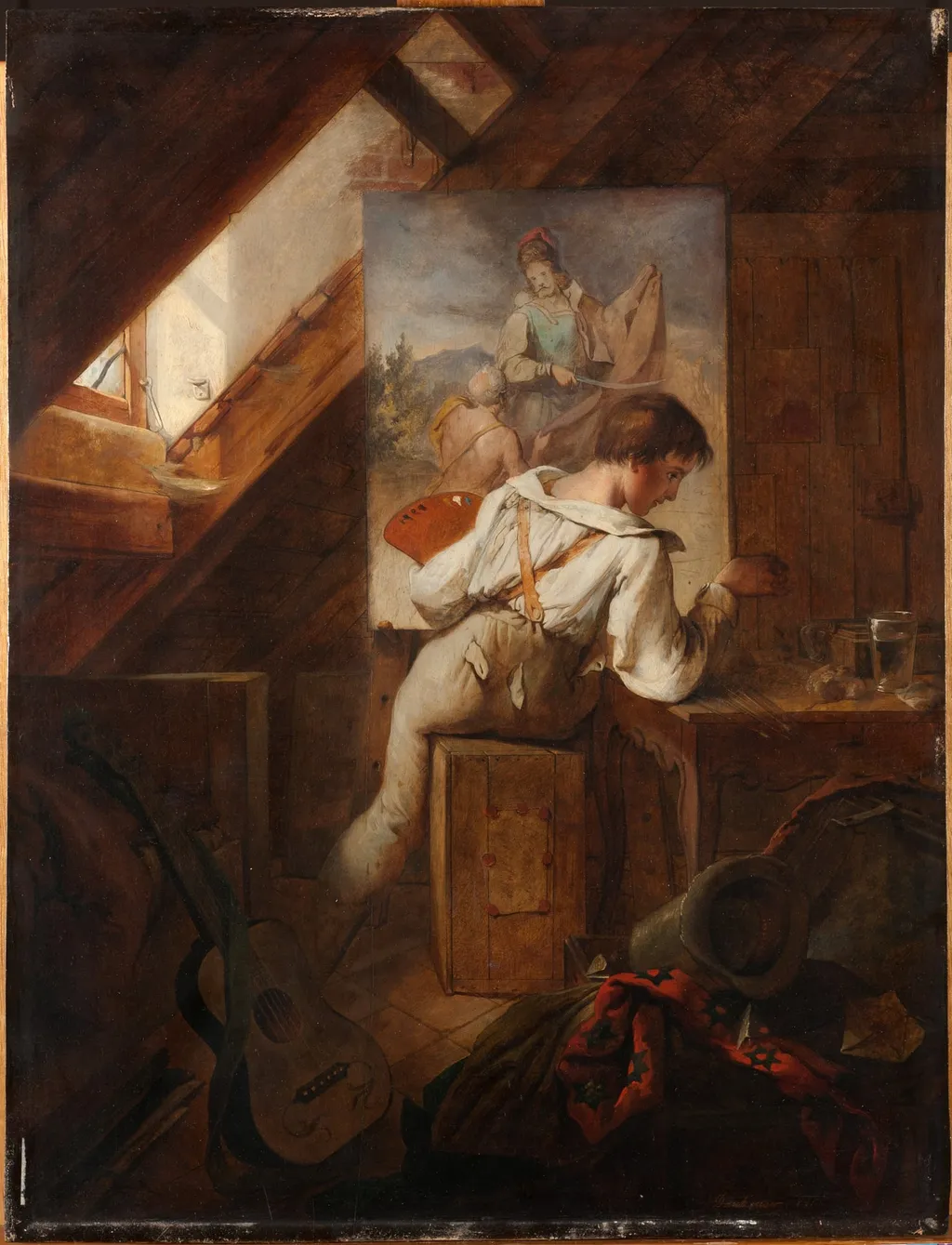
Der Maler im Dachstübchen is a drawing by Unknown. It dates from 1850 and is held in the collection of the Art Collection of the University Göttingen. The painting portrays a young artist in a modest attic studio, absorbed in his work.
About this work
Overview
A large canvas on an easel behind him shows a pastoral scene, suggesting he is copying or studying another work while creating his own.
The painting portrays a young artist in a modest attic studio, absorbed in his work. He sits on a wooden chest, dressed in simple linen attire, with a leather strap across his shoulders—possibly holding sketching tools. The room is filled with everyday objects: a guitar, a draped red cloth, a glass of water. A large canvas on an easel behind him shows a pastoral scene, suggesting he is copying or studying another work while creating his own.
Subject & Meaning
The figure represents the solitary artist at work, emphasizing quiet concentration over dramatic gesture. His focus on the small drawing in his hands, while surrounded by larger, unfinished pieces, hints at the iterative nature of artistic practice. The presence of personal items like the guitar and the red cloth suggests a lived-in space, reinforcing the idea of art as an intimate, daily ritual rather than a grand public endeavor.
Technique & Style
The artist employs careful tonal modeling and subtle shading to define form and texture, particularly in the folds of fabric and the grain of wood. The use of cross-hatching in the sketch visible on the artist’s lap suggests a deliberate study of line and volume. Light falls gently from an unseen window, casting soft shadows that enhance the spatial depth and quiet intimacy of the scene.
History & Provenance
The painting was created in the early 19th century by a German artist associated with the Biedermeier tradition. It remained in private collections in southern Germany until the mid-20th century, when it entered a regional museum’s holdings. Its attribution and date are supported by stylistic comparisons with the artist’s known sketches and studio studies from the same period.
Context
This work reflects the Biedermeier era’s emphasis on domestic tranquility and the dignity of private labor. In a time when artistic training often involved copying masterworks, the depiction of an artist studying a landscape while creating his own drawing captures a common studio practice. The cluttered room and humble furnishings align with middle-class ideals of modest, earnest creativity.
Legacy
The painting contributes to a broader 19th-century visual discourse on the artist’s studio as a site of quiet discipline. It avoids romanticized notions of genius, instead presenting art-making as a grounded, repetitive act. Its preservation offers insight into the material conditions and daily rhythms of artists outside major urban centers during the early industrial age.
Artist & collection
Museum
Art Collection of the University Göttingen
Continue through works from the same source collection.
 Domestic Scene
 Giacomo and Cardinal Marco, investing Andrea, Abbot of San Zeno, with his Benefice
 The Nymph of Fontainebleau
 Portrait of a Woman
 Madonna and Child with Saints in the Enclosed Garden
 Venus and Minerva
 Family Group of Four on Sofa
 Wall painting from Room H of the Villa of P. Fannius Synistor at Boscoreale
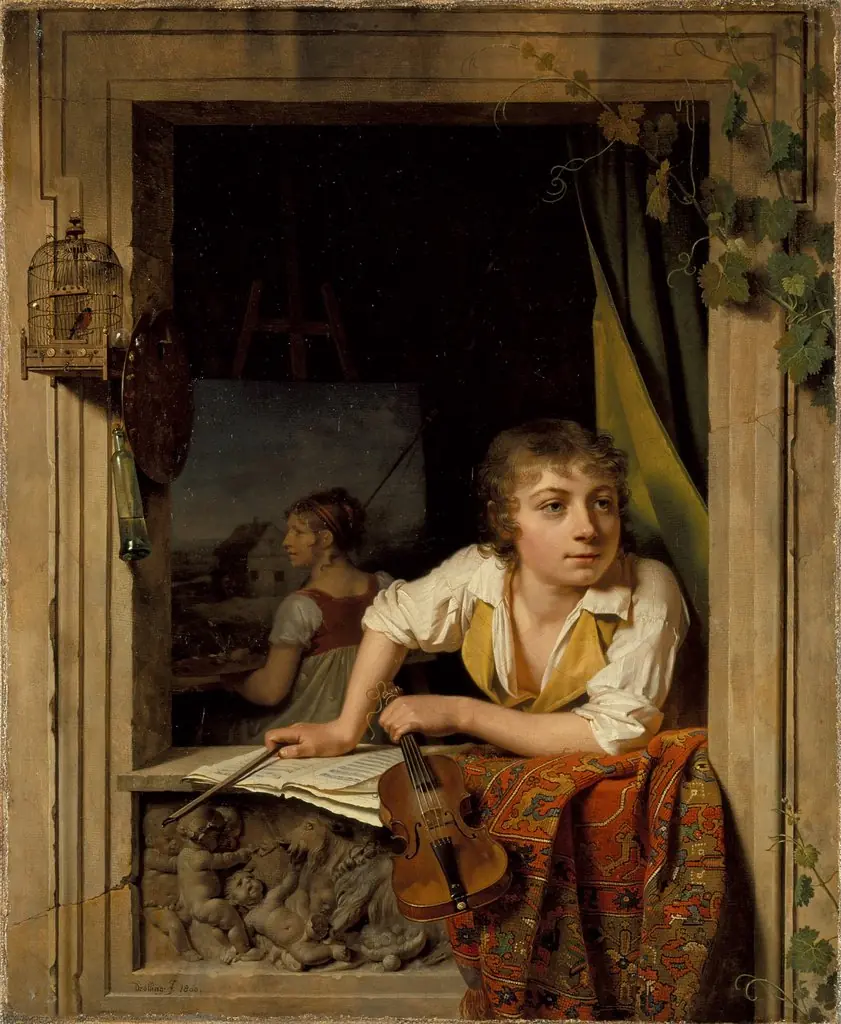 Painting and Music (Portrait of the Artist's Son)
 Schildersatelier
 Glass of wine
 Anthony van Dyck wooing his Model
 Un estudiante de Salamanca siglo XVIII
 Young Artist in a Studio
 Anthony van Dyck in Love with his Model
 Drinking Song
 Wirtshausszene
 Workshop of a Painter
 Standing Young Man at the Window in his Study Reading, known as"The Student"
 Return of the "Lisowczycy"