Artwork
Elokeshi and the Mahant
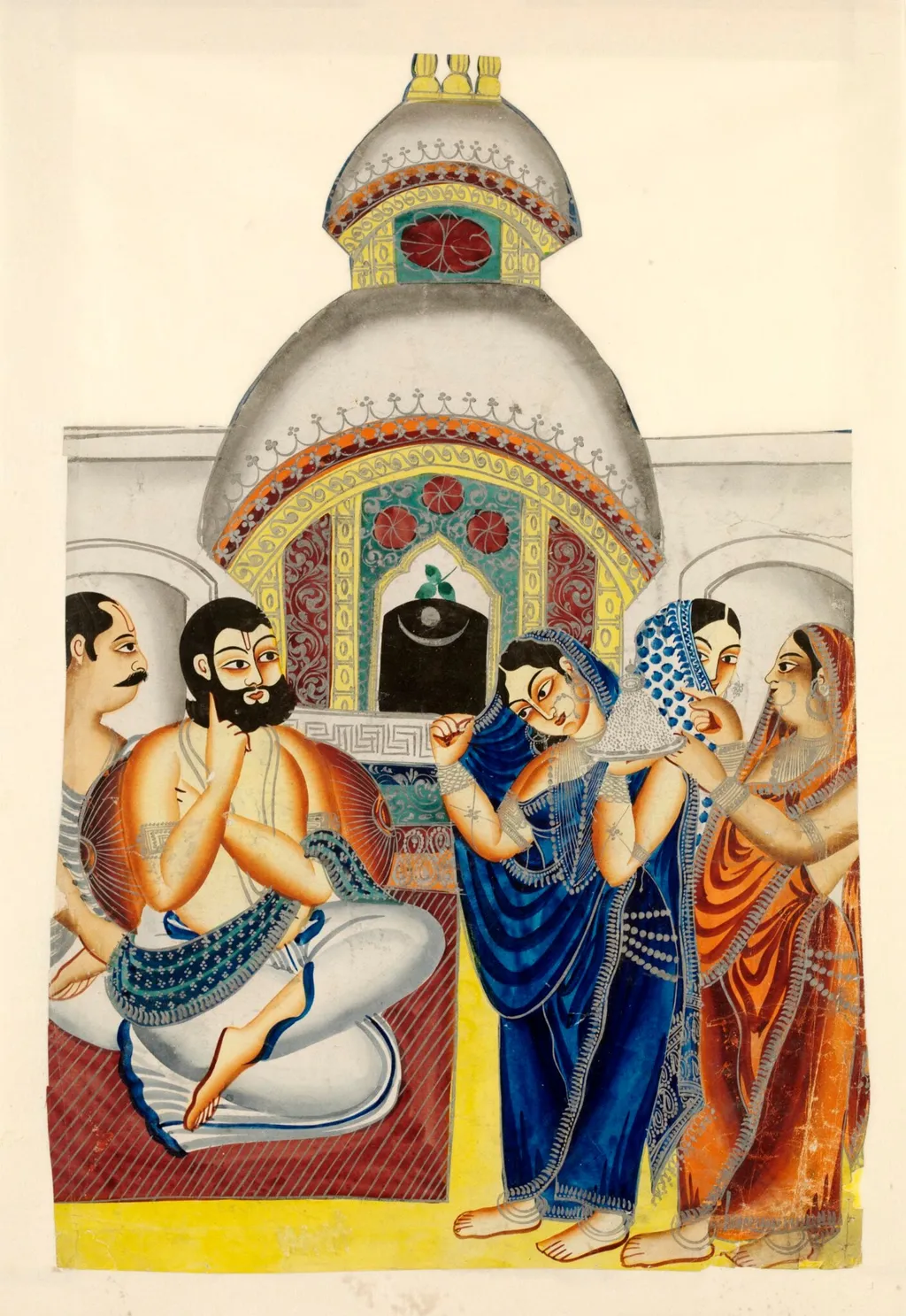
Elokeshi and the Mahant is a paint painting by the Impressionist artist Unknown. It dates from 1875 and is held in the collection of the Victoria and Albert Museum. This opaque watercolor on paper, part of a larger album compiled by J.
About this work
Overview
The work was likely produced for public consumption, reflecting contemporary public interest in the affair and its moral implications.
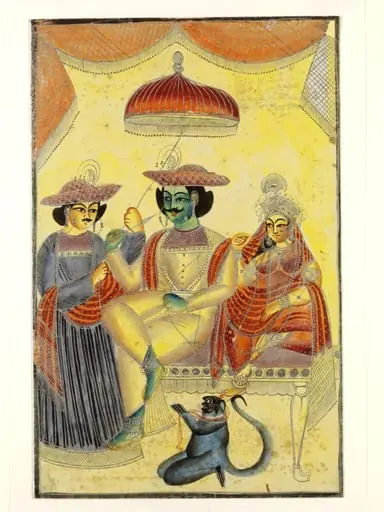
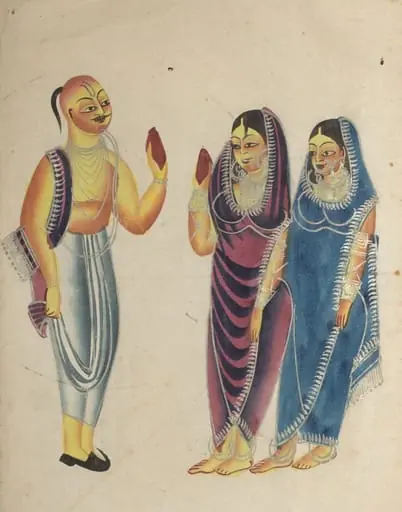
This opaque watercolor on paper, part of a larger album compiled by J. Lockwood Kipling between 1865 and 1893, captures a notorious social scandal from 1870s Bengal. Executed in the Kalighat folk style, it portrays the Mahant of the Tarakeshwar Shiva temple alongside three women, rendered with bold outlines and vivid pigments. The work was likely produced for public consumption, reflecting contemporary public interest in the affair and its moral implications.
Subject & Meaning
The scene illustrates the aftermath of an alleged sexual encounter between the Mahant and Elokeshi, the wife of a middle-class clerk. Elokeshi and her sister, both veiled, offer ritual items while the servant Telibou gazes directly at the priest. The Mahant’s relaxed posture and lack of Brahminical symbols—replaced by a Vaishnavite mark—suggest moral ambiguity. The composition frames the encounter as both sacred ritual and social transgression, blurring religious authority with personal misconduct.
Technique & Style
Painted in the Kalighat tradition, the work employs flat planes of intense color, minimal shading, and strong black outlines. Gold leaf accents highlight jewelry and architectural details, while the figures are rendered with stylized simplicity. The background arch, adorned with swirling red, green, and gold patterns, functions as a decorative frame rather than a spatial setting. The use of tin alloy in the pigments adds subtle luminosity, characteristic of 19th-century Calcutta workshop practices.
History & Provenance
The painting was collected by J. Lockwood Kipling during his tenure in British India, likely acquired from Kalighat artists near the Kalighat temple in Calcutta. It formed part of a portfolio of 196 works documenting urban life, religious figures, and contemporary scandals. The album was later donated to a public museum, preserving a rare visual record of how public events were interpreted through popular art in colonial Bengal.
Context
Created shortly after the real-life Tarakeshwar scandal, which sparked public outrage and legal proceedings, the painting reflects the intersection of morality, class, and gender in mid-Victorian Bengal. Kalighat artists responded swiftly to current events, producing images for a broad, literate urban audience. The depiction of the Mahant’s unorthodox appearance and the women’s dignified postures reveals shifting attitudes toward religious authority and female agency in a rapidly changing society.
Legacy
As part of a broader corpus of Kalighat paintings, this work exemplifies how folk art documented and critiqued social norms in colonial India. Its survival in institutional collections underscores its value as a historical document, offering insight into public discourse on power, religion, and gender. Unlike elite art forms, it reached a wide audience, making it a vital record of popular consciousness in 19th-century Bengal.
Artist & collection

 Domestic Scene
 Giacomo and Cardinal Marco, investing Andrea, Abbot of San Zeno, with his Benefice
 The Nymph of Fontainebleau
 Portrait of a Woman
 Madonna and Child with Saints in the Enclosed Garden
 Venus and Minerva
 Family Group of Four on Sofa
 Wall painting from Room H of the Villa of P. Fannius Synistor at Boscoreale