Artwork
Emperor Alamgir II
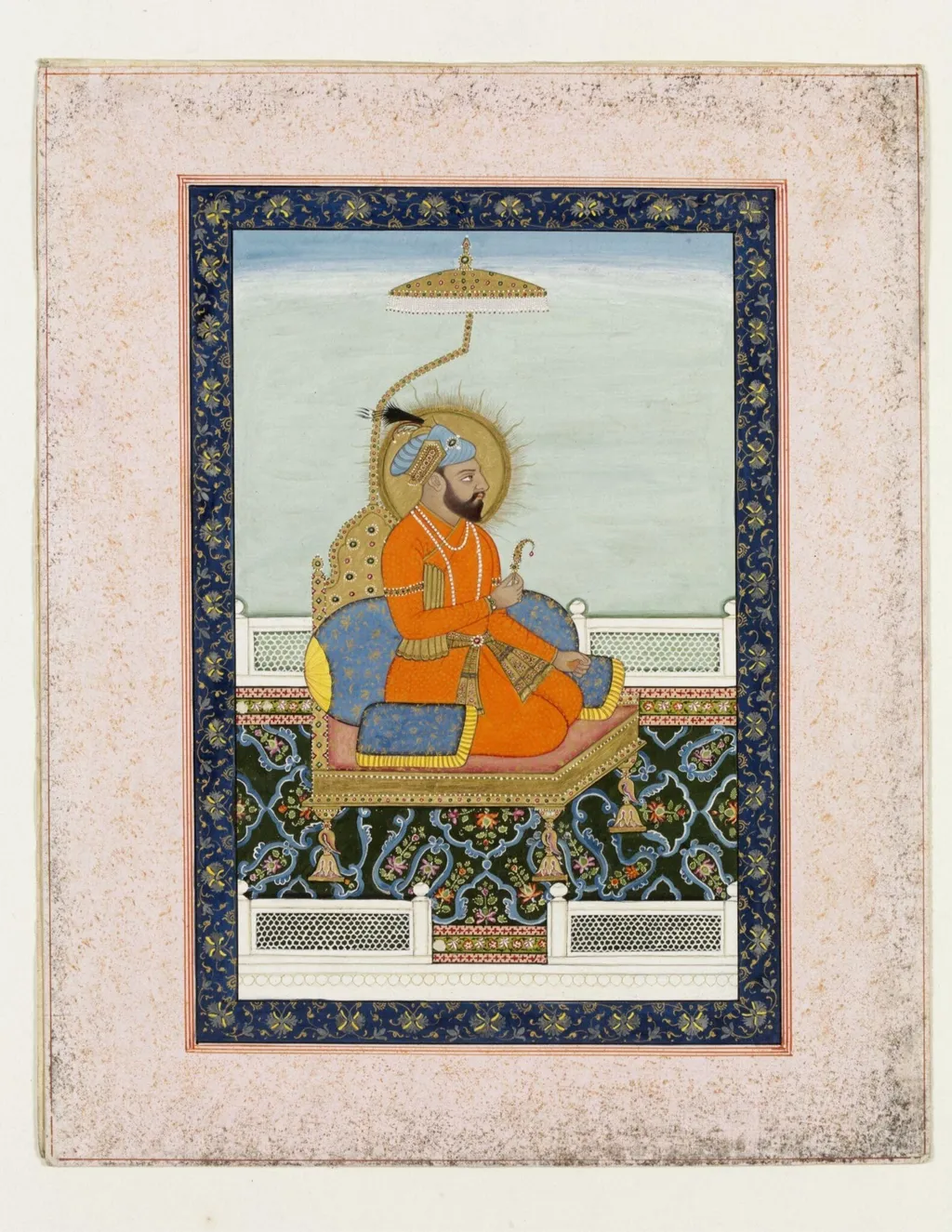
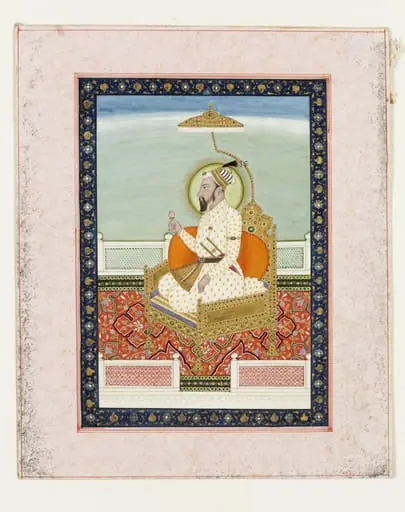
Emperor Alamgir II is a paint painting by the Romanticist artist Unknown. It dates from 1840 and is held in the collection of the Victoria and Albert Museum. The work is an opaque watercolor and gold painting on paper, executed in 1840.
About this work
Overview
The work is an opaque watercolor and gold painting on paper, executed in 1840. It portrays the Mughal emperor Alamgir II, who ruled from 1754 to 1759, seated on an elaborately jeweled golden throne. The composition is flat and decorative, with a plain background and a richly patterned border of blue and gold motifs.
Subject & Meaning
Alamgir II is shown facing right, dressed in a vivid orange robe trimmed with gold, a blue turban, and a golden belt. In his right hand he holds a curved object, likely a hookah, while a small umbrella hovers above his head, emphasizing his regal status. The portrait conveys imperial authority through sumptuous costume and throne.
Technique & Style
The artist employed opaque watercolor combined with gold leaf, producing a luminous surface without modeling or chiaroscuro. Colors are applied in bold, flat areas, and the border features intricate miniature-like figures and floral designs typical of courtly Indian painting traditions.
History & Provenance
The painting formed part of a series depicting Muslim rulers. It entered the collection of the Earl of Auckland, who served as Governor‑General of India between 1836 and 1842, before being acquired by the museum.
Context
Created during the early nineteenth century, the portrait reflects British colonial interest in documenting Indian royalty. Its stylized aesthetic aligns with the hybrid visual language that merged traditional Mughal court portraiture with European watercolor techniques.
Artist & collection

 Domestic Scene
 Giacomo and Cardinal Marco, investing Andrea, Abbot of San Zeno, with his Benefice
 The Nymph of Fontainebleau
 Portrait of a Woman
 Madonna and Child with Saints in the Enclosed Garden
 Venus and Minerva
 Family Group of Four on Sofa
 Wall painting from Room H of the Villa of P. Fannius Synistor at Boscoreale