Artwork
Farfurie semi-adâncă, cu corp scund și buză lată, răsfrântă și muchie ondulată (mici alveole). Piesa este modelată la roata olarului, angobată cu humă albă pe fața interioară a acesteia. Decorul, bogat, cu linii groase, este realizat prin pictare cu cornul și cu pensula și constă în motive decorative vegetale stilizate (flori și frunze) și geometrice (linii, puncte) dispuse pe întreaga suprafață a farfuriei. Cromatica decorului: alb, albastru. Farfuria este smălțuită pe interior, cu smalț transparent.
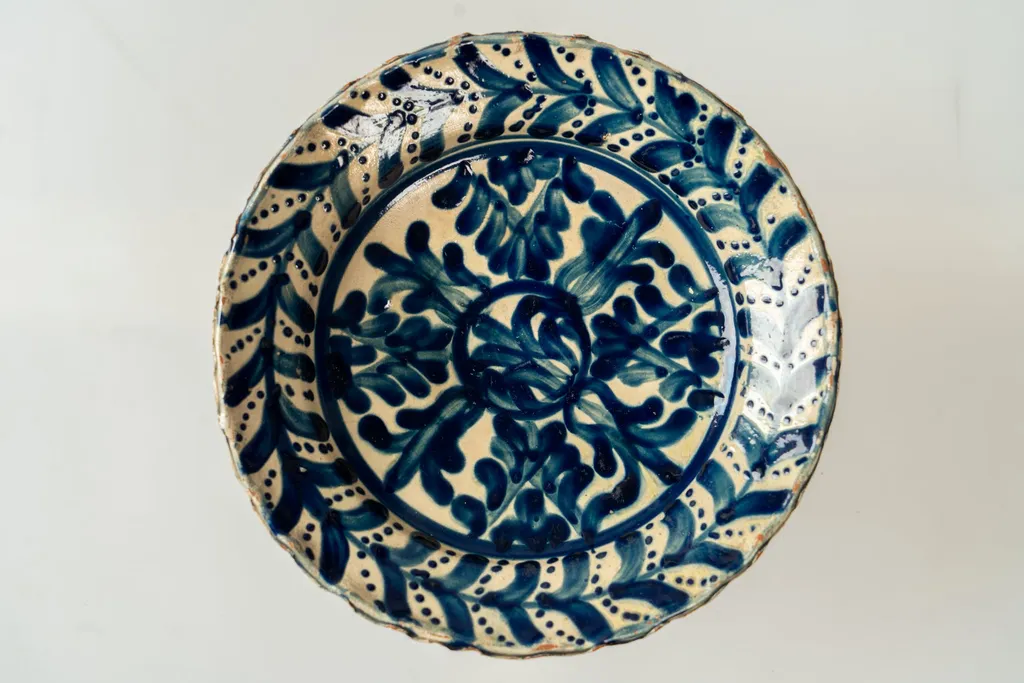
Farfurie semi-adâncă, cu corp scund și buză lată, răsfrântă și muchie ondulată (mici alveole). Piesa este modelată la roata olarului, angobată cu humă albă pe fața interioară a acesteia. Decorul, bogat, cu linii groase, este realizat prin pictare cu cornul și cu pensula și constă în motive decorative vegetale stilizate (flori și frunze) și geometrice (linii, puncte) dispuse pe întreaga suprafață a farfuriei. Cromatica decorului: alb, albastru. Farfuria este smălțuită pe interior, cu smalț transparent. is a print by Unknown. It dates from 1850 and is held in the collection of the Ethnographical Museum of Transylvania. This shallow ceramic plate features a broad, flared rim with a wavy edge and small internal depressions.
About this work
Overview
This shallow ceramic plate features a broad, flared rim with a wavy edge and small internal depressions. Crafted on a potter’s wheel, it is coated with a white slip on the interior surface and finished with a clear glaze. The decoration, executed with both brush and stylus, covers the entire interior with intricate patterns in blue and white, reflecting a refined handcrafted tradition.
Subject & Meaning
The decoration combines stylized floral elements—flowers and leaves—with geometric motifs such as lines and dots. These patterns, arranged in continuous bands, suggest an emphasis on rhythm and repetition rather than naturalistic representation. The absence of figural imagery points to a decorative tradition rooted in symbolic abstraction, common in regional ceramic practices of the period.
Technique & Style
The plate was formed on a wheel and treated with a white engobe on its interior before being painted with blue pigments using fine brushes and a pointed tool.
The plate was formed on a wheel and treated with a white engobe on its interior before being painted with blue pigments using fine brushes and a pointed tool. The thick, fluid lines and precise dots indicate skilled manual control. A transparent glaze was applied over the design, sealing the surface and enhancing the contrast between the white slip and the blue motifs, creating a luminous, cohesive surface.
History & Provenance
This piece is held in the collection of the Museum of Ethnography. Its form and decoration align with ceramic traditions from Eastern Europe, likely dating to the late 19th or early 20th century. It reflects regional practices where household wares were decorated with locally available materials and inherited visual vocabularies, preserved through generations of artisan production.
Context
The use of blue and white on a white slip echoes broader Eurasian ceramic traditions, yet the specific arrangement of motifs and the shallow form are characteristic of local folk pottery. Such plates were likely used for daily service, their decoration serving both aesthetic and cultural functions, reinforcing communal identity through repeated visual symbols.
Legacy
This plate exemplifies a durable tradition of vernacular ceramics that prioritized craftsmanship over mass production. Its preservation in a museum setting underscores its value as a record of regional artisan practices. While no longer in common use, its design continues to inform studies of folk art and material culture in Eastern Europe.
Artist & collection
Museum
Ethnographical Museum of Transylvania
Continue through works from the same source collection.
 Domestic Scene
 Giacomo and Cardinal Marco, investing Andrea, Abbot of San Zeno, with his Benefice
 The Nymph of Fontainebleau
 Portrait of a Woman
 Madonna and Child with Saints in the Enclosed Garden
 Venus and Minerva
 Family Group of Four on Sofa
 Wall painting from Room H of the Villa of P. Fannius Synistor at Boscoreale
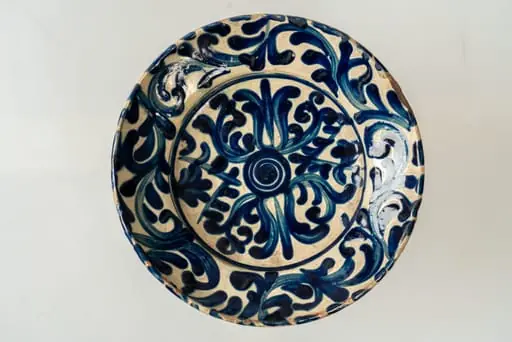 Farfurie semi-adâncă, cu corp scund și buză lată, răsfrântă. Piesa este modelată la roata olarului, angobată cu humă albă pe fața interioară a acesteia. Decorul este unul bogat, realizat prin pictare cu pensula, cu linii groase, și constă în motive decorative florale și vegetale stilizate (flori și frunze), dispuse pe toată suprafața farfuriei. Cromatica decorului: alb, albastru. Farfuria este smălțuită pe interior, cu smalț transparent.
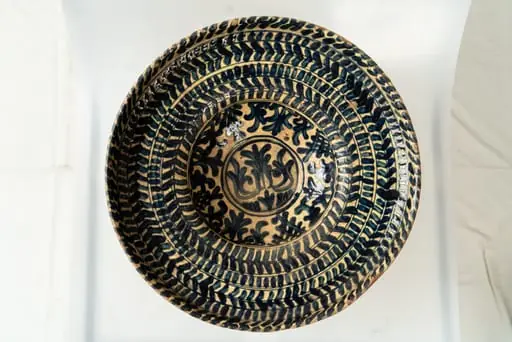 Farfurie mare, adâncă, cu corp tronconic și buză foarte lată, răsfrântă și cu muchia buzei dreaptă. Piesa este modelată la roata olarului, angobată cu humă albă pe fața interioară a acesteia. Decorul este unul foarte bogat, acoperă întreaga suprafață a piesei și este realizat prin pictare cu pensula, cu linii groase. Motivele decorative sunt florale și vegetale stilizate (flori și frunze, dispuse în zona centrală a farfuriei) și geometrice (șiruri de linii paralele și oblice, înscrise în cercuri concentrice, pe buza și muchia farfuriei). Cromatica decorului: alb, albastru. Farfuria este smălțuită pe interior, cu smalț transparent.
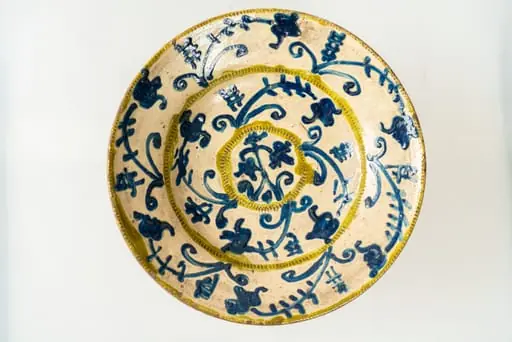 Farfurie mare, semi-adâncă, cu corp scund și buză lată, răsfrântă. Piesa este modelată la roata olarului, angobată cu humă albă pe fața interioară a acesteia. Decorul este realizat prin pictare cu pensula și cu cornul și constă în motive decorative florale și vegetale stilizate (flori și frunze), dispuse pe toată suprafața farfuriei, încadrate în trei registre separate de cercuri concentrice formate dintr-o linie verde și un șir continu de linii mici, paralele, incizate (cercuri localizate: central - pe fundul farfuriei; pe bordura interioară a buzei și pe muchia acesteia). Cromatica decorului: alb, albastru, verde. Farfuria este smălțuită pe interior, cu smalț transparent.
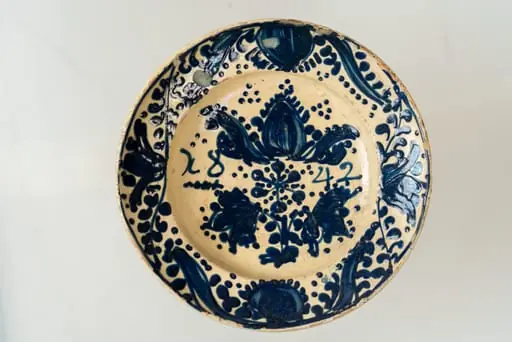 Farfurie adâncă, cu corp scund și buză lată, răsfrântă. Piesa este modelată la roata olarului, angobată cu humă albă pe fața interioară a acesteia. Decorul este realizat prin pictare cu cornul și cu pensula și constă în motive decorative vegetale stilizate (flori și frunze) și geometrice (puncte), dispuse pe întreaga suprafață a farfuriei. Central, pe fundul farfuriei, este înscris anul fabricației "1842", deoparte și de alta a registrului decorativ central. Cromatica decorului: alb, albastru. Farfuria este smălțuită pe interior, cu smalț transparent.
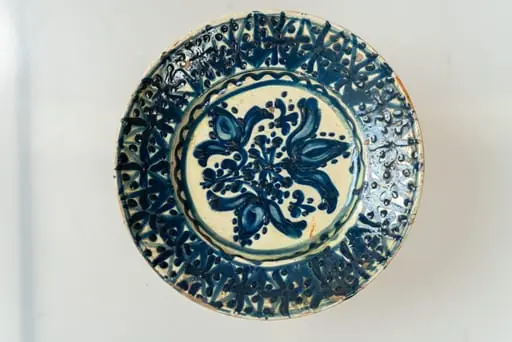 Farfurie de formă aplatizată, cu buză lată, răsfrântă. Piesa este modelată la roata olarului, angobată cu humă albă pe fața interioară a acesteia. Decorul este unul bogat, realizat prin pictare cu pensula și cu cornul, cu linii groase, și constă în motive decorative florale și vegetale stilizate (lalele și frunze), dispuse central pe fundul farfuriei și motive decorative geometrice pe buza acesteia (linii vălurite, puncte, linii intersectate sub forma motivului de stea). Cromatica decorului: alb, albastru. Farfuria este smălțuită pe interior, cu smalț transparent.
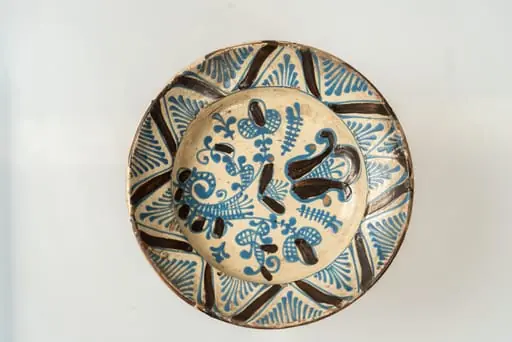 Farfurie adâncă, cu buză răsfrântă; piesa este modelată la roata olarului și este angobată cu humă albă pe fața interioară. Decorul este realizat prin pictare cu pensula și cu cornul și se compune din motive decorative florale stilizate (amplasate central, pe fundul farfuriei) și motive decorative geometrice, pe buza farfuriei (dungi de culoare maro, grupuri de linii paralele sub forma motivului de brăduț, linii hașurate). Cromatica: alb, maro, albastru. Fața farfuriei este acoperită cu un strat de smalț transparent.
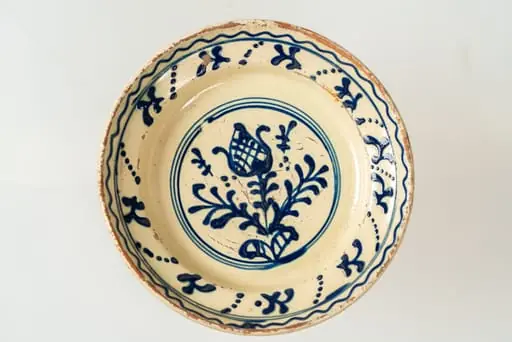 Farfurie semi-adâncă, cu corp scund și buză lată, răsfrântă, cu muchia buzei ușor concavă spre interior. Piesa este modelată la roata olarului, angobată cu humă albă pe fața interioară a acesteia. Decorul este realizat prin pictare cu pensula și cu cornul și constă în motive decorative florale și vegetale stilizate (flori și frunze), dispuse central, pe fundul farfuriei (încadrate in trei cercuri concentrice) și pe buza acesteia. Motive decorative geometrice: șiruri oblice de puncte, linie vălurită, linii sub formă de cerc. Cromatica decorului: alb, albastru. Farfuria este smălțuită pe fața interioară cu smalț transparent.
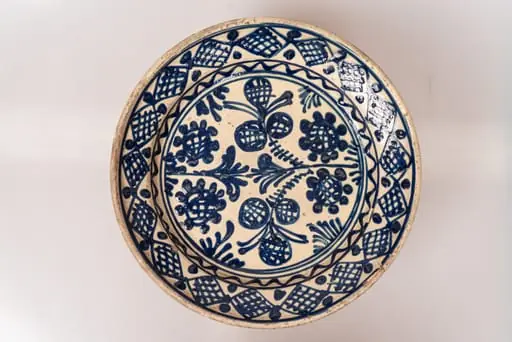 Farfurie de formă semi-adâncă, cu buza răsfrântă; piesa este modelată la roata olarului și angobată cu humă albă pe fața interioară. Decorul monocromatic este realizat prin pictare cu cornul și cu pensula și se compune din motive florale stilizate și geometrice, dispuse pe întreaga suprafață a piesei (registrul central de pe fundul farfuriei, delimitat de un cerc format din două linii concentrice, conține două perechi de flori cu petale rotunde, așezate diametral opus și o tulpină cu două ramuri ce se termină cu câte trei boboci și frunze; florile sunt umplute cu linii hașurate). Registrul marginal de pe buza farfuriei este decorat cu un șir continuu de romburi umplute cu linii hașurate și cu puncte groase. Peretele foarte îngust al farfuriei este decorat cu un cerc dintr-o linie vălurită iar muchia buzei și bordura interioară a farfuriei sunt marcate de câte o linie albastră sub formă de cerc. Cromatica: alb, albastru. Piesa este acoperită pe fața ornamentată cu un strat de smalț transparent.
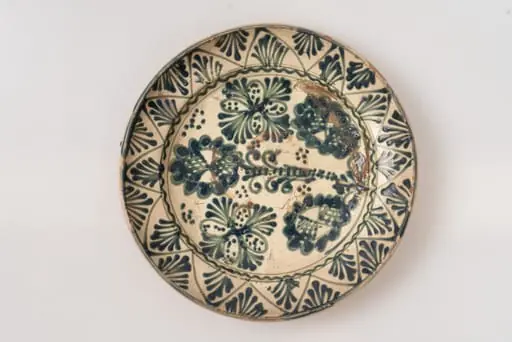 Farfurie de formă semi-adâncă, cu buză lată, răsfrântă; este angobată pe fața interioară cu un strat de humă albă, peste care este pictat cu cornul decorul monocromatic, format din motive florale și fitomorfe foarte stilizate (tulpină cu cinci flori și frunze, reprezentate pe centrul farfuriei) și geometrice (o linie în formă de zig-zag, pe toată lungimea buzei, completată cu motive formate din linii verticale, dispuse în formă de triunghi; linii circulare simple și linie circulară ondulată ce marchează bordura interioară a farfuriei; puncte, linii hașurate). Buza farfuriei este marcată cu o dungă de culoare albastră. Cromatica: alb, albastru. Farfuria este acoperită pe fața decorată cu un strat de smalț transparent.