Artwork
Flowering Lotus and Bud
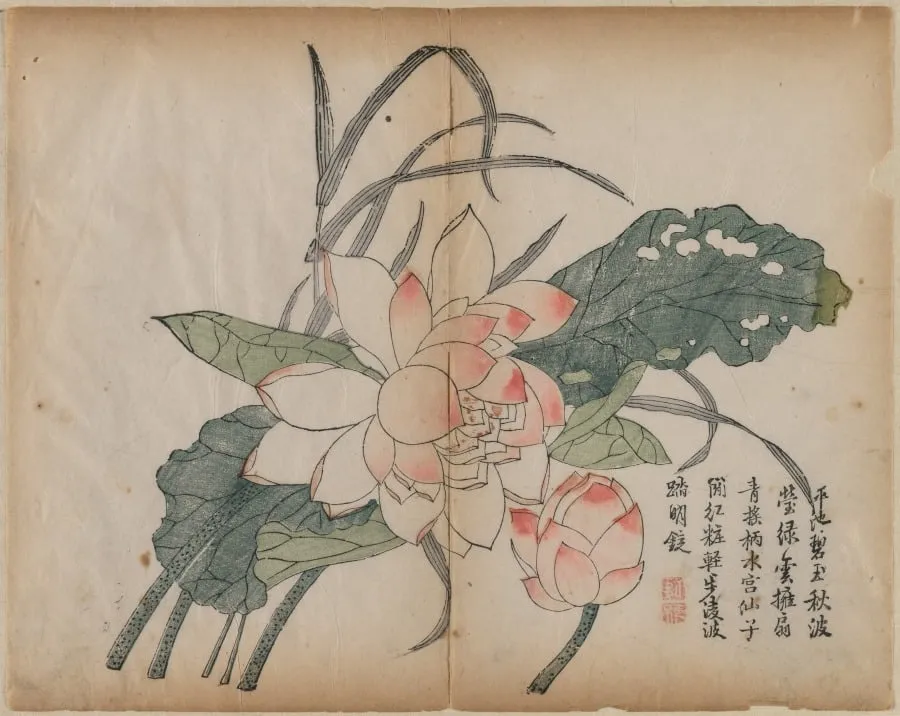
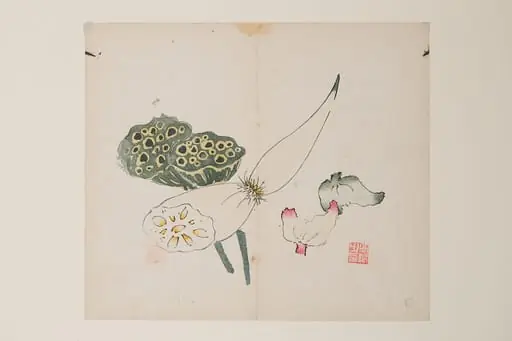
Flowering Lotus and Bud is a print by the Baroque artist Unknown. It dates from 1750 and is held in the collection of the Cleveland Museum of Art. This print depicts a single flowering lotus and an unopened bud, rendered with minimal detail and flat, unmodulated color.
About this work
Overview
The absence of ornamental detail invites quiet contemplation, aligning with aesthetic traditions that value restraint over elaboration.
This print depicts a single flowering lotus and an unopened bud, rendered with minimal detail and flat, unmodulated color. The white petals, edged in soft pink, rise above broad leaves and slender stems on a neutral beige ground. The composition avoids depth or shadow, emphasizing stillness and simplicity. The absence of ornamental detail invites quiet contemplation, aligning with aesthetic traditions that value restraint over elaboration.
Subject & Meaning
The lotus, a symbol of purity and spiritual emergence in many Asian cultures, is presented here in its natural state—flowering and budding simultaneously. Its isolation against a plain background suggests solitude and inner growth. The absence of water or other contextual elements focuses attention on the plant’s quiet resilience, reinforcing themes of renewal and detachment from worldly disturbance.
Technique & Style
The work employs bold, unbroken outlines and uniform color fields, rejecting shading and perspective. Stems and leaves are rendered with slight variations in line weight to suggest form without realism. The flatness of the composition and deliberate lack of texture reflect a deliberate simplification, prioritizing symbolic clarity over naturalistic representation. This approach aligns with decorative and ink-based traditions that favor essential forms.
History & Provenance
The origin of this print is not documented in available records. Its stylistic traits suggest possible influence from East Asian woodblock or ink traditions, though it lacks definitive cultural markers. No known artist, date, or collection history accompanies the work. Its production likely occurred in the 20th century, possibly as part of a modern reinterpretation of classical motifs for decorative purposes.
Context
While the image evokes calm, its aesthetic is unrelated to the Baroque movement, which emphasized drama, movement, and rich detail. Instead, it resonates more closely with minimalist or Zen-inspired art forms that prioritize silence and economy of form. The suggestion of Baroque affinity appears misleading; the work’s quietude and flatness stand in direct contrast to Baroque dynamism and ornamentation.
Legacy
This print contributes to a broader 20th-century trend of distilling natural subjects into abstracted, meditative forms. Though not tied to a major artistic movement, it reflects a recurring desire to use nature as a vessel for stillness. Its simplicity has found appeal in modern interior design and mindfulness-based visual culture, where clarity and calm are valued over complexity.
Artist & collection

 Domestic Scene
 Giacomo and Cardinal Marco, investing Andrea, Abbot of San Zeno, with his Benefice
 The Nymph of Fontainebleau
 Portrait of a Woman
 Madonna and Child with Saints in the Enclosed Garden
 Venus and Minerva
 Family Group of Four on Sofa
 Wall painting from Room H of the Villa of P. Fannius Synistor at Boscoreale