Artwork
A Quatrain about Peonies
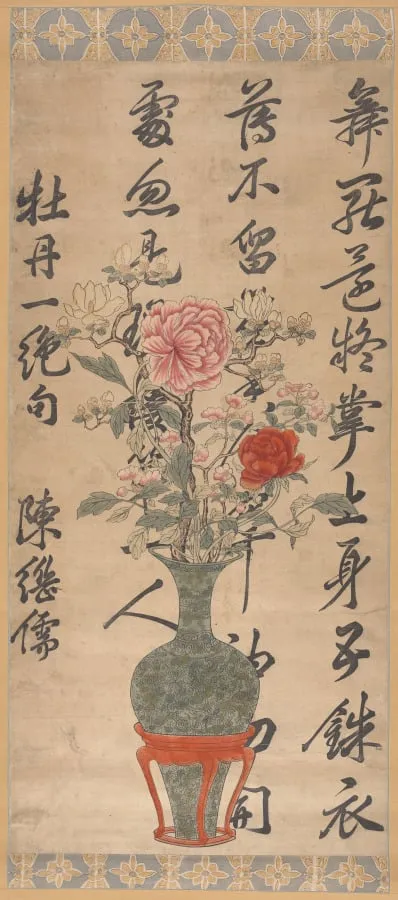
A Quatrain about Peonies is a print by the Baroque artist Unknown. It dates from 1766 and is held in the collection of the Cleveland Museum of Art.
About this work
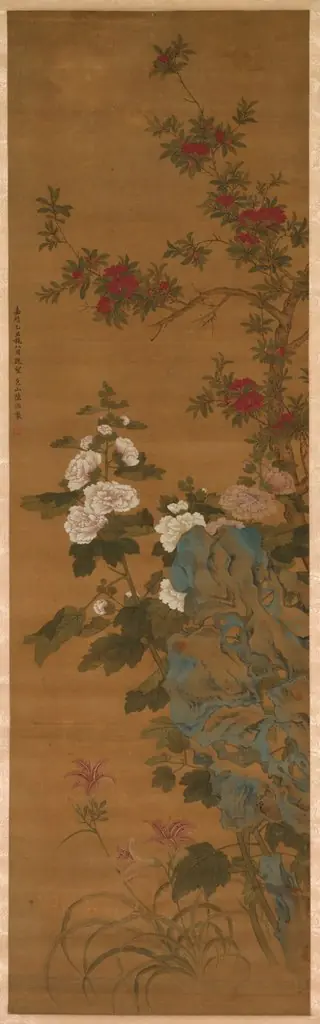
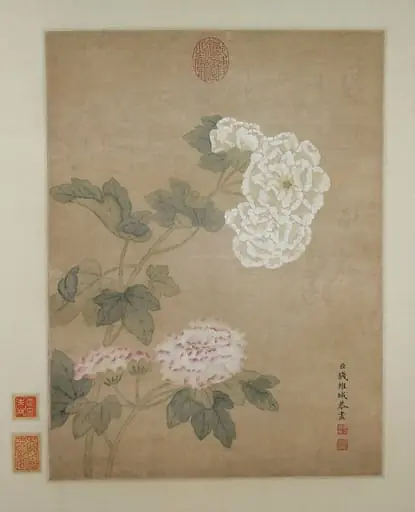
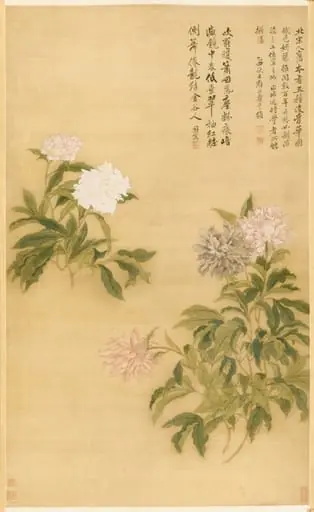
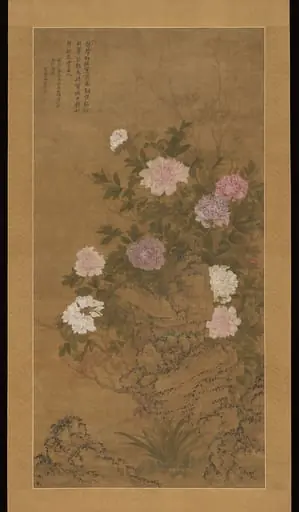
You see four peonies in a row, each on its own branch, printed in soft pinks and greens against a pale background.
You see four peonies in a row, each on its own branch, printed in soft pinks and greens against a pale background.
This is a woodblock print—meaning each color was stamped from a separate carved block. The artist never signed it, so we don’t know who made it. The flowers were printed during the Qianlong reign, when this kind of colorful printing was at its best in China.
To see more work from this time, look up the subject qing dynasty (1644–1911).
Overview
This woodblock print depicts four peonies, each set on an individual branch, rendered in delicate pinks and muted greens against a light background. The composition is arranged in a linear sequence, emphasizing the graceful form of each blossom.
Subject & Meaning
Peonies have long symbolized wealth and honor in Chinese visual culture. By presenting multiple flowers in a calm, orderly fashion, the image conveys a sense of refined elegance associated with aristocratic taste during the imperial era.
Technique & Style
The work employs traditional multicolour woodblock printing, a process that required a separate carved block for each hue. Ink was applied to each block and transferred sequentially onto the paper, creating the soft tonal variations characteristic of late Ming and early Qing prints.
History & Provenance
Printed during the reign of the Qianlong emperor (1736–1795), the piece belongs to a period when colour woodblock production reached its artistic apex in China. No signature is present, so the creator remains unidentified, a common circumstance for many commercial prints of the time.
Context
The print reflects the broader aesthetic of the Qing dynasty, when decorative motifs such as peonies were popular in both courtly and popular art. Its style aligns with other contemporaneous works that celebrated natural beauty through meticulous, multicoloured block techniques.
Artist & collection

 Domestic Scene
 Giacomo and Cardinal Marco, investing Andrea, Abbot of San Zeno, with his Benefice
 The Nymph of Fontainebleau
 Portrait of a Woman
 Madonna and Child with Saints in the Enclosed Garden
 Venus and Minerva
 Family Group of Four on Sofa
 Wall painting from Room H of the Villa of P. Fannius Synistor at Boscoreale