Artwork
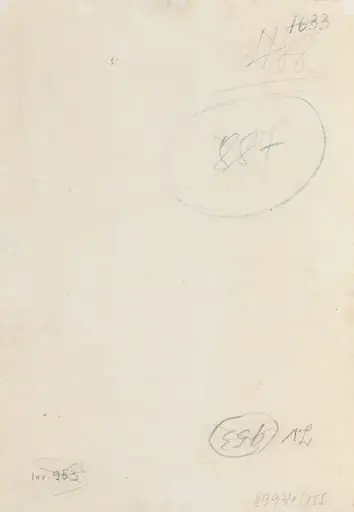
Fragment of Two Figures (verso)
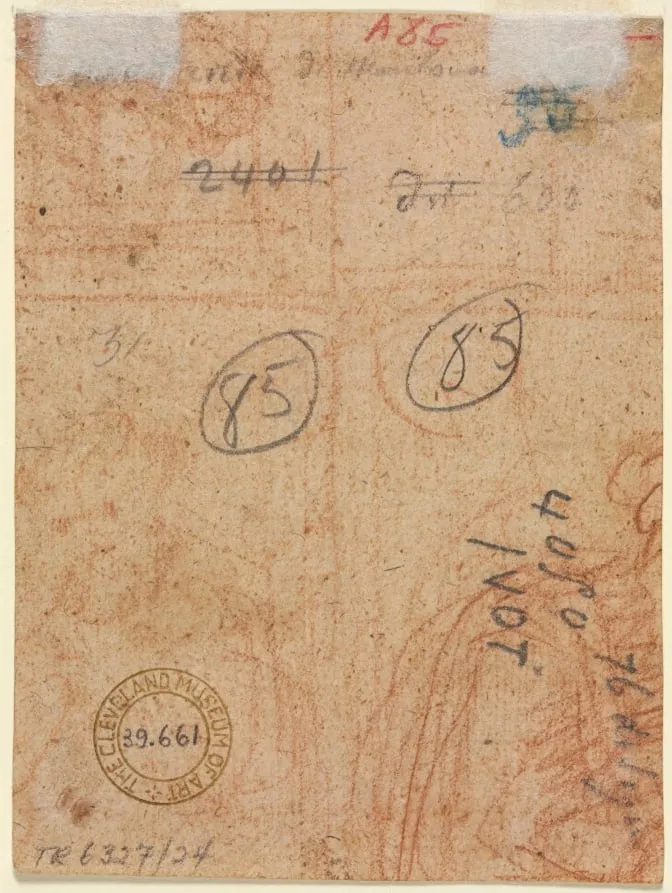
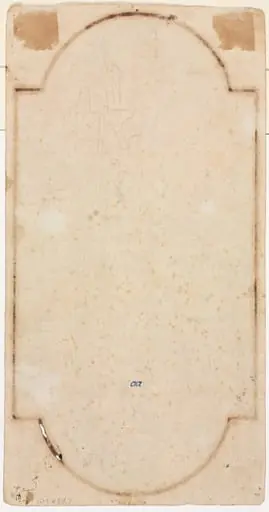
Fragment of Two Figures (verso) is a drawing by the Renaissance artist Unknown. It dates from 1550 and is held in the collection of the Cleveland Museum of Art. This is the reverse side of a Renaissance-era drawing, preserved as a fragment.
About this work
Overview
A museum stamp in the lower left confirms its institutional custody, likely from early 20th-century acquisition or reclassification.
This is the reverse side of a Renaissance-era drawing, preserved as a fragment. The surface shows signs of prolonged handling: smudged pencil marks, faint brown toning, and layered annotations. Two labeled ovals, marked '15' and '16,' suggest it was part of a systematic study or cataloging process. A museum stamp in the lower left confirms its institutional custody, likely from early 20th-century acquisition or reclassification.
Subject & Meaning
The two ovals may reference numbered studies of human forms, possibly preparatory sketches for a larger composition. The absence of clear imagery implies this was not a finished work but a working surface—perhaps a draft or inventory tag. The labels hint at an artist’s or collector’s method of organizing visual ideas, though their exact purpose remains undocumented.
Technique & Style
Pencil lines are lightly applied, with smudging indicating erasures or revisions. The paper is thin and aged, its texture softened by time and touch. No ink or wash is present; the work is purely linear and provisional. The style reflects utilitarian draftsmanship, prioritizing function over aesthetic finish.
History & Provenance
The fragment entered a museum collection with minimal documentation. Its wear suggests repeated handling, possibly during cataloging, study, or exhibition preparation. The stamp indicates institutional ownership since at least the early 1900s, though its origin before that is unknown. It likely came from a larger corpus of Renaissance studies now dispersed or lost.
Context
In Renaissance workshops, the backs of drawings were often reused for notes, sketches, or inventory. This fragment aligns with practices of artists and assistants who recorded observations on available materials. Such scraps were rarely preserved—making this one unusual, as it survived as evidence of behind-the-scenes creative processes.
Legacy
Today, this fragment offers insight into the mundane, iterative nature of artistic production. It stands as a quiet testament to the labor behind Renaissance art, revealing how ideas were tracked, revised, and stored. Its survival underscores the value modern institutions place on process, not just final outcomes.
Artist & collection

 Domestic Scene
 Giacomo and Cardinal Marco, investing Andrea, Abbot of San Zeno, with his Benefice
 The Nymph of Fontainebleau
 Portrait of a Woman
 Madonna and Child with Saints in the Enclosed Garden
 Venus and Minerva
 Family Group of Four on Sofa
 Wall painting from Room H of the Villa of P. Fannius Synistor at Boscoreale
 Nud la malul mării
 Ruine
Ruine Lectura
 Prince with Attendants and Horse in Foreground
 Prince in Pavilion; Princess with Attendants in Court
 PEISAJ
 The Meeting of Radha and Krishna in the Forest of Brindaban
 Zbor
Zbor Bărci pe plajă
 Court Scene with Various Princes and a Lady
 Bujori roșii pe fond violet
 Fragment of an Arch (tracing from recto) (verso)