Artwork
PEISAJ
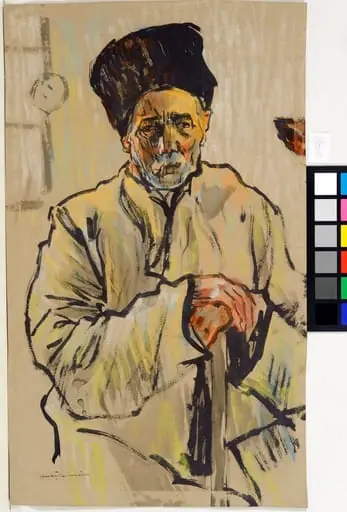
PEISAJ is a print by Rudolf Schweitzer-Cumpăna. It dates from 1920 and is held in the collection of the National Museum of Art of Romania.
About this work
Overview
Created in 1920 by Rudolf Schweitzer-Cumpăna, PEISAJ is a small, lightly drawn sketch on thin paper. Its minimal marks and open composition suggest it was made rapidly, possibly as an early attempt to capture a scene. The title, meaning 'landscape' in Romanian, implies an intent to depict natural or rural surroundings, though the forms remain ambiguous and undeveloped.
Subject & Meaning
The sketch contains no clear subject, only faint indications: a small, irregular oval near the top may suggest a tree or a figure, but it lacks definition. The absence of detail and the dominance of empty space point to an exploratory function rather than a finished representation. The work seems less about depicting a specific place and more about testing visual ideas in motion.
Technique & Style
Executed with loose, tentative pencil strokes, the drawing emphasizes spontaneity over precision. Lines are faint and uneven, with smudges suggesting erasures or reworking. The signature and date in the bottom right corner, handwritten and slightly blurred, reinforce the sense of immediacy. The technique reflects a private, experimental approach, typical of preparatory studies.
History & Provenance
No documented history of ownership or exhibition is available for PEISAJ. Its modest scale, unrefined finish, and lack of archival records suggest it remained in the artist’s personal collection or was never intended for public display. It survives as a fragment of Schweitzer-Cumpăna’s creative process, preserved likely by chance.
Context
In early 20th-century Romania, artists often engaged with modernist trends while maintaining ties to local traditions. Schweitzer-Cumpăna, active during this period, produced both finished works and informal sketches. PEISAJ aligns with a broader practice of rapid notations used to capture fleeting impressions, a habit common among artists navigating changing aesthetic ideals.
Legacy
Though not widely known or reproduced, PEISAJ offers insight into Schweitzer-Cumpăna’s working methods. Its unpolished nature makes it a valuable record of artistic inquiry, revealing how ideas emerged before formal composition. It stands as a quiet testament to the private moments behind public art, preserved for their evidentiary value rather than aesthetic finish.
Artist & collection
Artist
Rudolf Schweitzer-Cumpăna was a Romanian painter. Born in Pitești into an ethnic German family, he finished high school in his native town before attending the Royal Academy of Arts at Berlin from 1904 to 1909, studying…