Artwork
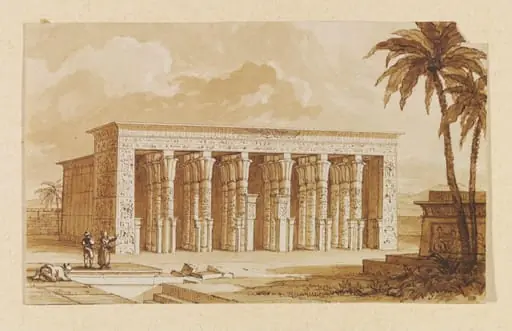
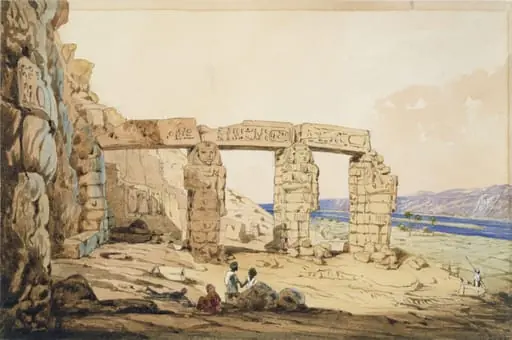
General View of the Ruins of the Palace of Sesostris or Osymandias
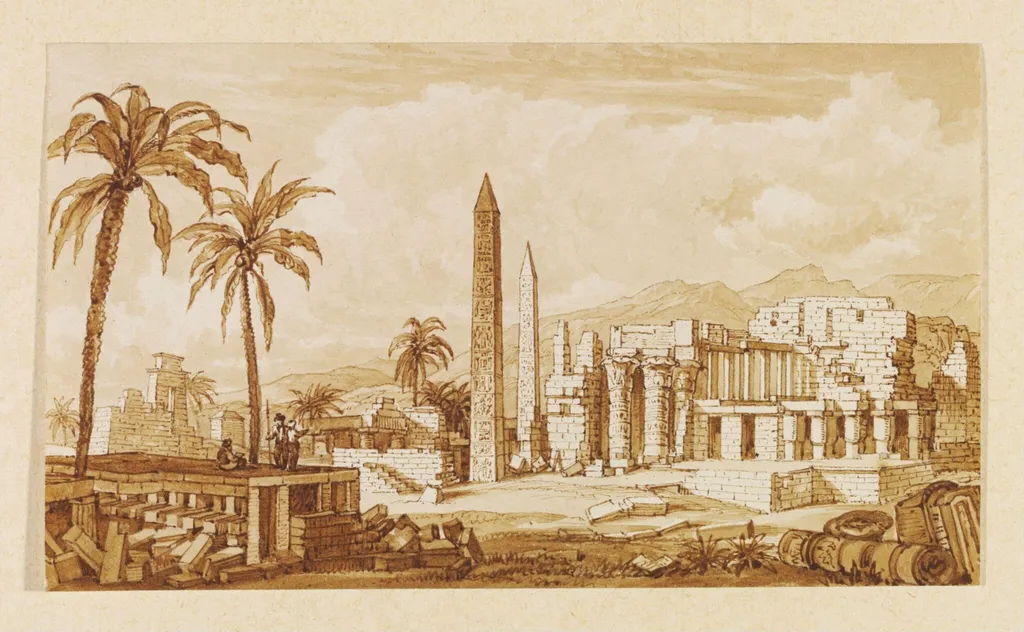
General View of the Ruins of the Palace of Sesostris or Osymandias is a drawing by the Romanticist artist Unknown. It dates from 1830 and is held in the collection of the Victoria and Albert Museum. This 1830 drawing is one of seven preparatory sketches made for Revd Michael Russell’s 1831 book on Egypt’s ancient and modern landscapes.
About this work
Overview
This 1830 drawing is one of seven preparatory sketches made for Revd Michael Russell’s 1831 book on Egypt’s ancient and modern landscapes.
This 1830 drawing is one of seven preparatory sketches made for Revd Michael Russell’s 1831 book on Egypt’s ancient and modern landscapes. It reproduces Plate 43 from Volume III of the *Description de l'Égypte*, a monumental survey commissioned by Napoleon. The image was later engraved by Branston for publication. Long attributed to Joseph Schranz, the work reflects the era’s scholarly interest in documenting Egypt’s architectural remnants through careful, if loose, observational drawing.
Subject & Meaning
The scene captures the decayed remains of what was once thought to be the palace of Sesostris, later associated with the mythic Osymandias. The ruins, half-buried in sand and framed by sparse palm trees, evoke a quiet sense of time’s passage. Two figures—seated and standing—offer scale and human presence, not as actors but as witnesses. The composition emphasizes solitude and erosion, aligning with early 19th-century Romantic sensibilities toward antiquity as a silent, enduring testament to lost civilizations.
Technique & Style
Executed in pencil or ink, the drawing employs loose, expressive lines and cross-hatching to suggest texture and depth. Shading is uneven, giving the stone blocks and columns a weathered, fragmented appearance. The pale sky and muted tones contribute to a faded, archival quality. The sketchy handling avoids polish, favoring immediacy and observational honesty. This approach reflects the working method of artists translating field studies into published illustrations, prioritizing documentation over aesthetic refinement.
History & Provenance
The drawing originated as a study for Russell’s 1831 publication, drawing directly from the *Description de l'Égypte*, a state-sponsored survey conducted during Napoleon’s campaign. Though initially credited to Joseph Schranz, later scholarship reattributed it as a copy after the original plate. Its survival as a standalone sheet suggests it may have been retained by the artist or publisher as a working reference, separate from the final engraved version distributed in the book.
Context
In the early 1830s, European interest in Egypt’s antiquities surged following the publication of the *Description de l'Égypte*. Artists and writers sought to translate these discoveries for a public fascinated by classical ruins and exotic landscapes. This drawing fits within a broader trend of topographical illustration, where accuracy and atmospheric tone were balanced to serve both scholarly and popular audiences, reinforcing the idea of Egypt as a land of timeless, crumbling grandeur.
Legacy
Though not widely exhibited today, the drawing represents a key link between scientific documentation and public imagination in the early Victorian era. It exemplifies how archaeological records were mediated through artistic interpretation, shaping Western perceptions of ancient Egypt. Its rough, unpolished character preserves the immediacy of early fieldwork, offering insight into the process behind more polished engravings that influenced generations of Egyptologists and travelers.
Artist & collection

 Domestic Scene
 Giacomo and Cardinal Marco, investing Andrea, Abbot of San Zeno, with his Benefice
 The Nymph of Fontainebleau
 Portrait of a Woman
 Madonna and Child with Saints in the Enclosed Garden
 Venus and Minerva
 Family Group of Four on Sofa
 Wall painting from Room H of the Villa of P. Fannius Synistor at Boscoreale