Artwork
Gulab Singh
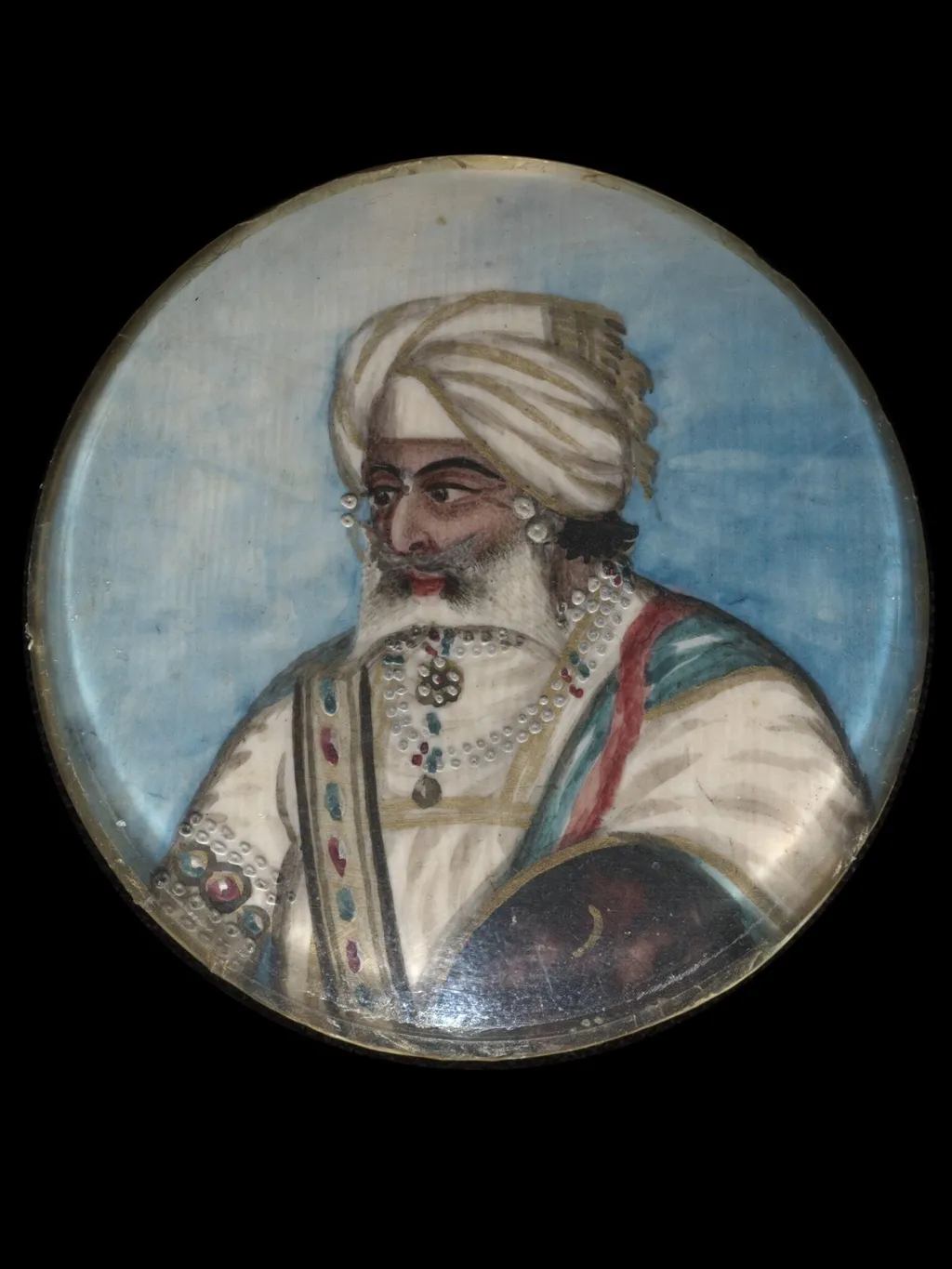
Gulab Singh is a paint painting by the Patna School of Painting artist Unknown. It dates from 1850 and is held in the collection of the Victoria and Albert Museum.
About this work
The painting's style and technique are reminiscent of Impressionism and Realism, which were popular art movements during the 19th century.
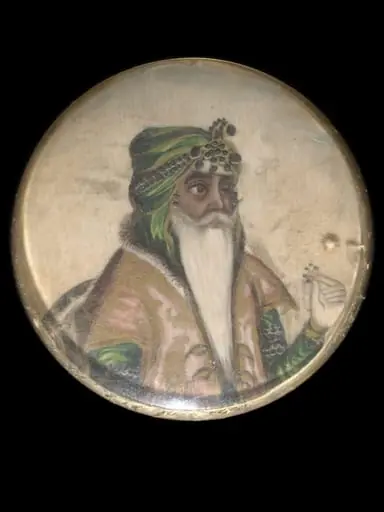
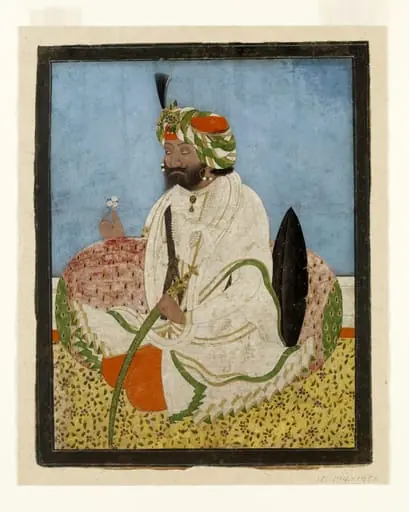
This painting is a portrait of a man, likely a ruler or noble, with a white turban and a long white beard. He wears a white robe adorned with colorful jewels and a dark blue shawl over his shoulder. The background is a light blue color.
The man's attire and jewelry suggest that he is a person of high status, and the painting's level of detail and realism indicate that it was created by a skilled artist. The use of color and texture adds depth and dimension to the portrait.
The painting's style and technique are reminiscent of Impressionism and Realism, which were popular art movements during the 19th century. If you're interested in learning more about these movements, you might want to explore the works of artists associated with Impressionism.
Overview
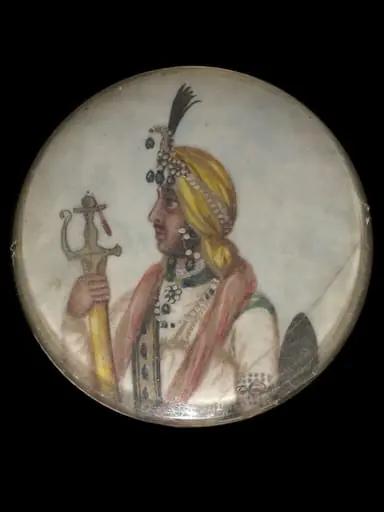
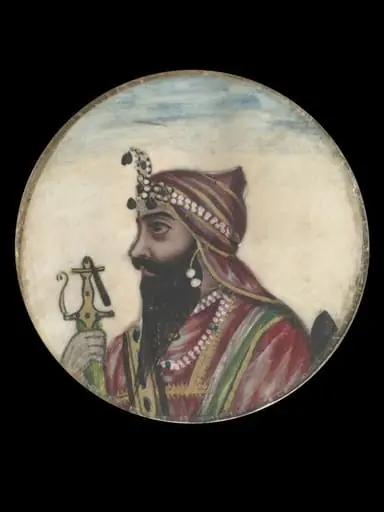
This portrait depicts Gulab Singh, ruler of Jammu and later the first Maharaja of Jammu and Kashmir, rendered in paint on ivory. The work captures him in a three-quarter view, facing right, with attention to the texture of his attire and the precision of his features. The small scale and fine detail reflect the tradition of Indian court portraiture, adapted with European techniques introduced during the 19th century.
Subject & Meaning
Gulab Singh is portrayed as a sovereign of authority, his white turban, beard, and ornate robe signaling his rank. The black shield he holds may symbolize his military leadership and political autonomy, earned after the First Anglo-Sikh War. The composition avoids overt symbolism, instead emphasizing dignity through stillness and refined dress, aligning with the visual language of legitimacy in regional princely courts.
Technique & Style
Executed on ivory, the painting employs fine brushwork to render fabric, jewelry, and skin with subtle gradations of tone. The blue background, lightly washed with white, creates a quiet contrast without distraction. While the realism in facial features and textures suggests European influence, the flatness of the setting and emphasis on pattern retain elements of indigenous miniature traditions, blending regional and colonial aesthetics.
History & Provenance
Created during Gulab Singh’s reign (1820–1857), the portrait likely originated in his court at Jammu, possibly commissioned to affirm his status after securing independence from the Sikh Empire. Its survival suggests it remained within royal collections, possibly transferred to British officials or collectors following the annexation of Kashmir in 1846. The ivory support indicates it was made for private or ceremonial use rather than public display.
Context
In early 19th-century India, regional rulers increasingly commissioned portraits that fused Mughal miniature conventions with Western realism, often through artists trained by European painters at court. Gulab Singh’s image reflects this transition: his attire retains traditional elements, while the naturalistic rendering and medium reflect new artistic exchanges. Such portraits served as tools of political identity amid British expansion.
Legacy
The portrait stands as a material record of a ruler who shaped the modern boundaries of Jammu and Kashmir. It exemplifies how Indian elites navigated colonial pressures by adopting foreign techniques to assert sovereignty. Though not widely exhibited, such works remain critical to understanding the visual culture of princely states and the hybrid identities they cultivated during a period of political transformation.
Artist & collection

 Domestic Scene
 Giacomo and Cardinal Marco, investing Andrea, Abbot of San Zeno, with his Benefice
 The Nymph of Fontainebleau
 Portrait of a Woman
 Madonna and Child with Saints in the Enclosed Garden
 Venus and Minerva
 Family Group of Four on Sofa
 Wall painting from Room H of the Villa of P. Fannius Synistor at Boscoreale