Artwork
H Beard Print Collection
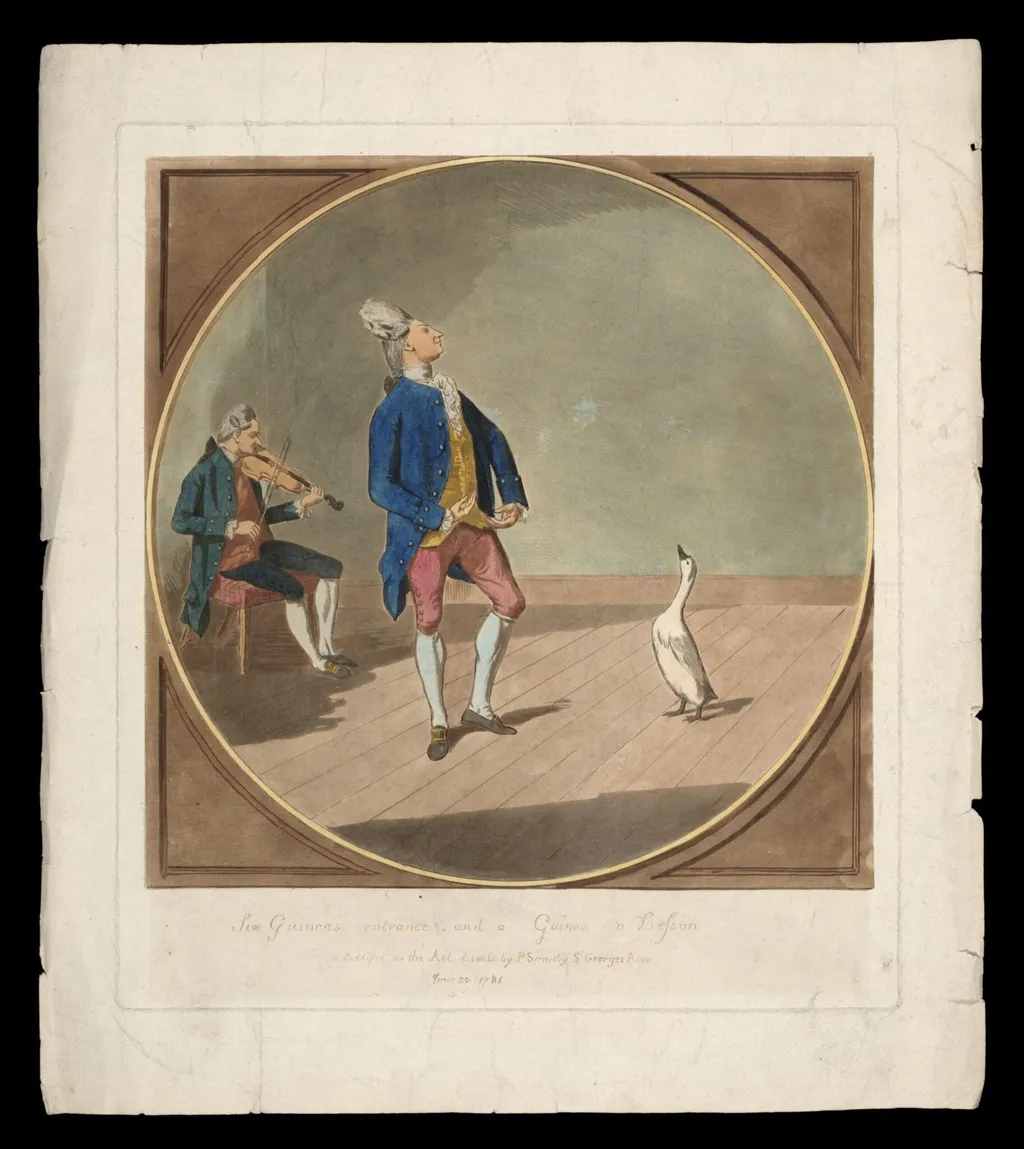
H Beard Print Collection is a print by the Romanticist artist Unknown. It dates from 20 and is held in the collection of the Victoria and Albert Museum.
About this work
It's interesting because it was published on a specific date, June 20, 1781.
This print shows a scene with people and horses near an entrance.
The scene is detailed, with many figures. It's interesting because it was published on a specific date, June 20, 1781.
It was made using a technique called sfumato, but in this case, the print is a sepia aquatint, which is a way of creating images with a brown color, and to learn more about this, you can look into the technique of sfumato.
Overview
This sepia aquatint print, published on 20 June 1781, depicts a bustling scene at the Six Guineas Entrance, likely a gateway to a public or aristocratic space. Part of the Harry Beard Collection, it captures a moment of daily life with numerous figures and horses, rendered in the soft tonal gradations characteristic of aquatint. The work reflects the period’s interest in documenting social activity through print media.
Subject & Meaning
The scene illustrates a transactional or ceremonial entrance, possibly referencing the cost of entry or service—'Six Guineas Entrance and a Guinea a Lesson' suggests a pricing structure tied to access or instruction. The presence of horses and varied figures implies a mix of social classes, hinting at the commercialization of public spaces in late 18th-century England. The title may carry ironic or satirical undertones common in prints of the era.
Technique & Style
Executed in sepia aquatint, the print uses acid-bitten metal plates to achieve subtle shifts in brown tonality, mimicking the softness of ink washes. Unlike sfumato—a painting technique involving blurred transitions—the aquatint achieves similar atmospheric depth through etching and ink density. The detailed rendering of figures and architecture reflects the precision expected in topographical and social commentary prints of the time.
History & Provenance
The print was issued in London in 1781, during a period of prolific print production for public consumption. It entered the Harry Beard Collection, a significant assemblage of theatrical and social prints from the 18th and 19th centuries. Its survival and cataloging reflect its value as a record of contemporary customs, though its original publisher and artist remain unattributed in available records.
Context
Published during a time of rising public interest in urban life and social hierarchy, this print aligns with a broader trend of satirical and documentary prints. The specificity of its date suggests it responded to a current event or local custom. Similar works often critiqued class distinctions or the commodification of public spaces, positioning this print within a visual culture that used imagery to comment on society.
Legacy
As part of the Harry Beard Collection, the print contributes to scholarly understanding of 18th-century British social practices and print culture. Though not widely reproduced or exhibited today, it remains a valuable primary source for historians studying public behavior, transportation, and the economics of access in Georgian England. Its preservation underscores the importance of ephemeral prints in documenting everyday life.
Artist & collection

 Domestic Scene
 Giacomo and Cardinal Marco, investing Andrea, Abbot of San Zeno, with his Benefice
 The Nymph of Fontainebleau
 Portrait of a Woman
 Madonna and Child with Saints in the Enclosed Garden
 Venus and Minerva
 Family Group of Four on Sofa
 Wall painting from Room H of the Villa of P. Fannius Synistor at Boscoreale