Artwork
H Beard Print Collection
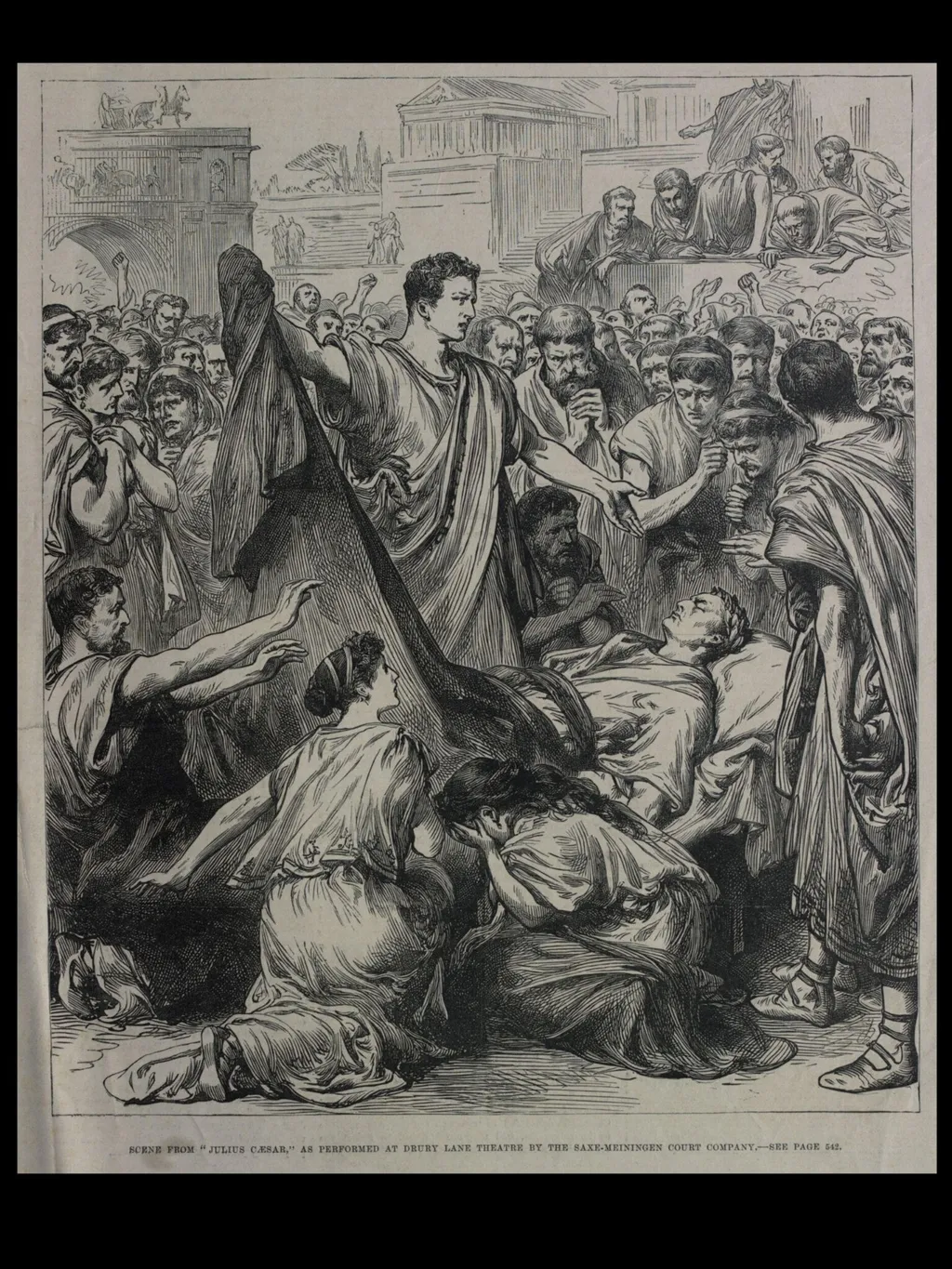
H Beard Print Collection is a print by the Impressionist artist Unknown. It dates from 1881 and is held in the collection of the Victoria and Albert Museum.
About this work
The detail that makes this print interesting is the glimpse into 19th-century theater.
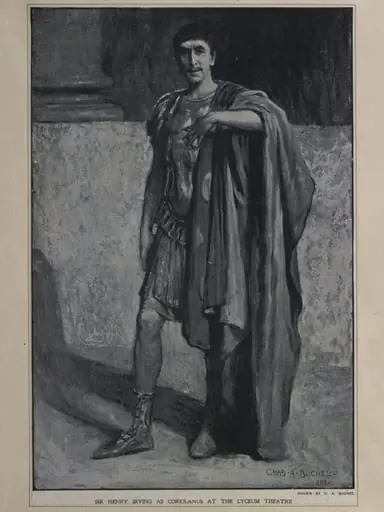
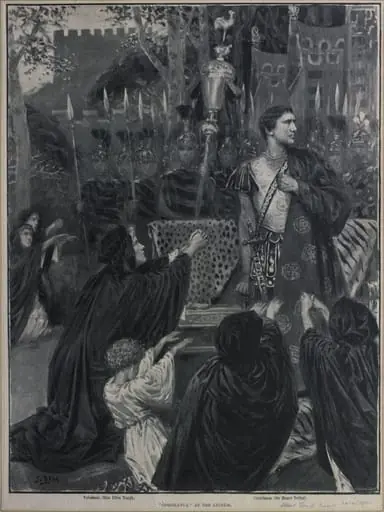
This print shows a scene from a play, with actors on stage.
The scene is from Julius Caesar, performed at Drury Lane Theatre.
It was performed by the Saxe-Meiningen Court Company in 1881.
The detail that makes this print interesting is the glimpse into 19th-century theater.
The print gives us a look at what the set and costumes were like back then.
To learn more about similar prints, look up the technique: sfumato.
Overview
This print captures a moment from William Shakespeare’s Julius Caesar, staged at London’s Drury Lane Theatre in 1881 by the Saxe-Meiningen Court Company. Produced as a theatrical souvenir, it documents a specific performance rather than a general illustration, offering a precise record of stage design and actor positioning during the late Victorian era.
Subject & Meaning
The scene depicts the assassination of Julius Caesar, a pivotal moment in Shakespeare’s tragedy. The composition emphasizes the chaos and tension of the conspirators surrounding the fallen leader, reflecting the play’s themes of power and betrayal. The actors’ gestures and grouping follow the company’s disciplined, historically informed staging, aiming for emotional realism over theatrical flourish.
Technique & Style
The print is a lithograph, a common medium for theatrical illustrations of the period. Lines are crisp and tonal contrasts are controlled to define figures and architecture without shading techniques like sfumato, which belongs to Renaissance painting, not 19th-century stage prints. The style prioritizes clarity and narrative legibility for a broad audience.
History & Provenance
Created as part of the H. Beard Print Collection, this image originates from the Saxe-Meiningen Company’s 1881 London tour, a landmark in European theater for its ensemble-based, historically researched productions. The print likely served as a promotional or commemorative item, circulating among theatergoers and collectors interested in the growing trend of director-led, visually cohesive staging.
Context
The Saxe-Meiningen Company revolutionized 19th-century theater by rejecting star-driven performances in favor of unified ensemble work and archaeological accuracy in costume and set design. Their 1881 London season influenced British stage practice and drew attention from figures like Bernard Shaw. This print preserves one of the earliest documented examples of such meticulous historical reconstruction in Shakespearean performance.
Legacy
As a visual artifact, the print contributes to the study of theatrical evolution, illustrating how stagecraft moved toward realism and directorial control. It remains a reference for historians examining the transition from melodramatic spectacle to psychologically grounded production, and it underscores the role of print media in disseminating performance culture before photography became widespread.
Artist & collection

 Domestic Scene
 Giacomo and Cardinal Marco, investing Andrea, Abbot of San Zeno, with his Benefice
 The Nymph of Fontainebleau
 Portrait of a Woman
 Madonna and Child with Saints in the Enclosed Garden
 Venus and Minerva
 Family Group of Four on Sofa
 Wall painting from Room H of the Villa of P. Fannius Synistor at Boscoreale