Artwork
Hannibal Swearing Eternal Enmity toward Rome
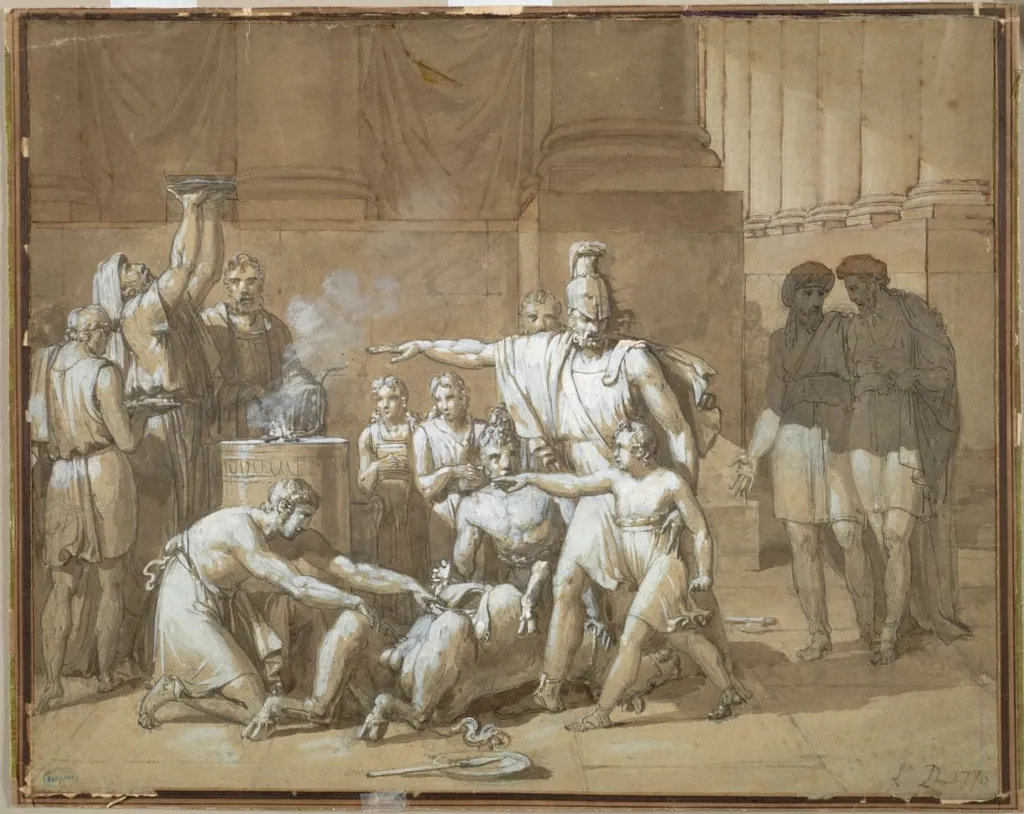
Hannibal Swearing Eternal Enmity toward Rome is a drawing by the Romanticist artist Unknown. It dates from 1808 and is held in the collection of the Cleveland Museum of Art.
About this work
If you like this kind of historical drama, look up paintings from France, 19th century.
A boy in a red cloak raises his hand beside a smoking altar. His father, dressed like an ancient general, stands over him. Below, a bull lies dead on the ground.
This painting shows Hannibal as a child swearing to hate Rome forever. The artist probably made it for a bigger work that was never finished. The scene feels staged, like a play—dramatic but not quite real.
If you like this kind of historical drama, look up paintings from France, 19th century.
Overview
This drawing depicts a pivotal moment in the youth of Hannibal, the renowned Carthaginian general, as he swears eternal enmity toward Rome under his father's guidance during a sacrificial ritual.
Subject & Meaning
The scene captures Hannibal's oath, influenced by his father, marking the genesis of his lifelong antagonism towards Rome. The composition conveys the solemnity and significance of this vow through the mimetic posture of the nine-year-old Hannibal beside his father, set against the backdrop of a sacrificed bull.
Technique & Style
Executed with pen, brush, and white highlights, this drawing likely served as a preliminary study for a larger, unfinished oil painting. The technique was common for finalizing compositions before scaling up. The dramatic, somewhat theatrical arrangement suggests a staged quality, reminiscent of 19th-century French historical dramas.
History & Provenance
The artist of this work remains unknown. The piece was likely intended as a study for a more substantial painting that was never completed.
Context
Historical subjects like this were typical in the period, often depicting pivotal ancient events. The work aligns with 19th-century French artistic interests in dramatic historical scenes.
Legacy
While the work itself may not have led to a larger painting as intended, it reflects the enduring fascination with Hannibal's legend and the appeal of ancient historical narratives in art.
Artist & collection

 Domestic Scene
 Giacomo and Cardinal Marco, investing Andrea, Abbot of San Zeno, with his Benefice
 The Nymph of Fontainebleau
 Portrait of a Woman
 Madonna and Child with Saints in the Enclosed Garden
 Venus and Minerva
 Family Group of Four on Sofa
 Wall painting from Room H of the Villa of P. Fannius Synistor at Boscoreale
![The Martyrdom of Saints Peter and Paul [recto], by Antonio da Trento](https://artifactworldgallery.com/img/antonio-da-trento--the-martyrdom-of-saints-peter-and-paul-recto--a51e90060085a207-w320.webp)