Artwork
Hanuman and Ravana
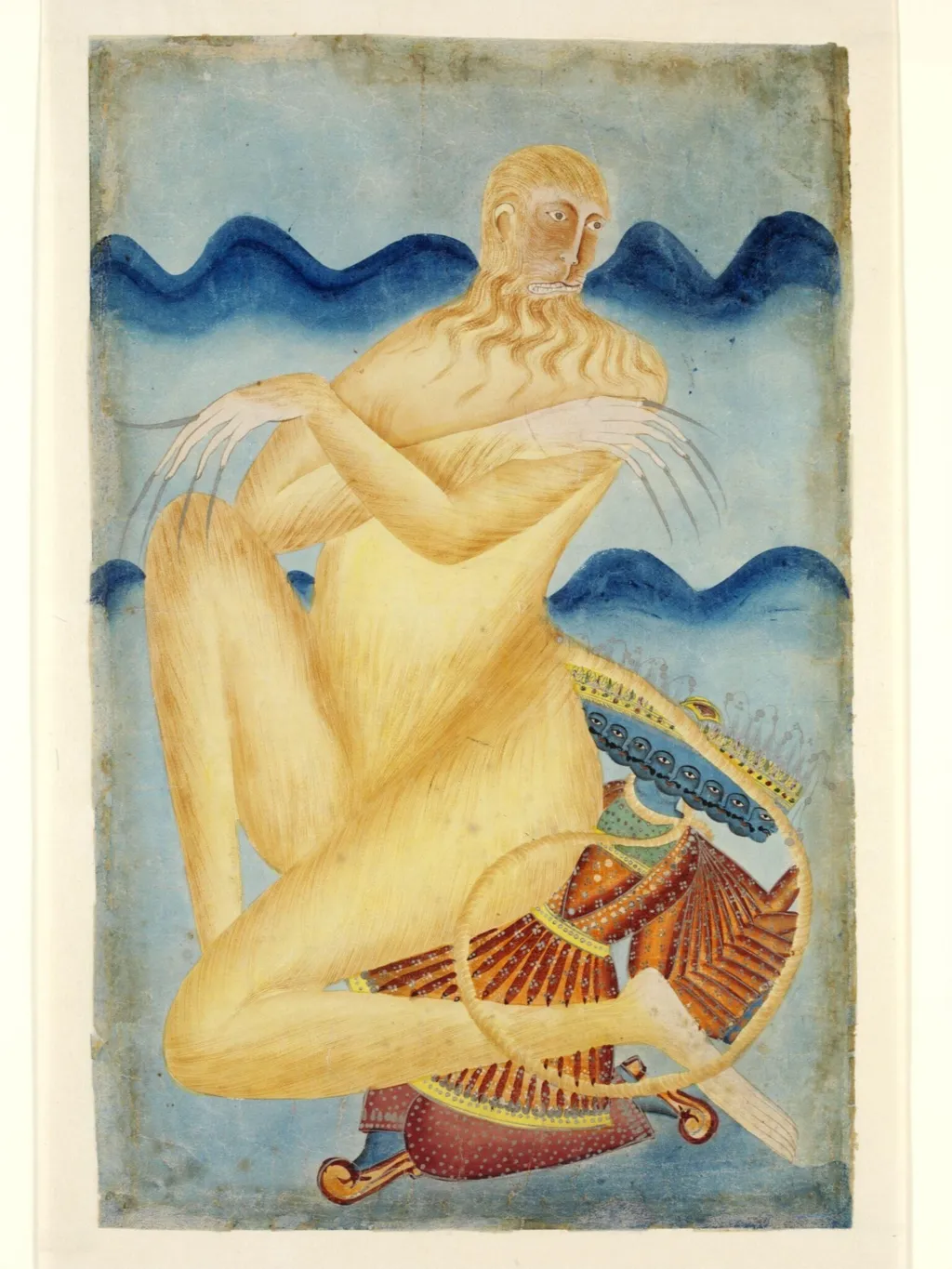
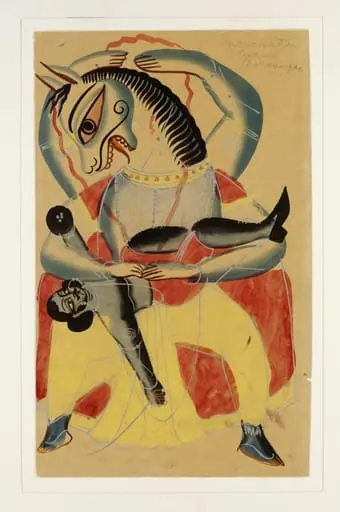
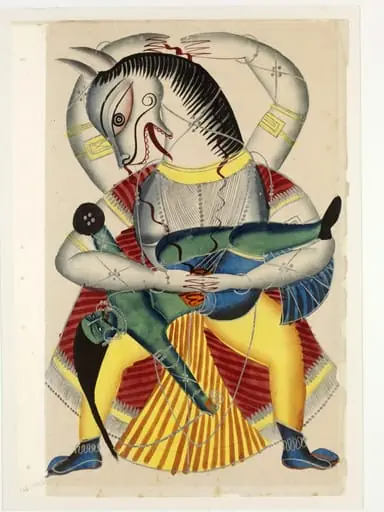
Hanuman and Ravana is a paint painting by the Impressionist artist Unknown. It dates from 1860 and is held in the collection of the Victoria and Albert Museum. This watercolour and tin-alloy painting on paper portrays a pivotal Hindu mythological scene: Hanuman subduing Ravana.
About this work
Overview
This watercolour and tin-alloy painting on paper portrays a pivotal Hindu mythological scene: Hanuman subduing Ravana. The artwork combines traditional elements with distinctive visual choices.
Subject & Meaning
The painting illustrates Hanuman, the monkey god, binding Ravana, the ten-headed demon king, with his tail. The blue-wave background alludes to Hanuman's journey across the sea to Lanka, where Ravana held Sita captive, contextualizing the scene within the Ramayana narrative.
Technique & Style
Executed with numerous fine brushstrokes, Hanuman's golden, hairy form exhibits varied tonal shading, deviating from the typical bold shading of Kalighat-style paintings. The contrast between the yellow, long-haired Hanuman and the blue, crowned Ravana adds visual depth.
History & Provenance
Acquired by the collection from G.S. Hill, Esq. in 1959, the painting's pre-1959 history is not detailed here.
Context
While reminiscent of Impressionist influences in its brushwork, the painting's subject matter and figures are deeply rooted in Hindu mythology, specifically the Ramayana.
Artist & collection

 Domestic Scene
 Giacomo and Cardinal Marco, investing Andrea, Abbot of San Zeno, with his Benefice
 The Nymph of Fontainebleau
 Portrait of a Woman
 Madonna and Child with Saints in the Enclosed Garden
 Venus and Minerva
 Family Group of Four on Sofa
 Wall painting from Room H of the Villa of P. Fannius Synistor at Boscoreale