Artwork
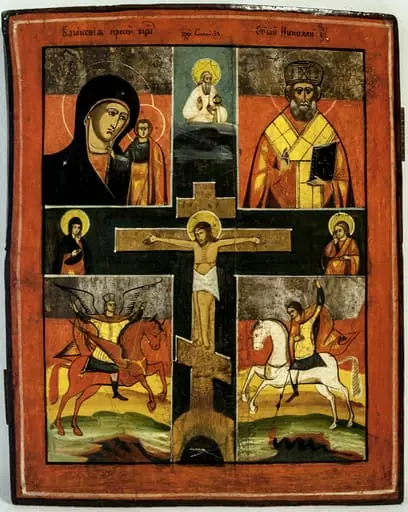
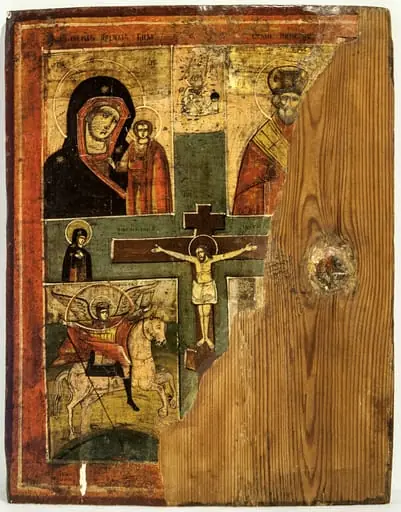
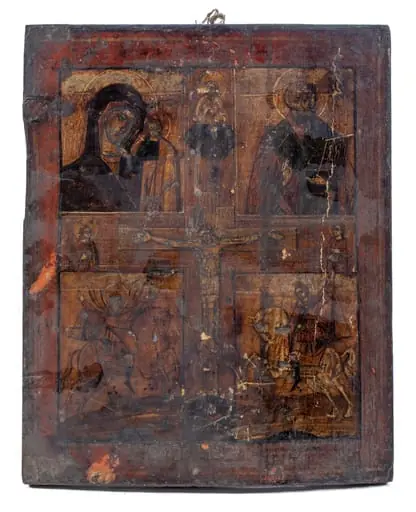
Icoană în patru registre, în centru Iisus Răstignit
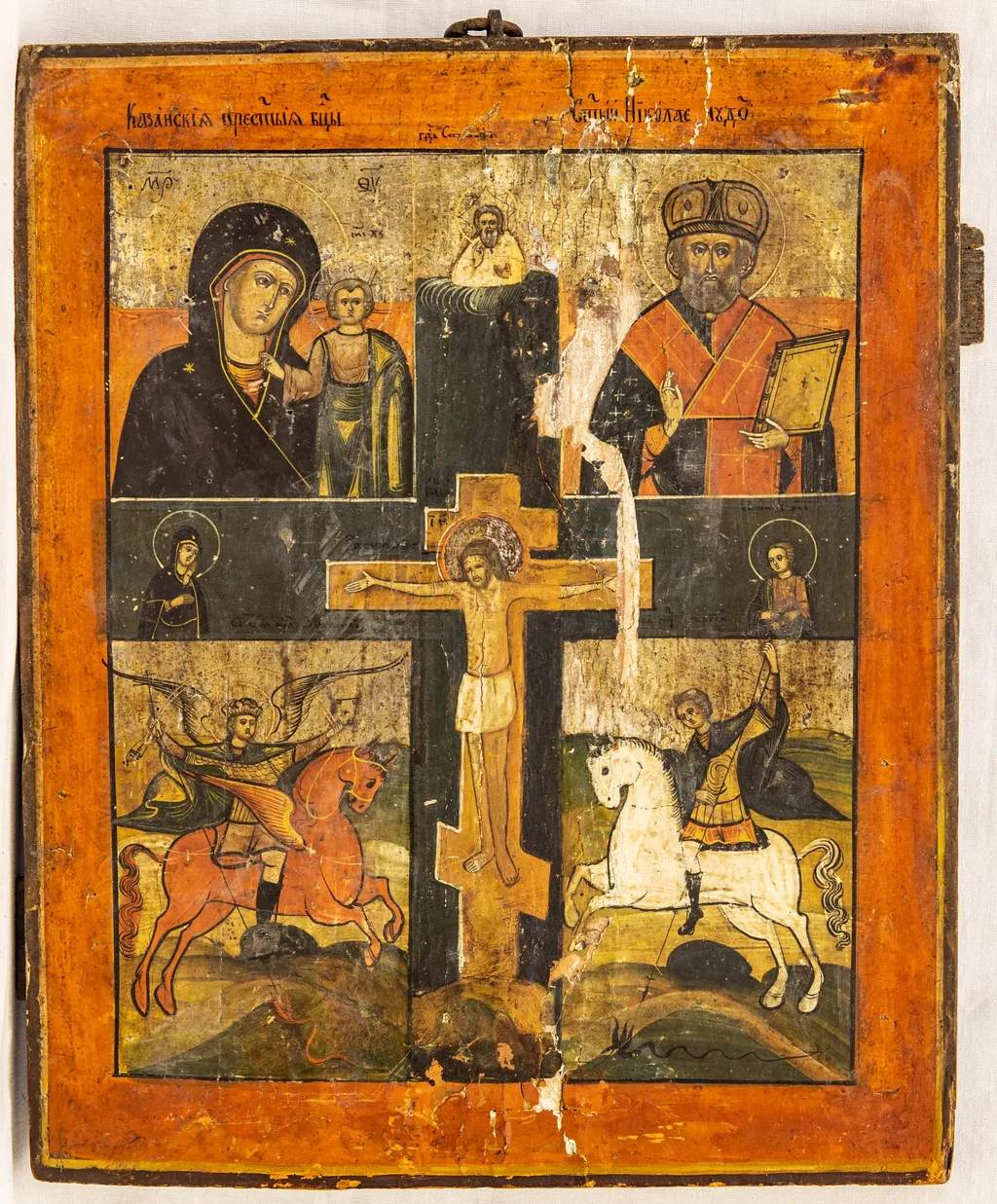
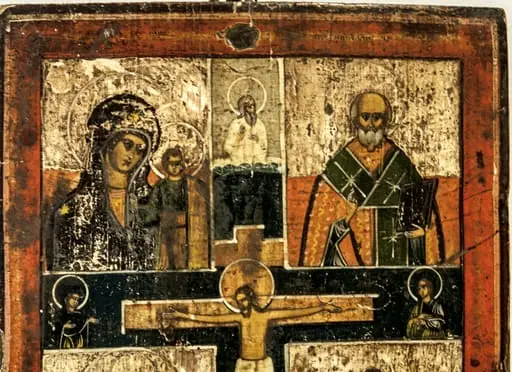
Icoană în patru registre, în centru Iisus Răstignit is a drawing by Unknown. It dates from 1850 and is held in the collection of the Gavrila Simion Eco-Museum Research Institute Tulcea. This small devotional panel is divided into four horizontal registers, each depicting a sacred scene.
About this work
Overview
Rendered with flat, opaque pigments and a gold leaf background, it was likely designed for personal or portable use in private worship.
This small devotional panel is divided into four horizontal registers, each depicting a sacred scene. Rendered with flat, opaque pigments and a gold leaf background, it was likely designed for personal or portable use in private worship. The rigid composition and stylized figures reflect Byzantine traditions, while the presence of inscriptions in an archaic script suggests an origin in the Eastern Orthodox world, possibly from the late medieval period.
Subject & Meaning
The upper register shows the Virgin Mary with the Christ Child, accompanied by a bearded figure holding a book, likely the Prophet Isaiah or another Old Testament figure. The central scene depicts Christ crucified, the focal point of Christian salvation. Below, two apocalyptic riders appear: one with a golden horse and winged being, possibly the Angel of the Apocalypse, and another on a white horse wielding a spear, symbolizing Christ’s return in judgment.
Technique & Style
The panel employs tempera paint on wood, with areas of gold leaf applied to signify divine presence and transcendence. Figures are rendered in a flattened, two-dimensional manner, with minimal modeling and no perspective. Color is symbolic rather than naturalistic—blue for Mary’s purity, red for Christ’s sacrifice. The use of fine linear details, including cross-hatching in drapery, suggests a skilled hand trained in iconographic conventions.
History & Provenance
The panel’s archaic script and stylistic features point to a production date between the 13th and 15th centuries, likely in the Balkans or Anatolia. Its compact size and portable format indicate it was owned by a private individual, possibly a member of the clergy or a wealthy layperson. The survival of the gold ground and legible inscriptions suggests careful preservation, though its exact origin and early ownership remain undocumented.
Context
This icon belongs to a broader tradition of Eastern Orthodox devotional art, where layered narratives served as visual theology for the faithful. The four-register format was common in portable icons, allowing worshippers to meditate on key moments from Scripture and Revelation. Its design reflects liturgical practices that emphasized the continuity between Old and New Testaments, and the expectation of Christ’s Second Coming.
Legacy
Though not widely known outside specialized circles, this icon exemplifies the enduring influence of Byzantine iconography in Orthodox Christian communities. Its preservation offers insight into how religious imagery functioned in daily spiritual life, bridging the divine and the domestic. Later artists and collectors have studied its formal discipline, recognizing its role in sustaining theological narratives through visual economy.
Artist & collection
Museum
Gavrila Simion Eco-Museum Research Institute Tulcea
Continue through works from the same source collection.
 Domestic Scene
 Giacomo and Cardinal Marco, investing Andrea, Abbot of San Zeno, with his Benefice
 The Nymph of Fontainebleau
 Portrait of a Woman
 Madonna and Child with Saints in the Enclosed Garden
 Venus and Minerva
 Family Group of Four on Sofa
 Wall painting from Room H of the Villa of P. Fannius Synistor at Boscoreale