Artwork
Icoană pe lemn ”Răstignirea”
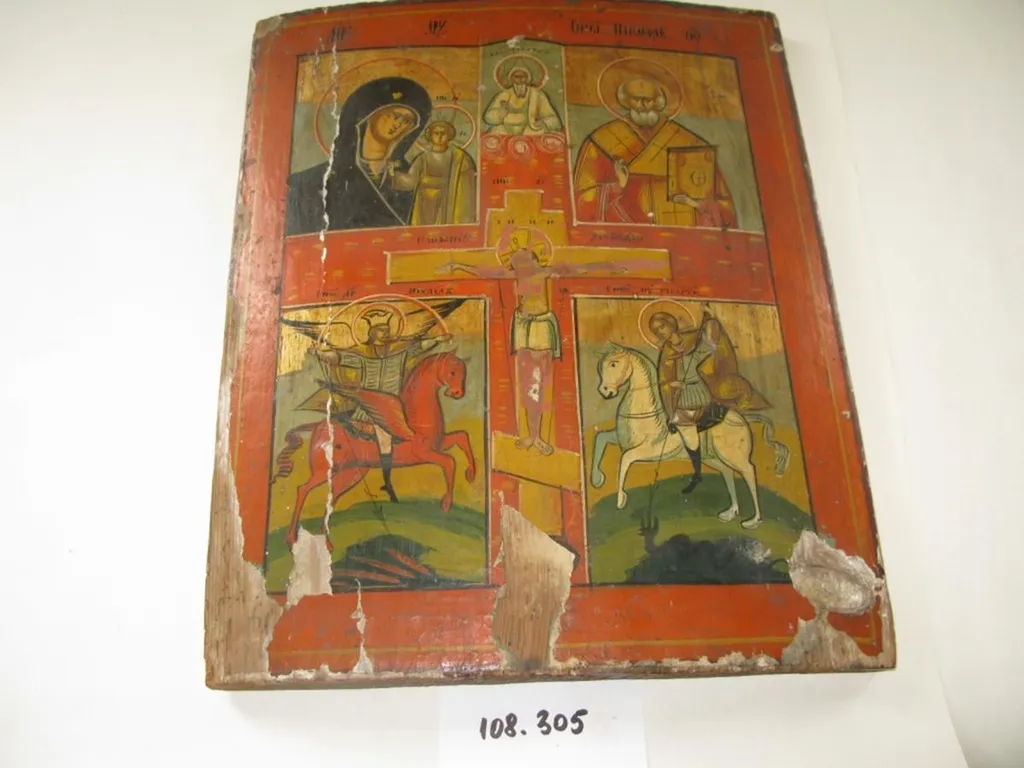
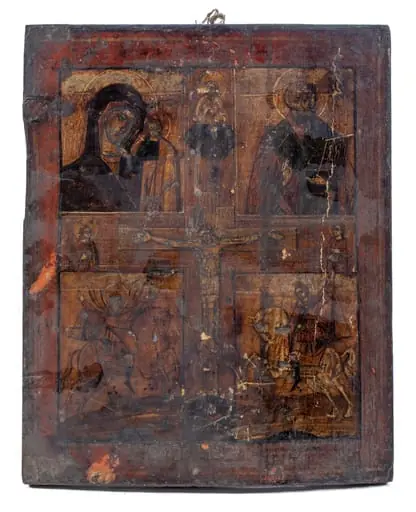
Icoană pe lemn ”Răstignirea” is a drawing by Unknown. It dates from 1850 and is held in the collection of the National Museum of Romanian History. This wooden panel, dated to the late medieval period, presents a narrative of Christ’s crucifixion through six compact, arranged scenes.
About this work
Overview
A dark, muted background enhances the vivid use of red, gold, and green pigments, which remain partially preserved despite surface wear and flaking.
This wooden panel, dated to the late medieval period, presents a narrative of Christ’s crucifixion through six compact, arranged scenes. The composition is divided into two horizontal rows, each containing three panels. A dark, muted background enhances the vivid use of red, gold, and green pigments, which remain partially preserved despite surface wear and flaking. The central image of the crucified figure anchors the sequence, implying a unified theological narrative.
Subject & Meaning
The scenes depict key moments from the Passion, with the crucifixion at the center as the focal point. Above, figures likely represent the Virgin Mary with the infant Christ, John the Evangelist, and a royal donor or emperor. Below, two mounted knights may symbolize guardians or pilgrims, while the lone crucified figure signifies Christ’s sacrifice. The arrangement suggests a devotional sequence meant to guide contemplation of redemption through suffering.
Technique & Style
Painted in tempera on wood, the panel employs flat, stylized forms typical of Byzantine-influenced iconography. Figures are rendered with minimal depth, emphasizing symbolic presence over naturalism. Gold leaf highlights garments and halos, while intense reds and greens contrast against the dark ground. The rigid grid layout reflects liturgical conventions, prioritizing clarity and spiritual order over spatial realism.
History & Provenance
The panel likely originated in a Eastern European Orthodox community, possibly in Romania or Moldavia, during the 15th or early 16th century. Its wear and partial paint loss indicate prolonged use in a domestic or chapel setting. No documented provenance exists, but similar panels were commonly commissioned by pious families or local churches for private devotion and ritual observance.
Context
Such wooden icons were integral to daily religious life, serving as focal points for prayer and remembrance. Placed in home altars or church niches, they facilitated personal connection with sacred events. The six-scene format aligns with liturgical cycles, allowing viewers to meditate on Christ’s Passion in stages. Their durability made them suitable for repeated handling and veneration across generations.
Legacy
This panel exemplifies a widespread tradition of narrative iconography in Orthodox Christianity, where visual storytelling reinforced doctrinal teachings. Though largely replaced by printed materials after the 18th century, such works remain vital to understanding pre-modern spiritual practice. Surviving examples like this one offer insight into how faith was visually encoded in everyday objects.
Artist & collection

 Domestic Scene
 Giacomo and Cardinal Marco, investing Andrea, Abbot of San Zeno, with his Benefice
 The Nymph of Fontainebleau
 Portrait of a Woman
 Madonna and Child with Saints in the Enclosed Garden
 Venus and Minerva
 Family Group of Four on Sofa
 Wall painting from Room H of the Villa of P. Fannius Synistor at Boscoreale
 Intrarea în biserică
 Bunavestire
 Adormirea Maicii Domnului
 Răstignirea
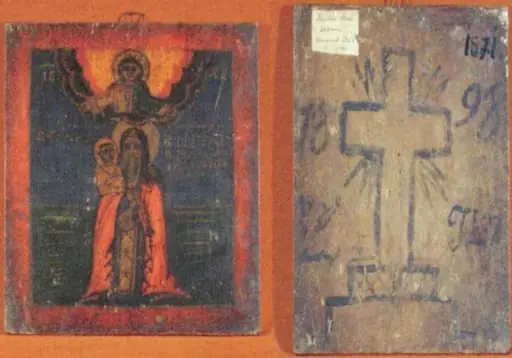 Sfântul Stelian
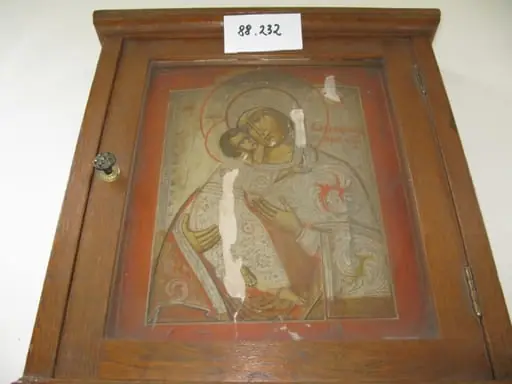 Icoană pe lemn "Maica Domnului cu Pruncul Iisus"
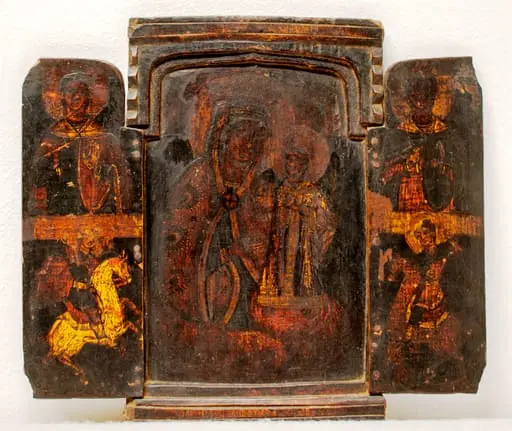 Pe panoul central este reprezentată Maica Domnului Hodighitria(Călăuzitoarea). Pruncul stă în picioare, amândoi fiind înveșmântați în straie împărătești. Maica ține Pruncul cu mâna stângă, cu dreapta arată către El. Voleul stâng, jumătatea inferioară - Sfântul Gheorghe călare pe cal alb. Înveșmântat în costum românesc de oștean medieval, mantie roșie. Calul cu picioarele din față ridicate, harnașament de culoare roșie. Deasupra e posibil să fie tot sfântul Gheorghe, în stânga ținând crucea, cu dreapta face gestul păcii, al liniștii.(prin analogie cu 34530). Simetric, pe latura dreaptă a tripticului se află jos, Sf. Dumitru, călare pe cal roșu, în poziție asemănătoare cu a SF. Gheorghe, iar sus probabil tot el, în altă ipostază iconografică(analogie) . Veșmintele au culorile inversate(tunica roșie -dreapta, albastru-stânga, mantie roșu -stânga, albastru - dreapta), la fel la sfinții războinici, probabil în legătură cu reprezentarea populară a timpului. Inițial, tripticul se închidea, dovadă inscripția care se continuă pe cele două uși. Ulterior a fost fixat cu cuie de fier, iar prinderea se făcea cu o sfoară legată de două cuie bătute pe cant.