Artwork
Icoana este deosebită, prin tematica iconografică abordată: Încoronarea Maicii Domnului. În centrul icoanei este Maica Domnului Împărăteasă, pe tron arhieresc, cu Pruncul iisus Hristos în brațe. Maica Domnului este îmbrăcată în veșmânt albastru bleumarin, iar Pruncul Iisus Hristos este înveșmântat cu alb-albastru. Pruncul Iisus ține în mână globul pământesc. În dreapta Maicii Domnului este Sfântul Mare Ierarh Nicolae făcător de minuni, îmbrăcat în veșminte arhirești, cu mantie roșie vermillon, mithră, cârjă mitropolitană. În stânga Maicii Domnului este Sfântul Mare Prooroc Ioan Botezătorul și Înaintemergătorul Domnului Iisus Hristos. Sfântul Ioan Botezătorul are și culoarea verde în combinația cromatică a veșmântului. Verdele este culoarea Sfântului Ioan. În registrul superior, sunt Sfinții Arhangheli Mihail și Gavriil, așezând coroana de Împărăteasă a Cerurilor pe capul Maicii Domnului. Aripile Sfinților Îngeri sunt galbene. Se remarcă mandorle de nouri albi-gri, în registrul superior. În registrul inferior, este un postament cărămiziu. Cromatica este armonioasă: roșu vermillon, orange, cărămiziu, galben chihlimbar, albastru ceruleum, cobalt, bleu-ciel, alb, negru, verde de China. Inscripția din româno-chirilică se traduce: IC XC MP Iisus Hristos Maica Domnului Sfântul Nicolae Sf Ioan Botezătorul Pocăiți-vă. Icoana este de Valea Sebeșului.
Icoana este deosebită, prin tematica iconografică abordată: Încoronarea Maicii Domnului. În centrul icoanei este Maica Domnului Împărăteasă, pe tron arhieresc, cu Pruncul iisus Hristos în brațe. Maica Domnului este îmbrăcată în veșmânt albastru bleumarin, iar Pruncul Iisus Hristos este înveșmântat cu alb-albastru. Pruncul Iisus ține în mână globul pământesc. În dreapta Maicii Domnului este Sfântul Mare Ierarh Nicolae făcător de minuni, îmbrăcat în veșminte arhirești, cu mantie roșie vermillon, mithră, cârjă mitropolitană. În stânga Maicii Domnului este Sfântul Mare Prooroc Ioan Botezătorul și Înaintemergătorul Domnului Iisus Hristos. Sfântul Ioan Botezătorul are și culoarea verde în combinația cromatică a veșmântului. Verdele este culoarea Sfântului Ioan. În registrul superior, sunt Sfinții Arhangheli Mihail și Gavriil, așezând coroana de Împărăteasă a Cerurilor pe capul Maicii Domnului. Aripile Sfinților Îngeri sunt galbene. Se remarcă mandorle de nouri albi-gri, în registrul superior. În registrul inferior, este un postament cărămiziu. Cromatica este armonioasă: roșu vermillon, orange, cărămiziu, galben chihlimbar, albastru ceruleum, cobalt, bleu-ciel, alb, negru, verde de China. Inscripția din româno-chirilică se traduce: IC XC MP Iisus Hristos Maica Domnului Sfântul Nicolae Sf Ioan Botezătorul Pocăiți-vă. Icoana este de Valea Sebeșului. is a drawing by Unknown. It dates from 1850 and is held in the collection of the ASTRA National Museum Complex. This wooden panel icon depicts the Coronation of the Virgin, a distinctive iconographic theme.
About this work
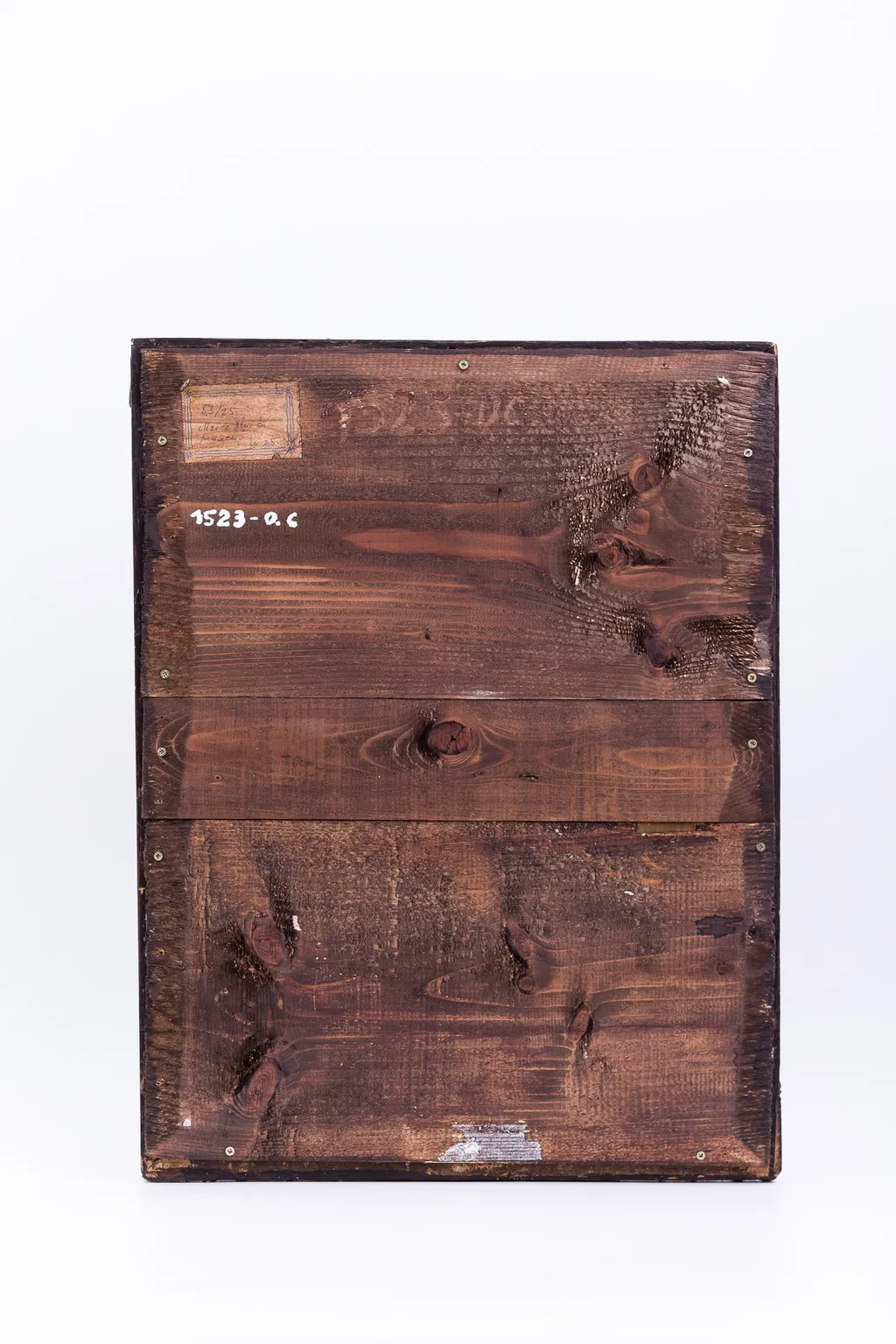
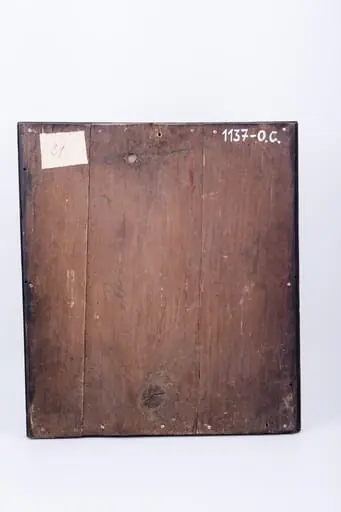
The colors are bright—deep reds, blues, and golds—but here you only see the wood’s rough texture and signs of age.
This is the back of a wooden panel. You see dark wood grain, worn smooth in spots. A faded label is stuck near the top, and a handwritten number, *1523-0,c*, is marked in the corner. The edges are uneven, like old furniture.
The front of this panel shows a religious scene: a crowned woman holding a child, flanked by two saints. The colors are bright—deep reds, blues, and golds—but here you only see the wood’s rough texture and signs of age.
Look up inscription to see how old texts like this one were written in churches.
Overview
This wooden panel icon depicts the Coronation of the Virgin, a distinctive iconographic theme. At its center, the Virgin Mary, enthroned as Empress, holds the Infant Jesus Christ. Flanked by Saint Nicholas on the right and Saint John the Baptist on the left, the scene is completed by Archangels Michael and Gabriel crowning the Virgin in the upper register.
Subject & Meaning
The icon's central theme, the Coronation of the Virgin, symbolizes her role as Queen of Heaven. The Virgin, dressed in blue bleumarin, and the Infant Jesus, in blue-white, are accompanied by Saint Nicholas, identifiable by his archiepiscopal attire and red vermillion mantle, and Saint John the Baptist, distinguished by green in his chromatic scheme, a color associated with him. The Infant Jesus holds a terrestrial globe, emphasizing dominion over the world.
Technique & Style
Executed on a wooden panel, the icon features a harmonious color palette including vermillion red, orange, terracotta, chihlimbar yellow, ceruleum blue, cobalt, sky blue, white, black, and China green. The style is characterized by the use of golden accents, notably in the coronation scene and the angels' yellow wings, set against a backdrop of white-grey cloud mandorles in the upper register and a terracotta postament below.
History & Provenance
Originating from Valea Sebeșului, the icon bears an old chirilic Romanian inscription translating to 'IC XC MP Jesus Christ, Mother of God, Saint Nicholas, Saint John the Baptist, Repent.' A handwritten number '1523-0,c' on the reverse suggests a potential dating or cataloging from the 16th century, though the icon's actual age must be verified through further analysis.
Context
The icon reflects traditional religious art practices of its region and era, with the chirilic inscription indicating its use in liturgical or devotional contexts within the Orthodox Church. The specific combination of saints and the Coronation theme may also hint at the patron's or artist's particular devotional focuses.
Legacy
As a piece from Valea Sebeșului, this icon contributes to the understanding of regional artistic and religious practices. Its state of preservation, with worn wood and faded labels, provides insight into the lifecycle of religious artifacts, while its iconography enriches the study of the Coronation of the Virgin theme in Orthodox iconography.
Artist & collection

 Domestic Scene
 Giacomo and Cardinal Marco, investing Andrea, Abbot of San Zeno, with his Benefice
 The Nymph of Fontainebleau
 Portrait of a Woman
 Madonna and Child with Saints in the Enclosed Garden
 Venus and Minerva
 Family Group of Four on Sofa
 Wall painting from Room H of the Villa of P. Fannius Synistor at Boscoreale
 Maica Domnului este înveșmântată în cămașă femeiască tradițională, presupusă iie cu câmpuri verticale alternativ pictate cu roșu vermillon și verde, cu danteluță aurie la baza gâtului, cu maforion roșu vermillon, poartă coroniță de împărăteasă și aureolă. Maica Domnului are gâtul neacoperit cu veșmânt și pe sub maramă se observă părul șaten castaniu. Este mai puțin frecventă această atitudine vestimentară a Maicii Domnului, asemănătoare femeilor din vremea aceea. Icoana este de la Poiana Sibiului, pictată în manieră specifică Mărginimii Sibiului. Pruncul Iisus Hristos este înveșmântat în roșu vermillon și verde și auriu la gulerașul cămășii populare, cu coroană și aureolă. Pruncul Iisus o ține pe Maica Domnului cu mânuța pe după gât, într-o tandrețe mângâietoare, lipindu-și capetele, unul de celălalt. Este a atitudine a Maicii Domnului Eleusa. Fondul icoanei este cerul de culoarea albastru ultramarin. Întreaga icoană este încadrată de un chenar decorativ geometrizant și floral compact, un ușor baroc, de culoare brun-roșcat-verde. Cromatică: roșu vermillon, albastru, verde de China, auriu, ocru-brun-bronziu, alb, negru, roșu stacojiu, brun-roșcat. Icoana este aparte și prin compoziție și prin veșminte. Chipurile au o delicatețe și o tandrețe emoționante. Inscripția din româno-chirilică se traduce MP Maica Domnului IC XC Iisus Hristos.
 Scena Cinei celei de Taină se desfășoară într-un interior sugerat de elemente arhitectonice, coloane, candelabru, candele. În centrul icoanei este Mântuitorul Iisus Hristos binecuvântând mâncarea, la masă, alături de ucenici și apostoli. Cu brațul stâng îl ține lipit de piept pe Ioan cel iubit. Pe masă sunt așezate un potir pentru vin și tacâmuri și farfurioare mici.Personajele au chipurile expresive, veșmintele personajelor și faldurile feței de masă, cât și draperiile sunt pictate cu măiestrie de pictor. Veșmintele sunt predominant roșii. Cromatica este armonioasă și echilibrată, pornindu-se gradual dinspre exterior înspre interior, de la albastru spre alb, ajungându-se la albul luminos al mesei celor dăruite. Compoziția este încadrată de elemente de arhitectură, coloane, arcade, creându-se, astfel, intimitatea Cinei celei de Taină. Totul este concentric, strângându-se în jurul Potirului. Elemente de arhitectură se întrezăresc printre cele 5 coloane. Se întrezărește o cruce formată din axa verticală Potirul și candela și cea orizontală - brațele Îmbrățișării Mântuitorului - Dragostea jertfelnică atotcuprinzătoare. Icoana este a lui Savu Moga, din Arpașu de Sus, Țara Făgărașului. Icoana este datată 1877. Inscripția din româno-chirilică se traduce Cina cea de Taină.
 Sfânta Mare Cuvioasă Parascheva de la Iași are crucea aurie-bronzie în mâna dreaptă și ramură de finic verde brad în mâna dreaptă. Este îmbrăcată în veșmânt roșu vermillon, cu interiorul căptușit cu gri antracit, alb ivoriu și galben-solar. Sacosul este alb ivoriu crem-bej, cu danteluță și guleraș galben. Sfânta Cuvioasă are părul negru lung, lăsat pe umeri, coroană roșie și aureolă. Fondul icoanei este cerul albastru bleu-ciel-alburiu senin, în registrul superior și un câmp înalt luminos de grâu galben-copt, în registrul mediu și inferior. Întreaga compoziție iconografică este încadrată de un chenar decorativ fitomorf, format dintr-o ghirlandă de 2 ruje - trandafiri roșii și bujori roșii. Inscripția din româno-chirilică se traduce Paraschiva. Cromatica este armonioasă: roșu vermillon, albastru bleu-ciel, verde forest, bej-crem, galben chihlimbar, ocru, muștar, negru, alb. Icoana este din Nordul Transilvaniei, Nicula.
 Maica Domnului Împărăteasă a Cerurilor, pe tron așezată, ține Pruncul Iisus Hristos, în brațe. Maica Domnului este îmbrăcată cu mantie cu maforion brun, cu interiorul căptușit cu verde închis. Poartă aureolă și coroniță roșie de împărăteasă. Pruncul Iisus Hristos este îmbrăcat cu gri și verde închis, are aureolă și binecuvântează cu mâna dreaptă. În registrul superior sunt ocrotitori și păzitori Sfinții Arhangheli Mihail și Gavriil, sprijinindu-se cu mâinile de cele două turnulețe - elemente decorativ geometrizante din structura arhitecturală a bogatului tron arhieresc al Maicii Domnului Împărăteasă. În registrul superior sunt Sfântul Mare Evanghelist Luca, cel care a pictat-o pentru prima dată pe Maica Domnului cu Pruncul Iisus Hristos. Sfântul Evanghelist Luca apare împreună cu simbolul reprezentativ - vițelul - Parabola Întoarcerii Fiului risipitor. În cealaltă parte este Sfântul Evanghelist Ioan, cu vulturul, asemenea căruia se înalță în zbor Cuvântul Dumnezeiesc, fiind Teologul Iubirii. Cromatica este armonioasă, caldă și luminoasă: roșu vermillon, verde spanac-avocado, ocru, brun, gri, alb, negru. Inscripția din româno-chirilică se traduce Maica Domnului MP Iisus Hristos IC XC. Icoana este încadrată de un chenar decorativ geometrizant, pe laterale, ca două panglici late, cu ghirlande de flori mari, de culoare verde-gri. Icoana este datată 1866. Icoana este a lui Savu Moga, din Arpașu de Sus, Țara Făgărașului.
 Trupul Mântuitorului Iisus Hristos este coborât de pe cruce de patru ucenici, învelit în giulgiul alb și primit de Maica Domnului și două femei mironosițe purtătoare mir. În partea dreaptă, alături de Maica Domnului este și ucenicul cei iubit, Ioan Teologul, care va fi Sfântul Apostol și Evanghelist Ioan, Teologul Iubirii. Compoziția este foarte simetrică, echilibrată. Petele de sânge de pe giulgiul alb, interiorul căptușit al maforiumului Maicii Domnului și scara, pe care se urcă ucenicii, sunt de culoare roșie. Veșmintele toate sunt verzi kaki, cu tonuri de bronz și olive-smarald. Cerul este albastru închis, ca de noapte de bleumarin. Inscripția în româno-chirilică este cu alb pe cerul ceruleum și se traduce Coborârea de pe cruce a Mântuitorului Iisus Hristos IC XC. Icoana este pictată la Lancrăm, Valea Sebeșului, având o cromatică fină, delicată, puternică, armonioasă: verde, kaki, olive, smarald, albastru ceruleum, gri, bronz, alb, negru, roșu.