Artwork
Icoana îi reprezintă alături, față în față, ca într-o oglindă, pe Pruncul Iisus Hristos și Pruncul Ioan, cel care avea să fie Sfântul Ioan Botezătorul și Înaintemergătorul Domnului nostru Iisus Hristos. Cei doi copilași erau veri, cu o diferență de șase luni între ei. Pruncul Iisus Hristos are în mânuțe globul pământesc cu o cruce deasupra, asemenea unui chivot sfințit, iar Pruncul Ioan are în brațe un mieluț, arătând către Mântuitorul Iisus Hristos: „Iată mielul!”. Sunt înfășurați amândoi cu câte o țesătură roșie-cărămizie-roz, culoarea pătimirii și a jertfei. În interiorul icoanei este un composit de albastru ultramarin bleu-marin și galben luminos. Întreaga tematică iconografică este încadrată de un chenar decorativ fitomorf, format dintr-o ghirlandă de trandafiri, 5 duble și 4 ruje roșii, bobocei de trandafirași, În centru icoanei, între cei doi copilași este un fruct de măceș. Icoana este de Nicula, având o cromatică luminoasă: roșu vermillon-cărămiziu-roz, albastru ultramarin și bleumarin, bleu ciel și ceruleum, galben chihlimbar, verde brad, alb, negru. Inscripția din româno-chirilică se traduce: Ioan IC XC Iisus Hristos. Icoana este din Nordul Transilvaniei, Nicula.
Icoana îi reprezintă alături, față în față, ca într-o oglindă, pe Pruncul Iisus Hristos și Pruncul Ioan, cel care avea să fie Sfântul Ioan Botezătorul și Înaintemergătorul Domnului nostru Iisus Hristos. Cei doi copilași erau veri, cu o diferență de șase luni între ei. Pruncul Iisus Hristos are în mânuțe globul pământesc cu o cruce deasupra, asemenea unui chivot sfințit, iar Pruncul Ioan are în brațe un mieluț, arătând către Mântuitorul Iisus Hristos: „Iată mielul!”. Sunt înfășurați amândoi cu câte o țesătură roșie-cărămizie-roz, culoarea pătimirii și a jertfei. În interiorul icoanei este un composit de albastru ultramarin bleu-marin și galben luminos. Întreaga tematică iconografică este încadrată de un chenar decorativ fitomorf, format dintr-o ghirlandă de trandafiri, 5 duble și 4 ruje roșii, bobocei de trandafirași, În centru icoanei, între cei doi copilași este un fruct de măceș. Icoana este de Nicula, având o cromatică luminoasă: roșu vermillon-cărămiziu-roz, albastru ultramarin și bleumarin, bleu ciel și ceruleum, galben chihlimbar, verde brad, alb, negru. Inscripția din româno-chirilică se traduce: Ioan IC XC Iisus Hristos. Icoana este din Nordul Transilvaniei, Nicula. is a drawing by Unknown. It dates from 1850 and is held in the collection of the ASTRA National Museum Complex. The icon portrays the infant Jesus and the infant John, presented as mirror images facing each other.
About this work
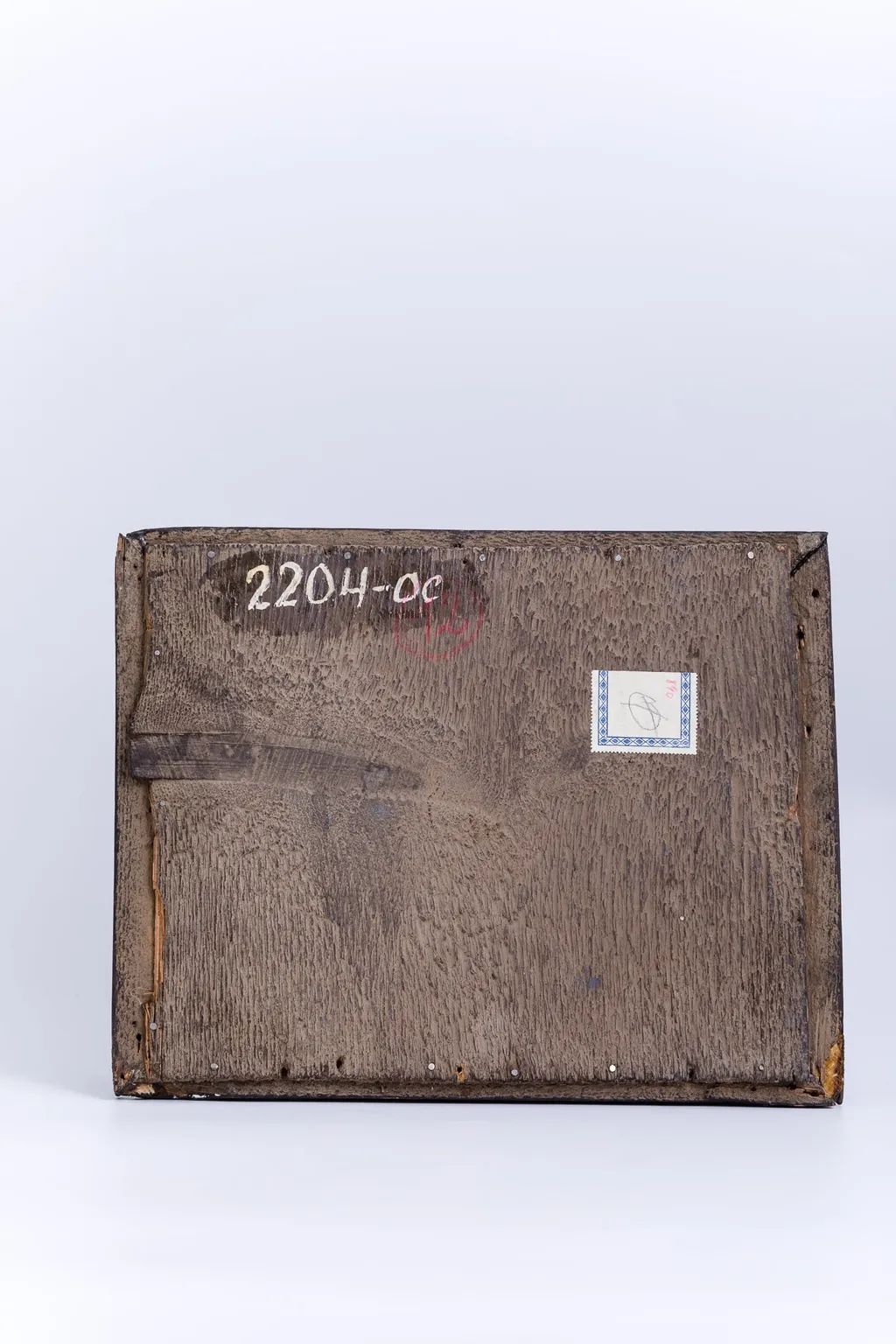
There’s a faded handwritten number "2204-00" near the top, and a small blue-and-white sticker in the corner, possibly a museum tag.
This looks like the back of an old wooden panel. The wood is dark, weathered, and shows signs of age with visible grain and some wear. There’s a faded handwritten number "2204-00" near the top, and a small blue-and-white sticker in the corner, possibly a museum tag.
The panel is likely part of an icon, given the religious symbols described in the facts—like the lamb and the inscription. The wood’s rough texture and simple framing suggest it’s meant to hold something sacred.
Next, look up inscription to see how these old symbols were used in religious art.
Overview
The icon portrays the infant Jesus and the infant John, presented as mirror images facing each other. Both children are wrapped in a red‑brick‑pink cloth that evokes themes of suffering and sacrifice. The composition is set against a background of ultramarine blue and bright yellow, framed by a decorative foliage border of roses and red berries, with a rose‑hip fruit at the centre.
Subject & Meaning
Jesus holds a small globe crowned with a cross, symbolising the world under divine authority, while John cradles a lamb and gestures toward the Christ child, echoing the biblical declaration “Behold the Lamb of God.” The two infants are described as cousins, six months apart in age, linking the future Baptist with the Savior.
Technique & Style
Executed in the luminous palette typical of Nicula workshop icons, the work combines vermilion‑brick‑pink, ultramarine, sky‑blue, amber yellow, fir‑green, white and black pigments. The use of ultramarine and bright yellow creates a radiant contrast, while the vegetal garland border reflects a stylised, ornamental approach common in Transylvanian ecclesiastical art.
History & Provenance
The piece originates from the northern Transylvanian region of Nicula, an area known for its iconographic tradition. An inscription in Romanian‑Cyrillic reads “Ioan IC XC Iisus Hristos,” identifying the figures. The back of the panel shows a weathered wooden surface with a faint “2204‑00” marking, suggesting a cataloguing or inventory number from a later collection.
Context
Within Eastern Christian iconography, pairing the infant Christ with the infant John underscores their intertwined destinies and the prophetic role of John the Baptist. The surrounding rose motif and the red‑toned drapery align the work with liturgical symbolism of martyrdom and redemption.
Artist & collection

 Domestic Scene
 Giacomo and Cardinal Marco, investing Andrea, Abbot of San Zeno, with his Benefice
 The Nymph of Fontainebleau
 Portrait of a Woman
 Madonna and Child with Saints in the Enclosed Garden
 Venus and Minerva
 Family Group of Four on Sofa
 Wall painting from Room H of the Villa of P. Fannius Synistor at Boscoreale
 Icoana îl reprezintă pe Pruncul Ioan Botezătorul, cel care avea să fie Sfântul Ioan Botezătorul și Înaintemergătorul Domnului nostru Iisus Hristos. Pruncul Ioan are în brațe un mieluț alb-brun, arătând către Mântuitorul Iisus Hristos: „Iată mielul!”. Îl ține în brațe cu tandrețe, aplecându-se peste el ocrotitor. Cu mâna stângă ține Crucea Jertfei brun-maro, cu un stindard verde. Este înfășurat cu o țesătură brun-neagră, culoarea pocăinței, jertfei și muceniciei. În interiorul icoanei este un composit de albastru bleu-ciel senin și galben chihlimbar. Întreaga tematică iconografică este încadrată de un chenar decorativ fitomorf, format dintr-o ghirlandă de trandafiri dubli și bujori - 15 ruje roșii stilizate. Icoana are o cromatică luminoasă: roșu vermillon, albastru bleu-ciel și ceruleum, galben chihlimbar, verde brad-forest, brun, maro, alb, negru, auriu. Icoana este Nordul Transilvaniei, Nicula.
 Icoana îl reprezintă pe Mântuitorul Iisus Hristos, copil fiind, având în mânuțe globul pământesc cu o cruce deasupra, asemenea unui chivot sfințit, galben cu verde. Copilașul este înfășurat cu o țesătură roșie vermillon-roz și negru. În interiorul icoanei este un composit de albastru ceruleum și galben chihlimbar luminos. Întreaga tematică iconografică este încadrată de un chenar decorativ fitomorf, format dintr-o ghirlandă de trandafiri, 3 ruje roșii, cu motivul zăluței albe în interior, pe latura inferioară a icoanei și un boboc de măceș în spatele Copilașului Iisus. Inscripția din româno-chirilică se traduce Cristos. Icoana este de Nicula, având o cromatică luminoasă: roșu vermillon, roz, albastru bleu-ciel și ceruleum, galben chihlimbar, verde brad, alb, negru. Icoana este din Nordul Transilvaniei, Nicula.
 Icoana reprezintă Învierea Domnului Iisus Hristos. Mântuitorul Iisus Hristos, ieșind din mormânt, Înviind, Binecuvântând zdrobește ușile iadului. Mântuitorul este înfășurat cu o țesătură verde kaki-gri în mijlocul coapselor și a mijlocului și cu mantia roșie vermillon pe umeri. În dreapta mormântului gri, deschis, sunt doi ostași romani, uimiți. Icoana de Nicula are o cromatică armonioasă: galben-solar, roșu vermillon, alb, albastru cobalt, verde brad-pădure, negru, gri cenușiu. Fondul icoanei este cerul albastru cobalt-ceruleum, în registrul superior și un câmp galben-ocru, cu brun-maro cu pete crem, în registrul inferior, realizându-se, astfel sugestiv, intrarea și ieșirea din pământul morții și a păcatului. Întreaga compoziție iconografică este încadrată de un chenar decorativ geometrizant roșu vermillon și de unul fitomorf, format dintr-o ghirlandă cu două flori-narcise cu frunze unduitoare. Cromatica este armonioasă: roșu vermillon, galben chihlimbar, albastru cobalt-ceruleum, brun, maro, bej, verde smarald, kaki, negru, gri, alb. Inscripția în româno-chirilică se traduce IC XC Iisus Hristos. Icoana este din Nordul Transilvaniei, Nicula.
 Icoana reprezintă Înălțarea Domnului Iisus Hristos, în a 40-a zi după Învierea Domnului. Înălțarea are loc într-o zi de joi, asemenea cu Cina cea de Taină, Cina Euharistiei. În registrul superior, este Mântuitorul Iisus Hristos cu mâinile ridicate în Binecuvântare și Ocrotire, fiind ridicat și Înălțat pe o mandorlă de nouri albi-gri-crem. În registrul inferior, este Maica Domnului dimpreună cu 4 din cei 12 ucenici și apostoli ai Mântuitorului Iisus Hristos. Veșmintele sunt într-o combinație de roșu vermillon, gri, negru antracit, crem-bej. Fondul icoanei este cerul albastru regal, în registrul superior, iar în registrul mediu-lateral este un câmp luminos galben-chihlimbar. Întreaga compoziție iconografică este încadrată de un chenar decorativ fitomorf, format dintr-o ghirlandă de bujori-trandafiri - 7 ruje duble roșii mari. Cromatica este armonioasă și luminoasă: roșu vermillon, albastru regal, ceruleum, verde forest, galben chihlimbar, crem-bej, gri, negru antracit, alb. Icoana este rară, datorită tematicii iconografice abordate și are o compoziție simetrică, echilibrată și armonioasă. Icoana este din Nordul Transilvaniei, Nicula.
 Icoana Schimbarea la Față reprezintă pentru teologia ortodoxă punctul-cheie în privința privirii și vederii Chipului Lui Dumnezeu. Compoziția iconografică Îl înfățișează pe Hristos stând nemișcat, învăluit în Slava și Pacea, izvorâte din El Însuși. Iisus Hristos este străjuit de Sfântul Mare Proroc Ilie Tesviteanul în stânga și de Profetul Moise, în dreapta. Mântuitorul Iisus Hristos între cei doi Moise și Ilie formează un cerc perfect, ce se află sub vălul de lumină necreată, Lumina Sfântului Duh. Veșmintele sunt realizate în combinație de roșu vermillon, verde kaki și fine dungi albe. În icoana aceasta, cele trei personaje din registrul inferior lipsesc, dar nu întâmplător sunt trei elemente vgetale, martore la Schimbarea la Față a Mântuitorului, care amintesc de Petru, Ioan și Iacob. Mandorlele de nouri albi rotunzi despart și unesc registrele. Mântuitorul Iisus Hristos, în nimbul auriu-bronziu, învăluit în Lumina necreeată, este deasupra vârfului Muntelui Tabor al Galileii. Cromatica este picturală și armonioasă: roșu vermillon, verde spanac-avocado, kaki, brun, bej, albastru ultramarin-gri, indigo, alb, negru. Inscripția din româno-chirilică se traduce Schimbarea la Față. Tematica iconografică abordată este foarte rară în pictura pe sticlă.
 Icoana este rară prin tematica iconografică abordată, având o compoziție simetrică, echilibrată și armonioasă cromatic, structural și teologic. Central este Dumnezeu pe tron arhieresc Mare Judecător și Învățător. Este îmbrăcat cu sacos albastru cobalt-regal cu dungi albe, cu felon și omofor roșu vermillon, cu epitrahil-patrafir vernil-absint, cu trei cruci negre și o floare de lalea cu trei petale lunguiețe albe. Cu mâna dreaptă ține Sfânta Scriptură deschisă pe genunchi și cu mâna stângă Binecuvântează. Tronul arhieresc este bogat ornamentat cu elemente decorative geometrizante bronzii, albe și negre, având aripile de arhitectură umplute cu un caroiaj aparte. Mântuitorul Iisus Hristos are picioarele așezate pe o pernă roșie. În partea dreaptă a Lui Dumnezeu este Sfântul Ioan Botezătorul și Înaintemergătorul Domnului Iisus Hristos. Sfântul Ioan este îmbrăcat în sarică albastră de păr de cămilă și omofor-mantie verde kaki. În stânga Mântuitorului Iisus Hristos este Maica Domnului, în sacos albastru cobalt și mantie cu maforiom roșu vermillon, cu interiorul vernil-absint. În registrul mai îndepărtat sunt situați Sfinții Arhangheli Mihail și Gavriil, mai-marii oștilor cerești și încă doi sfinți arhangheli, din soborul îngerilor păzitori. În registrul superior este Dumnezeu-Tatăl, în veșmânt roșu, trimițând din Cerurile deschise, printr-o mandorlă de nouri albi, pe Sfântul Duh, sub forma porumbelului alb. Fondul icoanei este cerul albastru cobalt, încadrată icoana fiind de un chenar decorativ bronziu, lat, cu elemente florale stilizate mari roșii - 9 ruje. Inscripția din româno-chirilică este IC XC MP Iisus Hristos Maica Domnului. Cromatica este vie, luminoasă și armonioasă: roșu vermillon, verde absint, vernil, kaki, albastru cobalt, brun, bej, negru, alb. Icoana este din Țara Făgărașului.