Artwork
Icoana reprezintă Învierea Domnului Iisus Hristos. Mântuitorul Iisus Hristos, ieșind din mormânt, Înviind, Binecuvântând zdrobește ușile iadului. Mântuitorul este înfășurat cu o țesătură verde kaki-gri în mijlocul coapselor și a mijlocului și cu mantia roșie vermillon pe umeri. În dreapta mormântului gri, deschis, sunt doi ostași romani, uimiți. Icoana de Nicula are o cromatică armonioasă: galben-solar, roșu vermillon, alb, albastru cobalt, verde brad-pădure, negru, gri cenușiu. Fondul icoanei este cerul albastru cobalt-ceruleum, în registrul superior și un câmp galben-ocru, cu brun-maro cu pete crem, în registrul inferior, realizându-se, astfel sugestiv, intrarea și ieșirea din pământul morții și a păcatului. Întreaga compoziție iconografică este încadrată de un chenar decorativ geometrizant roșu vermillon și de unul fitomorf, format dintr-o ghirlandă cu două flori-narcise cu frunze unduitoare. Cromatica este armonioasă: roșu vermillon, galben chihlimbar, albastru cobalt-ceruleum, brun, maro, bej, verde smarald, kaki, negru, gri, alb. Inscripția în româno-chirilică se traduce IC XC Iisus Hristos. Icoana este din Nordul Transilvaniei, Nicula.
Icoana reprezintă Învierea Domnului Iisus Hristos. Mântuitorul Iisus Hristos, ieșind din mormânt, Înviind, Binecuvântând zdrobește ușile iadului. Mântuitorul este înfășurat cu o țesătură verde kaki-gri în mijlocul coapselor și a mijlocului și cu mantia roșie vermillon pe umeri. În dreapta mormântului gri, deschis, sunt doi ostași romani, uimiți. Icoana de Nicula are o cromatică armonioasă: galben-solar, roșu vermillon, alb, albastru cobalt, verde brad-pădure, negru, gri cenușiu. Fondul icoanei este cerul albastru cobalt-ceruleum, în registrul superior și un câmp galben-ocru, cu brun-maro cu pete crem, în registrul inferior, realizându-se, astfel sugestiv, intrarea și ieșirea din pământul morții și a păcatului. Întreaga compoziție iconografică este încadrată de un chenar decorativ geometrizant roșu vermillon și de unul fitomorf, format dintr-o ghirlandă cu două flori-narcise cu frunze unduitoare. Cromatica este armonioasă: roșu vermillon, galben chihlimbar, albastru cobalt-ceruleum, brun, maro, bej, verde smarald, kaki, negru, gri, alb. Inscripția în româno-chirilică se traduce IC XC Iisus Hristos. Icoana este din Nordul Transilvaniei, Nicula. is a drawing by Unknown. It dates from 1850 and is held in the collection of the ASTRA National Museum Complex. This icon depicts the Resurrection of Jesus Christ, a central theme in Eastern Christian tradition.
About this work
The panel looks old and worn, with small holes and patches where the paint might have flaked off.
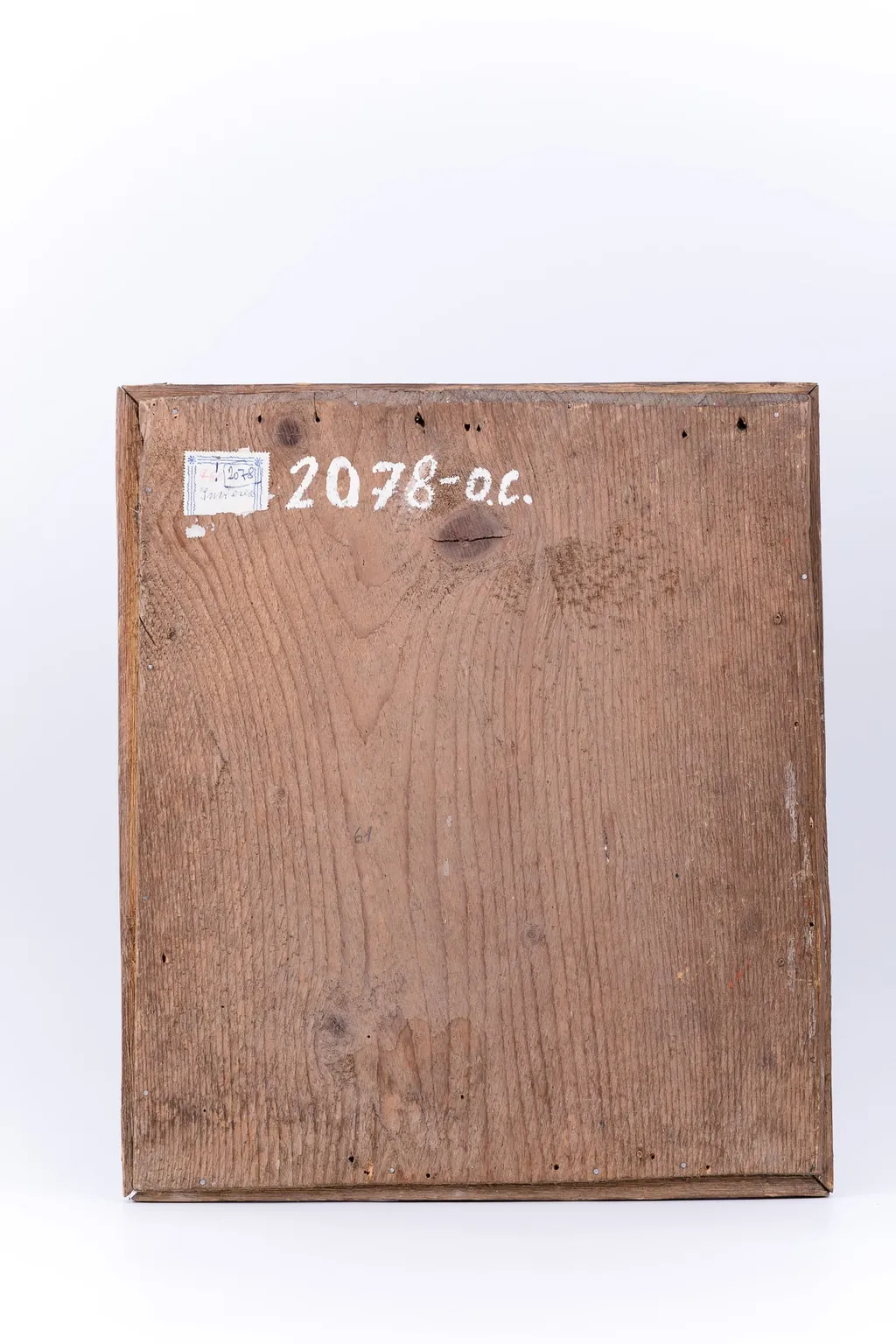
This is the back of a wooden panel. The wood is light brown with visible grain and some dark spots. There’s a faded handwritten number "2078-0c" near the top, and a small sticker in the corner.
The panel looks old and worn, with small holes and patches where the paint might have flaked off. This is likely the back of a religious painting, given the description of the front.
Check out inscription to see how old writing styles can tell stories.
Overview
This icon depicts the Resurrection of Jesus Christ, a central theme in Eastern Christian tradition. Painted on a wooden panel from northern Transylvania, it presents Christ emerging from an open tomb, breaking the gates of Hades. The composition follows Byzantine iconographic conventions while incorporating regional stylistic elements, particularly in its color palette and decorative framing.
Subject & Meaning
Christ, clad in a greenish-khaki tunic and a vermilion mantle, rises triumphantly from the tomb, blessing with one hand while holding a banner symbolizing victory over death. Two Roman soldiers, stunned by the miracle, flank the tomb. The lower field’s ochre and brown tones suggest the earth’s surface, while the cobalt-blue upper field evokes the heavens, visually framing Christ’s passage from death to life.
Technique & Style
The icon employs traditional tempera painting on wood, with pigments including vermilion, cobalt blue, amber yellow, and forest green. The figures are rendered with elongated proportions and stylized drapery, typical of Orthodox iconography. The decorative border combines geometric red bands with a floral motif of narcissus flowers and undulating leaves, reflecting local craftsmanship and symbolic references to renewal.
History & Provenance
Originating from the Nicula region in northern Transylvania, the icon is part of a local tradition of religious panel painting. The wooden backing shows signs of age—faded markings, small holes, and patches—indicating long-term use and possible repairs. The handwritten inscription '2078-0c' and remnants of a sticker suggest later cataloging, likely from a 20th-century ecclesiastical or museum collection.
Context
Created within a Romanian Orthodox context, the icon reflects theological themes of resurrection and divine triumph, common in Transylvanian religious art from the 17th to 19th centuries. The use of Cyrillic script for the inscription 'IC XC Iisus Hristos' aligns with liturgical practices in the region before the adoption of the Latin alphabet. Its visual language bridges Byzantine orthodoxy and local folk aesthetics.
Legacy
The Nicula Resurrection icon remains a representative example of Transylvanian religious art, preserving both doctrinal imagery and regional material culture. Its survival through centuries of political and religious change underscores the endurance of Orthodox iconography in rural communities. The panel’s physical wear and later annotations offer silent testimony to its devotional history and institutional handling.
Artist & collection

 Domestic Scene
 Giacomo and Cardinal Marco, investing Andrea, Abbot of San Zeno, with his Benefice
 The Nymph of Fontainebleau
 Portrait of a Woman
 Madonna and Child with Saints in the Enclosed Garden
 Venus and Minerva
 Family Group of Four on Sofa
 Wall painting from Room H of the Villa of P. Fannius Synistor at Boscoreale
 Icoana îl reprezintă pe Mântuitorul Iisus Hristos, copil fiind, având în mânuțe globul pământesc cu o cruce deasupra, asemenea unui chivot sfințit, galben cu verde. Copilașul este înfășurat cu o țesătură roșie vermillon-roz și negru. În interiorul icoanei este un composit de albastru ceruleum și galben chihlimbar luminos. Întreaga tematică iconografică este încadrată de un chenar decorativ fitomorf, format dintr-o ghirlandă de trandafiri, 3 ruje roșii, cu motivul zăluței albe în interior, pe latura inferioară a icoanei și un boboc de măceș în spatele Copilașului Iisus. Inscripția din româno-chirilică se traduce Cristos. Icoana este de Nicula, având o cromatică luminoasă: roșu vermillon, roz, albastru bleu-ciel și ceruleum, galben chihlimbar, verde brad, alb, negru. Icoana este din Nordul Transilvaniei, Nicula.
 Icoana îl reprezintă pe Pruncul Ioan Botezătorul, cel care avea să fie Sfântul Ioan Botezătorul și Înaintemergătorul Domnului nostru Iisus Hristos. Pruncul Ioan are în brațe un mieluț alb-brun, arătând către Mântuitorul Iisus Hristos: „Iată mielul!”. Îl ține în brațe cu tandrețe, aplecându-se peste el ocrotitor. Cu mâna stângă ține Crucea Jertfei brun-maro, cu un stindard verde. Este înfășurat cu o țesătură brun-neagră, culoarea pocăinței, jertfei și muceniciei. În interiorul icoanei este un composit de albastru bleu-ciel senin și galben chihlimbar. Întreaga tematică iconografică este încadrată de un chenar decorativ fitomorf, format dintr-o ghirlandă de trandafiri dubli și bujori - 15 ruje roșii stilizate. Icoana are o cromatică luminoasă: roșu vermillon, albastru bleu-ciel și ceruleum, galben chihlimbar, verde brad-forest, brun, maro, alb, negru, auriu. Icoana este Nordul Transilvaniei, Nicula.
 Icoana îi prezintă pe Mântuitorul Iisus Hristos și pe ucenicii, viitorii apostoli. Este Duminica Tomii, Venirea Domnului prin ușile încuiate, după Învierea cea de-a treia zi. Toma pipăie rana din coastă și urmele piroanelor, devenind din necredincios, credincios. Este pictată de Simion Zugrav din Laz. Este datată 1837. Chipurile sunt desenate fin, trăsăturile fiind expresive. Elementele arhitectonice, coloane și arcadele sun redate în detaliu, iar roșul vermillon al lor s-a păstrat în imaginea deteriorată. Cromatica este armonioasă: gri, bej, bronziu, roșu vermillon. Întreaga tematică iconografică este încadrată de un chenar decorativ fitomorf.
 Icoana îi reprezintă pe cei doisprezece Apostoli cu Sfinții Apostoli Petru și Pavel, Petru cu cheile Împărăției Cerești în mână și pe Pavel cu sabia Cuvântului în mână. Sfinții Apostoli au mantiile roșii vermillon, înspre trandafiriu, și veșmintele în combinație de crem-rozaliu și ocru-orange, cu liniuțe albe-roșii. Toți cei 12 Apostoli țin chivotul Bisericii creștin-ortodoxe și sobornicești cu mânilie dimpreună. În registrul superior, dintr-o mandorlă este Dumnezeu-Tatăl Binecuvântând. Fondul icoanei este cerul albastru regal-cobalt. În registrul îndepărtat elementul de arhitectură reprezintă simbolic Biserica ortodoxă-creștină apostolică, pe care o poartă, ca pe un chivot, Sfinții Apostoli Petru și Pavel, propovăduind-o. Biserica, cheile și crucea sunt simboluri puternice. Compoziția este rezistentă și cromatica armonioasă: roșu vermillon-trandafiriu, albastru regal, cobalt și ceruleum, galben chihlimbar, ocru, brun, gri, alb zinc, negru, auriu. Inscripția din româno-chirilică se traduce Petru și Pavel. Icoana este din Țara Oltului, Șcheii Brașovului.
 Icoana îl reprezintă pe Mântuitorul Iisus Hristos, copil fiind, redat semi-profil, înfășurat cu o mantie roșie vermillon, dar cu umerii goi de copilaș, ținând în mâini, globul pământesc cu crucea deasupra, asemnea unui chivot de biserică. Fondul icoanei este albastru cobalt, în centrul icoanei, creându-se un adânc veșnic. În marginile icoanei, fondul este alb-ivoriu, înconjurat de elemente decorative fitomorfe - 8 trandafiri, ruje, roșii, cu frunze verzi. În registrul inferior este galben-solar.
 Icoana îi reprezintă împreună pe Sfântul Mare Ierarh Nicolae, Sfântul Ioan Botezătorul și Sfântul Mare Mucenic Teodor Tiron. Veșmintele Sfântului Nicolae sunt sacos gri și roșu vermillon, cu patrafir-epitrahil auriu cu verde, două bedernițe verzi, de o parte și de alta a veșmântului. În mijloc, este Sfântul Ioan Botezătorul și Înaintemergătorul Domnului Iisus Hristos îmbrăcat cu un himation alb-gri-negru, din păr de cămilă, și o mantie roșie, purtând crucea biruinței. Alături este Sfântul Mare Mucenic Teodor Tiron, îmbrăcat cu haine de oștean-militar, tunică și vestă de zale aurie, cu mantie roșie cu interiorul galben, de lumină. În mâna dreaptă are spada credinței. Fondul icoanei este albastru cobalt, în registrul superior și roz, în registrul inferior. Pe latura inferioară, icoana este încadrată de elemente florale - trei ruje mari, trandafiri roșii, cu frunze verzi. Inscripția din româno-chirilică se traduce Sf Nicolae Sf Ioan Botezătorul Sf Teodor Tiron. Icoana este de Țara Oltului.
 Icoana este rară prin tematica iconografică abordată, având o compoziție simetrică, echilibrată și armonioasă cromatic, structural și teologic. Central este Dumnezeu pe tron arhieresc Mare Judecător și Învățător. Este îmbrăcat cu sacos albastru cobalt-regal cu dungi albe, cu felon și omofor roșu vermillon, cu epitrahil-patrafir vernil-absint, cu trei cruci negre și o floare de lalea cu trei petale lunguiețe albe. Cu mâna dreaptă ține Sfânta Scriptură deschisă pe genunchi și cu mâna stângă Binecuvântează. Tronul arhieresc este bogat ornamentat cu elemente decorative geometrizante bronzii, albe și negre, având aripile de arhitectură umplute cu un caroiaj aparte. Mântuitorul Iisus Hristos are picioarele așezate pe o pernă roșie. În partea dreaptă a Lui Dumnezeu este Sfântul Ioan Botezătorul și Înaintemergătorul Domnului Iisus Hristos. Sfântul Ioan este îmbrăcat în sarică albastră de păr de cămilă și omofor-mantie verde kaki. În stânga Mântuitorului Iisus Hristos este Maica Domnului, în sacos albastru cobalt și mantie cu maforiom roșu vermillon, cu interiorul vernil-absint. În registrul mai îndepărtat sunt situați Sfinții Arhangheli Mihail și Gavriil, mai-marii oștilor cerești și încă doi sfinți arhangheli, din soborul îngerilor păzitori. În registrul superior este Dumnezeu-Tatăl, în veșmânt roșu, trimițând din Cerurile deschise, printr-o mandorlă de nouri albi, pe Sfântul Duh, sub forma porumbelului alb. Fondul icoanei este cerul albastru cobalt, încadrată icoana fiind de un chenar decorativ bronziu, lat, cu elemente florale stilizate mari roșii - 9 ruje. Inscripția din româno-chirilică este IC XC MP Iisus Hristos Maica Domnului. Cromatica este vie, luminoasă și armonioasă: roșu vermillon, verde absint, vernil, kaki, albastru cobalt, brun, bej, negru, alb. Icoana este din Țara Făgărașului.