Artwork
Icon of the New Testament Trinity
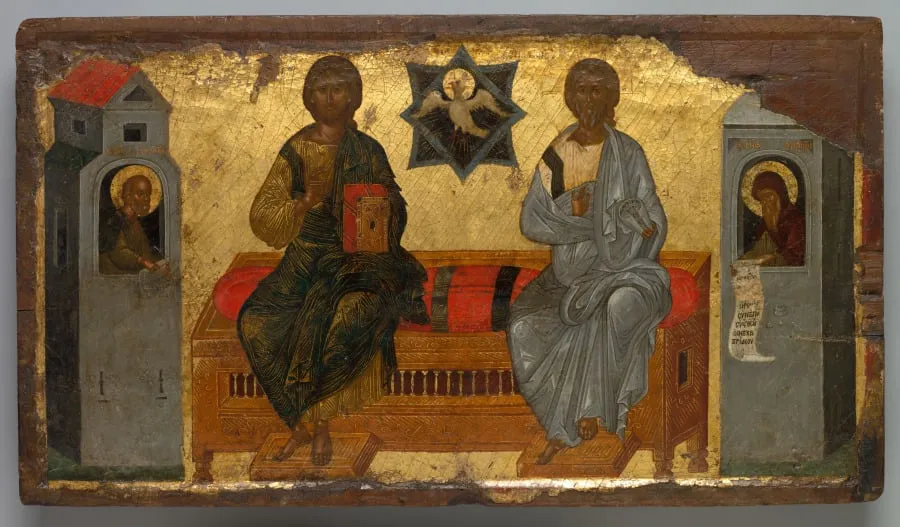
Icon of the New Testament Trinity is an unspecified painting by the Italo Byzantine artist Unknown. It dates from 1450 and is held in the collection of the Cleveland Museum of Art.
About this work
Overview
Christ and an aged figure representing God the Father sit side by side, while a dove symbolising the Spirit hovers between them within an eight‑pointed star.
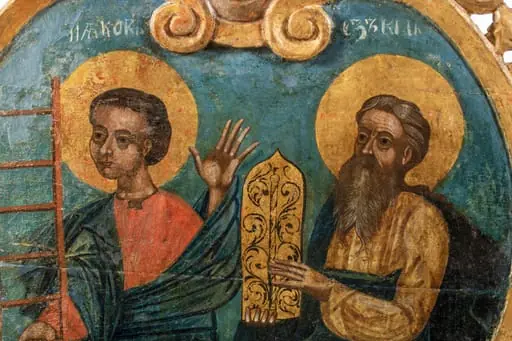
The panel portrays the Christian doctrine of the Trinity, arranging the Father, the Son, and the Holy Spirit together on a richly gilded throne. Christ and an aged figure representing God the Father sit side by side, while a dove symbolising the Spirit hovers between them within an eight‑pointed star. Flanking the central group are two saintly hymnographers holding scrolls, their names rendered in gold lettering.
Subject & Meaning
The composition follows the “New Testament Trinity” type, a visual expression of the three persons of one deity as described in the New Testament. The dove, placed in a star denoting the eighth day, alludes to the resurrection and the forthcoming age. The inclusion of hymnographers Saint Kosmas and Saint Joseph underscores the role of liturgical poetry in articulating theological truth.
Technique & Style
Executed in tempera on wood, the image displays the luminous gold leaf that characterises late Byzantine painting. Figures are rendered with delicate linear modeling and a restrained palette of blues, reds, and earth tones. The gilded throne and ornamental star reveal a sophisticated use of metallic highlights, while the facial types and drapery folds reflect the refined classicism typical of Constantinopolitan workshops of the mid‑15th century.
History & Provenance
The work is unsigned and undated, yet stylistic analysis situates its creation in Constantinople around 1450, shortly before the Ottoman conquest. Its original function was likely as a templon icon, forming part of the screen that separated the nave from the sanctuary in an Orthodox church. The panel has survived the fall of the city and entered museum collections in the modern era, representing a rare surviving example of this iconographic type.
Context
By the early 15th century the “New Testament Trinity” began to replace earlier depictions that showed only Christ. This painting’s addition of an elderly God the Father creates a more intimate, familial tableau, reflecting theological developments that emphasized the relational aspect of the divine. As one of the few extant 1400s renditions, it offers scholars insight into the artistic climax of Byzantine iconography just before its political transformation.
Artist & collection

 Domestic Scene
 Giacomo and Cardinal Marco, investing Andrea, Abbot of San Zeno, with his Benefice
 The Nymph of Fontainebleau
 Portrait of a Woman
 Madonna and Child with Saints in the Enclosed Garden
 Venus and Minerva
 Family Group of Four on Sofa
 Wall painting from Room H of the Villa of P. Fannius Synistor at Boscoreale