Artwork
Kalyan Ragini
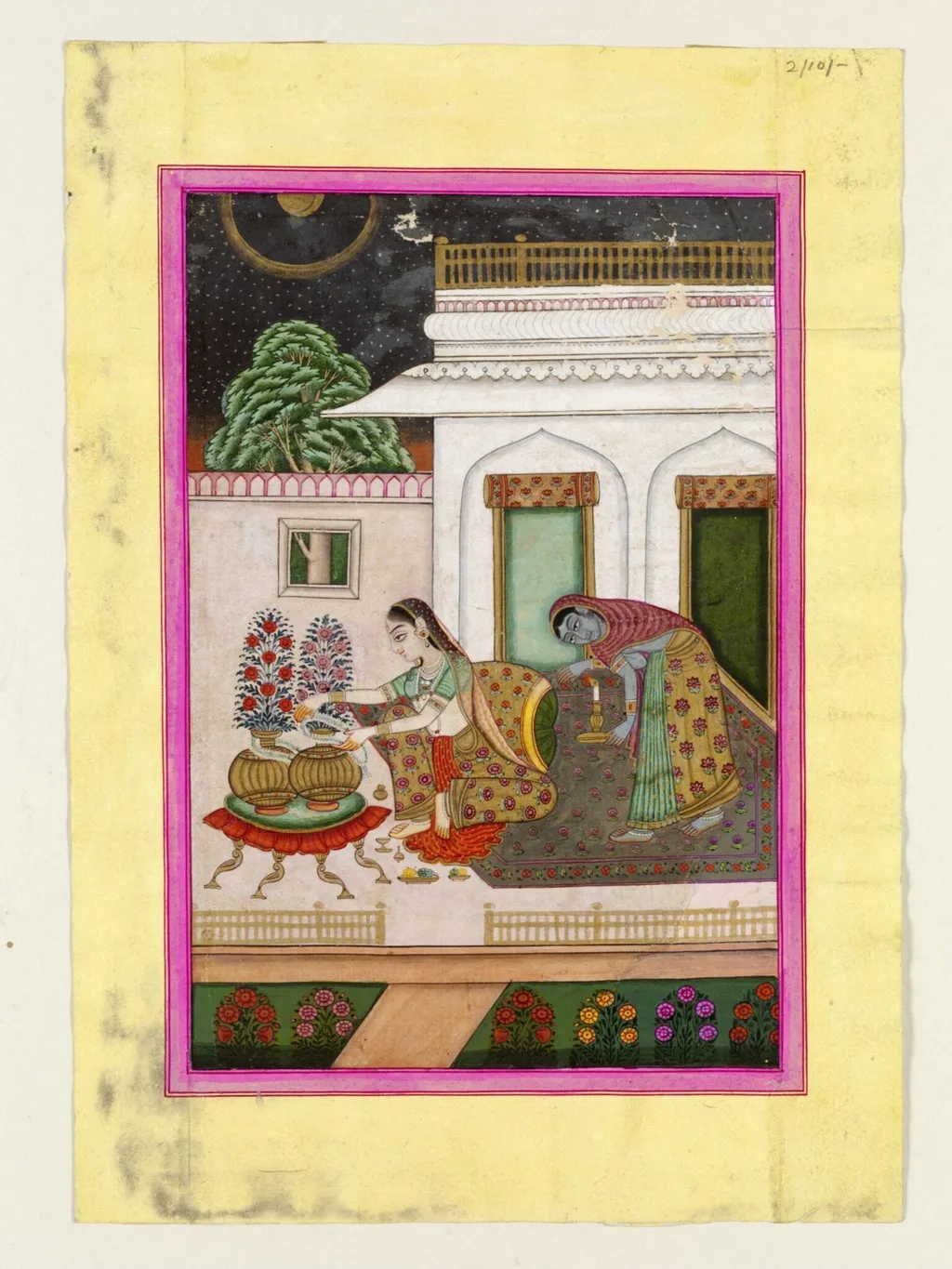
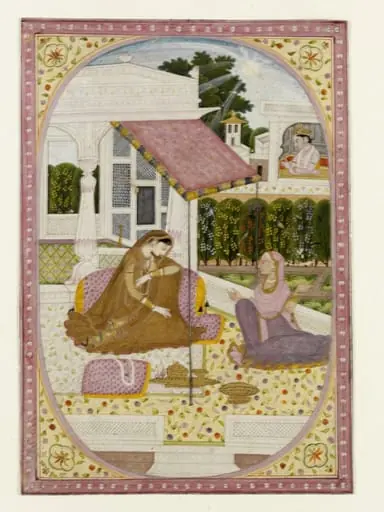
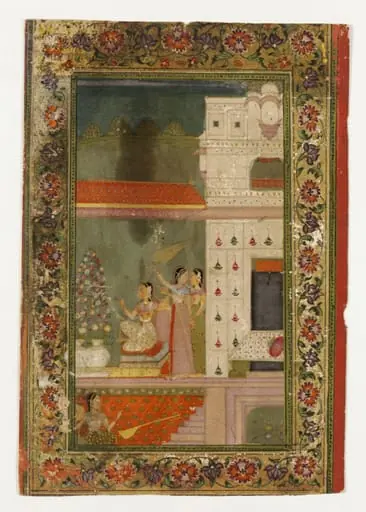
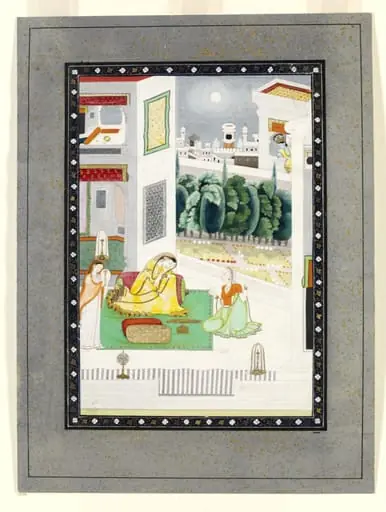
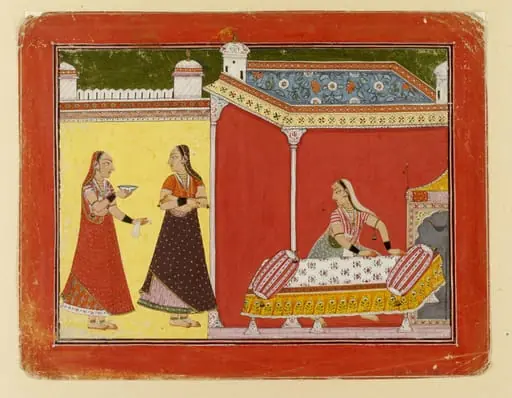
Kalyan Ragini is a paint painting by the Patna School of Painting artist Unknown. It dates from 1830 and is held in the collection of the Victoria and Albert Museum.
About this work
Overview
This opaque watercolor on paper dates to approximately 1830 and belongs to a Ragamala series, a set of illustrations linking musical modes to visual narratives.
This opaque watercolor on paper dates to approximately 1830 and belongs to a Ragamala series, a set of illustrations linking musical modes to visual narratives. It depicts the Kalyan Ragini, a raga associated with evening serenity and devotion. The composition captures a quiet domestic moment, rendered with meticulous detail and vibrant pigments, typical of Pahari or Rajasthani court painting traditions of the period.
Subject & Meaning
Two women engage in a tranquil ritual: one pours water from a vessel, while the other holds a tray with a lit candle and small cups, suggesting an offering or evening rite. The crescent moon and night sky above the balcony evoke the raga’s association with twilight. The scene’s stillness and symbolic objects—flowers, candlelight—convey calm and spiritual contemplation, aligning with Kalyan’s emotional character as a mode of peace and introspection.
Technique & Style
The painting employs fine brushwork and layered opaque watercolors to render intricate patterns on textiles, architecture, and flora. Arched walls and floral motifs frame the space with rhythmic precision, while the night sky is rendered in subtle gradations. The figures’ elaborate embroidery and the balanced composition reflect a refined courtly aesthetic, where decorative detail serves both ornament and symbolic function.
History & Provenance
Created in the early 19th century, likely in a North Indian royal atelier, this work was part of a larger Ragamala set commissioned for musical or devotional use. Such series were often kept in royal libraries or used by performers to internalize raga moods. Its survival suggests it was valued as both artistic and cultural artifact, though its specific patron and early ownership remain undocumented.
Context
Ragamala paintings emerged as a visual language for Indian classical music, translating abstract sonic emotions into tangible scenes. This work reflects a broader trend in regional courts to merge poetry, music, and painting into cohesive aesthetic systems. The domestic setting, uncommon in mythological themes, highlights a shift toward intimate, everyday imagery as a vessel for spiritual expression.
Legacy
Though individual Ragamala paintings were once functional aids for musicians, they are now studied as key examples of South Asian visual culture. This piece contributes to understanding how music and daily life were intertwined in pre-colonial Indian aesthetics. Its preservation in institutions like the Victoria and Albert Museum ensures continued scholarly and public engagement with these nuanced traditions.
Artist & collection

 Domestic Scene
 Giacomo and Cardinal Marco, investing Andrea, Abbot of San Zeno, with his Benefice
 The Nymph of Fontainebleau
 Portrait of a Woman
 Madonna and Child with Saints in the Enclosed Garden
 Venus and Minerva
 Family Group of Four on Sofa
 Wall painting from Room H of the Villa of P. Fannius Synistor at Boscoreale