Artwork
Komurasaki of the Miuraya and Shirai Gonpachi
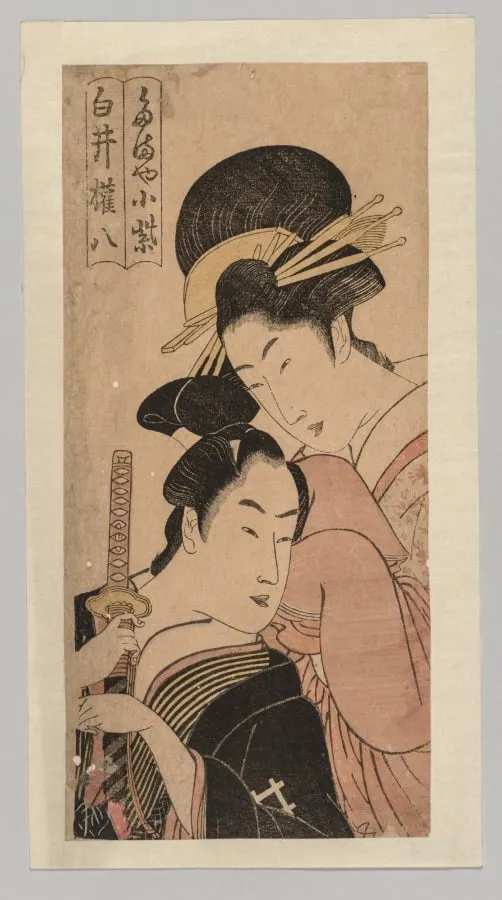
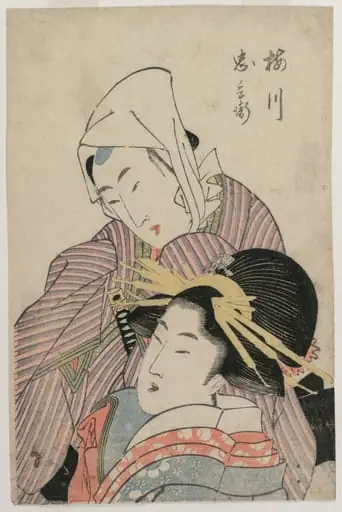
Komurasaki of the Miuraya and Shirai Gonpachi is a print by the Impressionist artist Unknown. It dates from 1906 and is held in the collection of the Cleveland Museum of Art. This ukiyo-e print depicts two women, likely courtesans, in quiet contemplation.
About this work
Overview
The interplay of bold outlines and soft gradations creates a sense of volume and mood, characteristic of late Edo-period portraiture.
This ukiyo-e print depicts two women, likely courtesans, in quiet contemplation. Rendered in monochrome ink with subtle tonal variations, the composition focuses on their stillness and attire. The plain background isolates them, emphasizing their presence without narrative distraction. The interplay of bold outlines and soft gradations creates a sense of volume and mood, characteristic of late Edo-period portraiture.
Subject & Meaning
The figures are identified as Komurasaki of the Miuraya and Shirai Gonpachi, courtesans of known status. Their serious expressions and formal dress suggest a moment of introspection rather than performance. The absence of decorative elements or action conveys emotional restraint, possibly reflecting the isolation or melancholy often associated with their social position, despite their public roles.
Technique & Style
The artist employs strong, clean contours to define facial features and kimono patterns, contrasting with delicate washes of gray to model skin and fabric. This modulation of tone, akin to chiaroscuro, imparts three-dimensionality without color. The restrained palette and precise line work reflect the refined aesthetic of bijin-ga, where elegance is conveyed through subtlety rather than ornamentation.
History & Provenance
Produced in the early 19th century, this print belongs to a series documenting famous courtesans of Kyoto’s pleasure quarters. It was likely published by a local printer for collectors interested in celebrity figures of the urban elite. Surviving impressions are rare, as such prints were often handled and discarded after brief circulation.
Context
During the Edo period, courtesans were both objects of desire and cultural icons, their images circulated in prints as part of a thriving consumer market. While often depicted in lively settings, this print’s somber tone diverges from typical portrayals, hinting at the private lives behind public personas and the complex social dynamics of the Yoshiwara and Kamigata districts.
Legacy
This print exemplifies the shift in bijin-ga toward psychological depth in the late Edo era. Its quiet intensity influenced later artists who sought to capture inner life over surface glamour. Though not widely known outside specialist circles, it remains a significant record of how individual identity was negotiated within rigid social structures.
Artist & collection

 Domestic Scene
 Giacomo and Cardinal Marco, investing Andrea, Abbot of San Zeno, with his Benefice
 The Nymph of Fontainebleau
 Portrait of a Woman
 Madonna and Child with Saints in the Enclosed Garden
 Venus and Minerva
 Family Group of Four on Sofa
 Wall painting from Room H of the Villa of P. Fannius Synistor at Boscoreale