Artwork
Krishna adorning the hair of a holy man
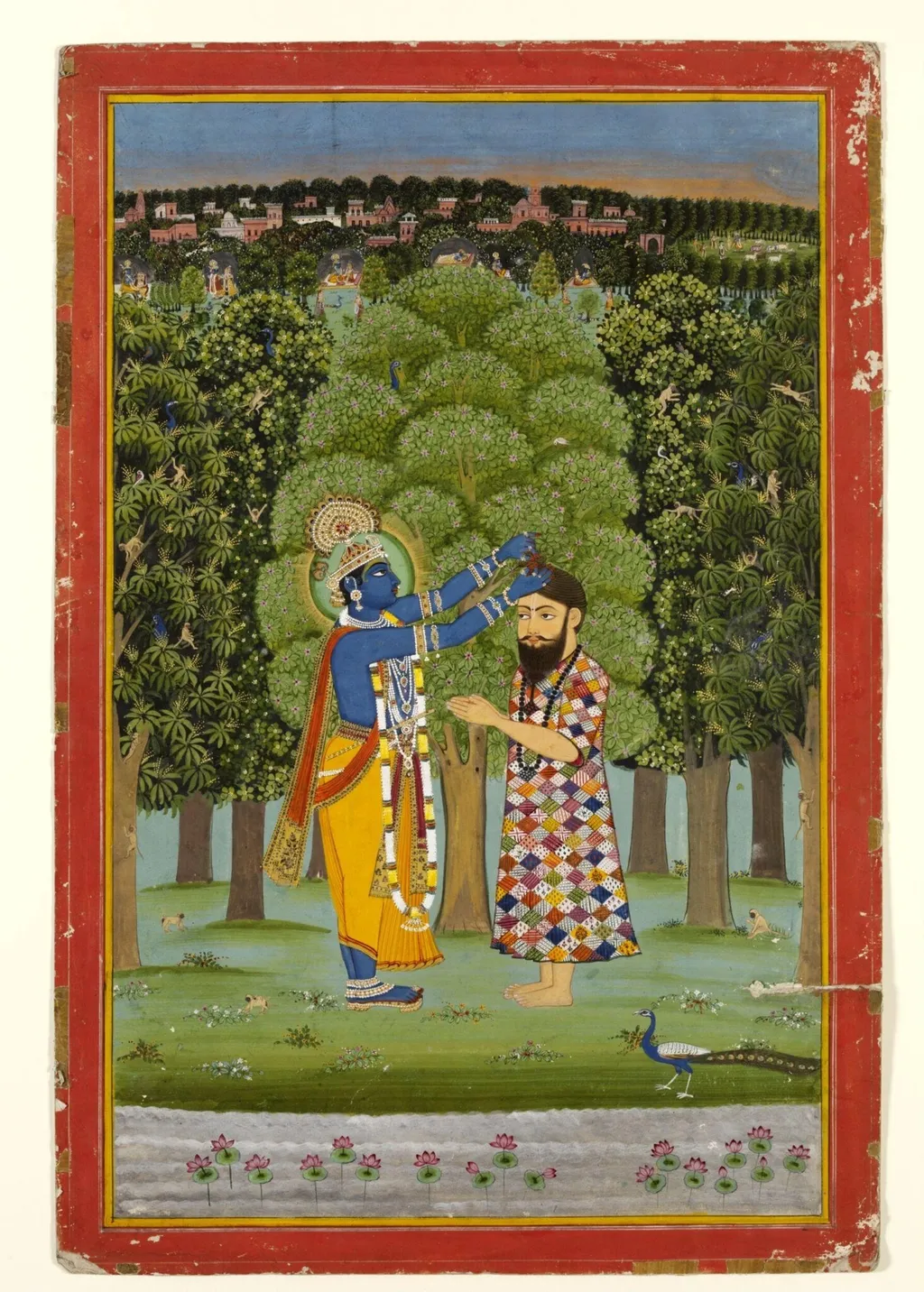
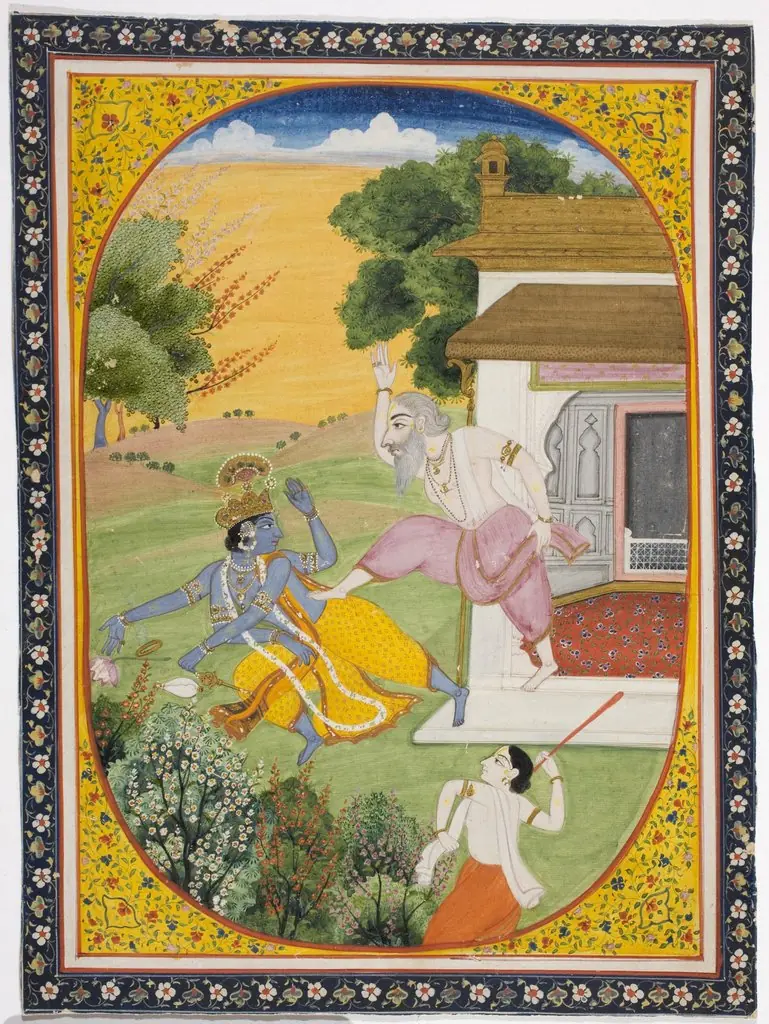
Krishna adorning the hair of a holy man is a paint painting by the Mughal Painting artist Unknown. It dates from 1850 and is held in the collection of the Victoria and Albert Museum. This rectangular painting, dated to around 1850, portrays a moment of intimate ritual between Krishna and a bearded ascetic.
About this work
Overview
This rectangular painting, dated to around 1850, portrays a moment of intimate ritual between Krishna and a bearded ascetic.
This rectangular painting, dated to around 1850, portrays a moment of intimate ritual between Krishna and a bearded ascetic. Executed in opaque watercolor on paper, it reflects the hybrid aesthetic of late Rajasthani court painting, blending Mughal refinement with regional color traditions. The work entered a museum collection in the mid-20th century through a donation by Mrs. G. Clark, who did not reclaim it, leaving its provenance partially unresolved.
Subject & Meaning
The scene depicts Krishna, identified by his blue skin and crown, gently weaving flowers into the long hair of a holy man. This act symbolizes divine service and the blurring of boundaries between the mortal and the divine. The ascetic’s stillness suggests surrender, while Krishna’s tender gesture implies spiritual intimacy. The flowers, often associated with devotion in Hindu iconography, reinforce the theme of sacred offering.
Technique & Style
The artist combines Mughal precision in fine line work with Rajasthani vibrancy in pigment use. Gold leaf outlines trace the ascetic’s robes and the floral motifs, adding luminosity against deep indigo and ochre backgrounds. Delicate brushwork renders individual petals and leaves with meticulous care, demonstrating a high level of technical control. The soft modeling of light on skin and fabric reflects Mughal influence, while the saturated hues are characteristic of Rajput traditions.
History & Provenance
The painting was deposited in the Indian Department of a major museum during the mid-20th century by Mrs. G. Clark, who never reclaimed it. Its prior ownership and origin remain undocumented. It was likely produced in a Rajasthani atelier, possibly in Kota or Bundi, where such devotional scenes were common. Its survival in institutional custody, rather than private hands, suggests it was acquired as part of a broader collection of South Asian art.
Context
In mid-19th century Rajasthan, devotional paintings of Krishna serving saints were popular among royal patrons seeking to express both piety and cultural continuity. Artists drew from earlier Mughal naturalism while adapting to regional tastes for bold color and ornamental detail. Such works often adorned temple interiors or private shrines, serving as aids to meditation and expressions of bhakti devotion.
Legacy
This painting exemplifies the enduring synthesis of Mughal and Rajput styles in colonial-era Indian art. Its preservation in a public collection allows ongoing study of regional artistic exchange. Comparable works can be found in the Victoria and Albert Museum’s South Asian holdings, where similar compositions highlight the continuity of devotional imagery across North Indian courts during the 1800s.
Artist & collection

 Domestic Scene
 Giacomo and Cardinal Marco, investing Andrea, Abbot of San Zeno, with his Benefice
 The Nymph of Fontainebleau
 Portrait of a Woman
 Madonna and Child with Saints in the Enclosed Garden
 Venus and Minerva
 Family Group of Four on Sofa
 Wall painting from Room H of the Villa of P. Fannius Synistor at Boscoreale