Artwork
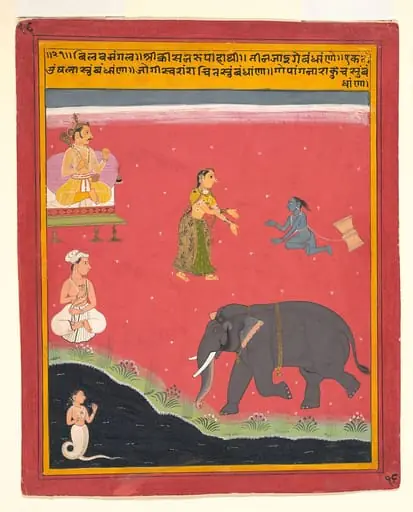
Krishna and Aghasura
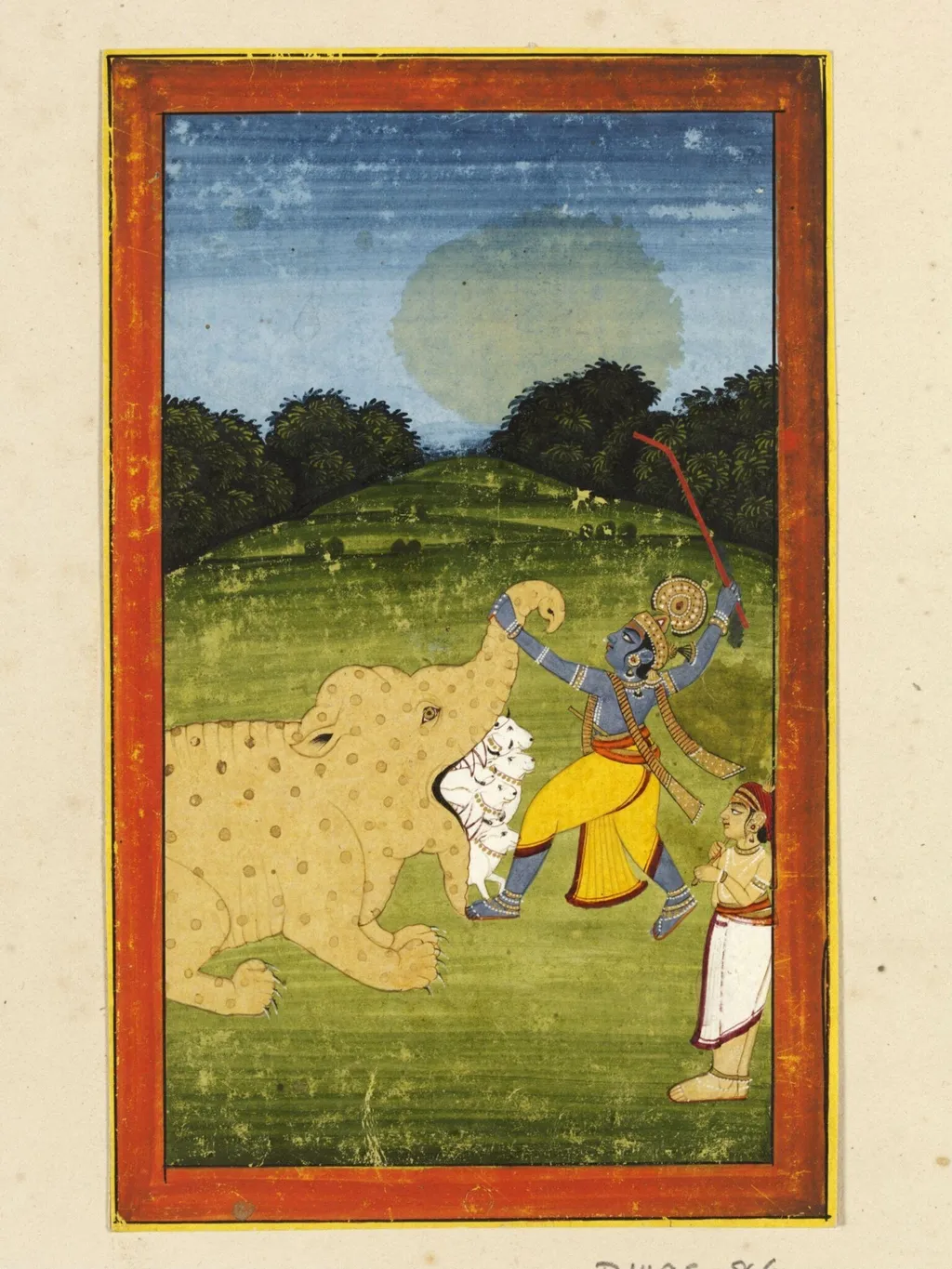
Krishna and Aghasura is a paint painting by the Mughal Painting artist Unknown. It dates from 1850 and is held in the collection of the Victoria and Albert Museum.
About this work
Overview
The work entered the Victoria and Albert Museum’s collection via the Department of Engraving, Illustration & Design, catalogued as RP 51/2237.
This 1850 Indian miniature painting, executed in opaque watercolour and gold on paper, illustrates a moment from Krishna’s childhood legends. It captures the moment he confronts the demon Aghasura, who had taken the form of a massive serpent-like creature. The scene is rendered with vivid pigments and metallic accents, typical of Pahari or Rajasthani court traditions. The work entered the Victoria and Albert Museum’s collection via the Department of Engraving, Illustration & Design, catalogued as RP 51/2237.
Subject & Meaning
The painting depicts Krishna, identified by his blue skin and divine attributes, compelling the demon Aghasura to expel the cows he had swallowed whole. This episode symbolizes divine intervention to protect the innocent and restore cosmic balance. A cowherd stands nearby, witnessing the miracle, reinforcing the narrative’s pastoral context. The act affirms Krishna’s role as protector of dharma, even in his youth, against deceptive malevolence.
Technique & Style
Rendered in fine opaque watercolour with gold detailing, the painting employs bold outlines and saturated hues characteristic of North Indian miniature traditions. The figures are stylized with elongated eyes and intricate jewelry, while the landscape is simplified into rolling hills and scattered trees. The use of gold enhances sacred elements—Krishna’s crown and the demon’s scales—creating a luminous contrast against the blue sky and earth tones.
History & Provenance
The painting was acquired by the Victoria and Albert Museum through the Department of Engraving, Illustration & Design, with the accession reference RP 51/2237. Its precise origin within India is undocumented, but its stylistic features suggest production in a royal atelier of the Punjab Hills or Rajasthan during the mid-19th century. It was likely part of a larger illustrated manuscript or devotional album, later separated and preserved as a standalone work.
Context
This image belongs to a broader tradition of devotional painting that visualized episodes from Krishna’s life, particularly popular in northern Indian courts during the 18th and 19th centuries. Such works served both religious devotion and courtly display, often commissioned by patrons seeking to align themselves with divine narratives. The emphasis on vivid color and symbolic form reflects regional aesthetics distinct from Mughal naturalism, favoring spiritual expression over realism.
Legacy
As a preserved example of 19th-century Indian miniature painting, this work contributes to the understanding of how Hindu mythological narratives were visually sustained in colonial-era India. Its survival in a major Western collection highlights the global interest in South Asian art during the 19th century, even as indigenous artistic practices evolved under new cultural and economic pressures.
Artist & collection

 Domestic Scene
 Giacomo and Cardinal Marco, investing Andrea, Abbot of San Zeno, with his Benefice
 The Nymph of Fontainebleau
 Portrait of a Woman
 Madonna and Child with Saints in the Enclosed Garden
 Venus and Minerva
 Family Group of Four on Sofa
 Wall painting from Room H of the Villa of P. Fannius Synistor at Boscoreale
 Krishna
 Gajendramoksha
 Krishna Rebuked by a Priest
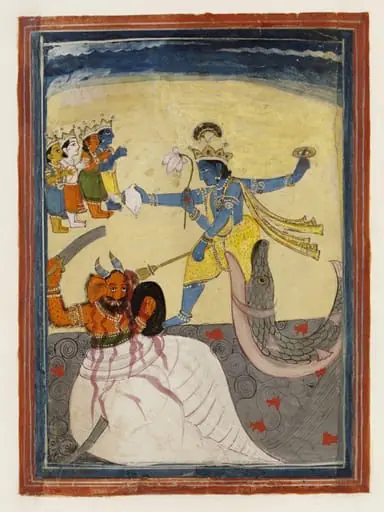 Vishnu as Matsya
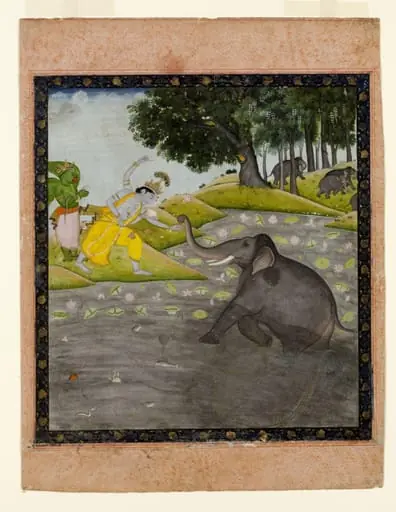 Vishnu and Gajendra
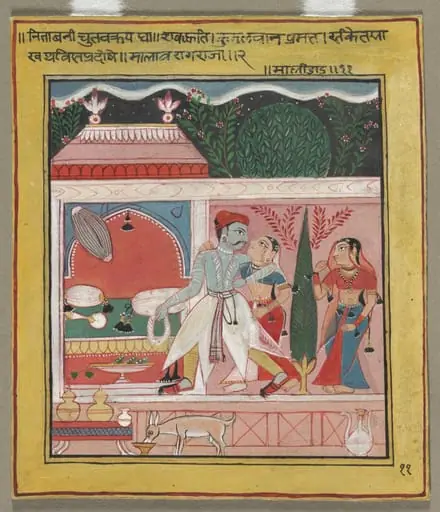 Ragini
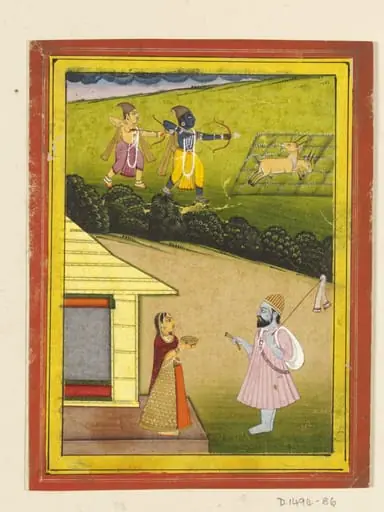 Sita
Sita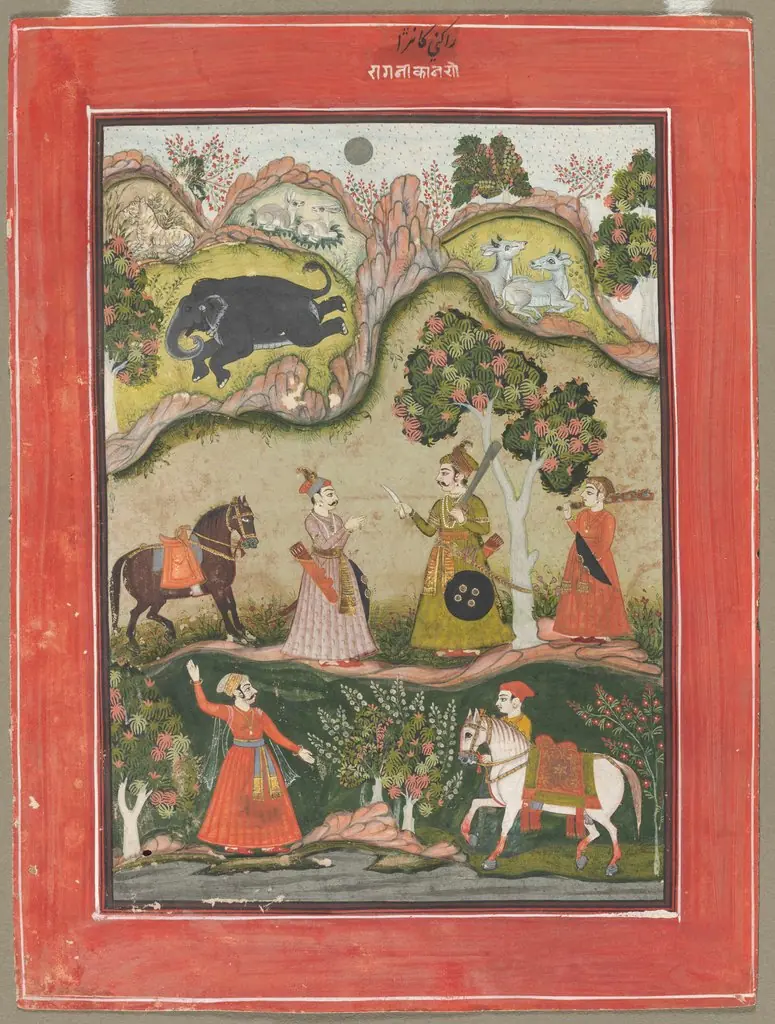 Kanhara Ragini: Song of Inspiration to Krishna for Killing the Elephant Demon, from the Ragamala Series
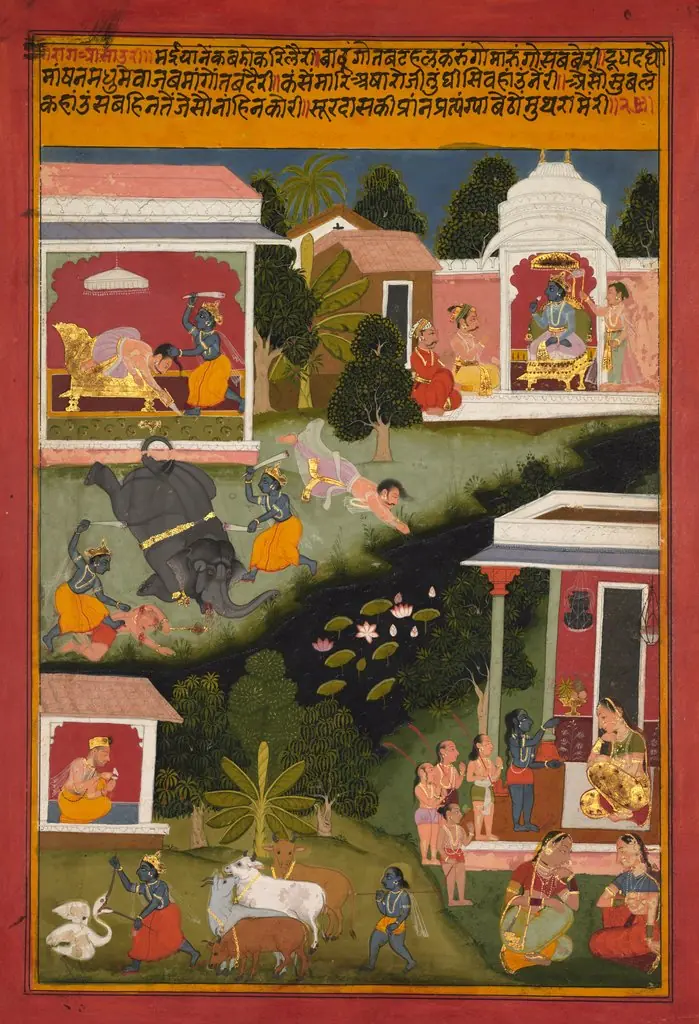 Krishna asks for sweets, from a Sursagar of Surdas (Indian, c. 1480–1580)
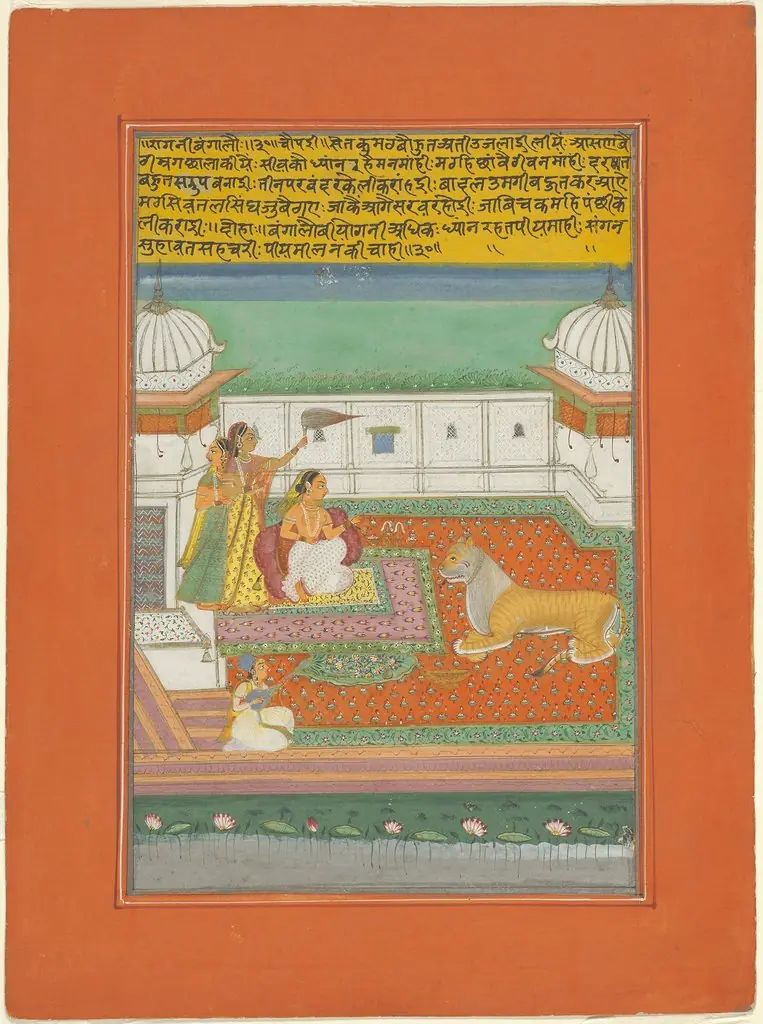 Ragini Bangali, Page from a Jaipur Ragamala Set
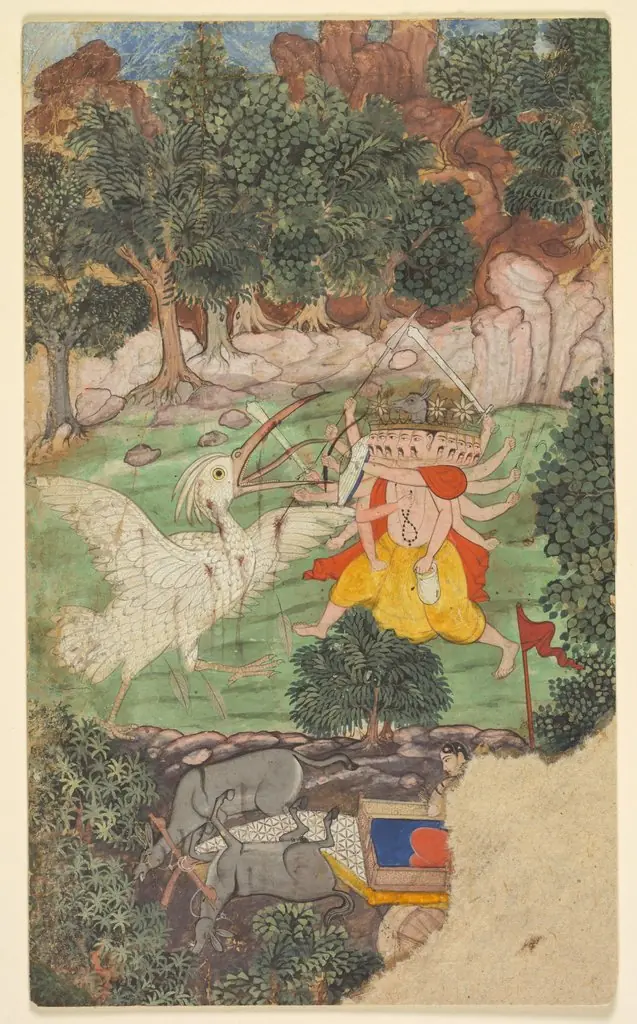 Battle of Ravana and Jatayu, from Chapters 50 and 51 of the Aranya Kanda (Book of the Forest) of Valmiki's Ramayana (Rama’s Journey); folio from the "Burnt" Ramayana
 Untitled